Get Full Government Meeting Transcripts, Videos, & Alerts Forever!
Get email alerts on the Parking And Transportation topic
No spam. Unsubscribe anytime.
Staff proposes bicycle‑parking, parking minimum and PUDO rules in zoning rewrite; commissioners back plain‑language edits
Summary
Staff proposed consolidated bicycle parking rules, rightsized parking minimums and new parking maximums, PUDO and loading standards, EV and compact‑space guidance, and amenity space requirements with a narrow exception for some affordable housing; commissioners asked for practical detail and asked staff to continue plain‑language edits to the draft ordinance.
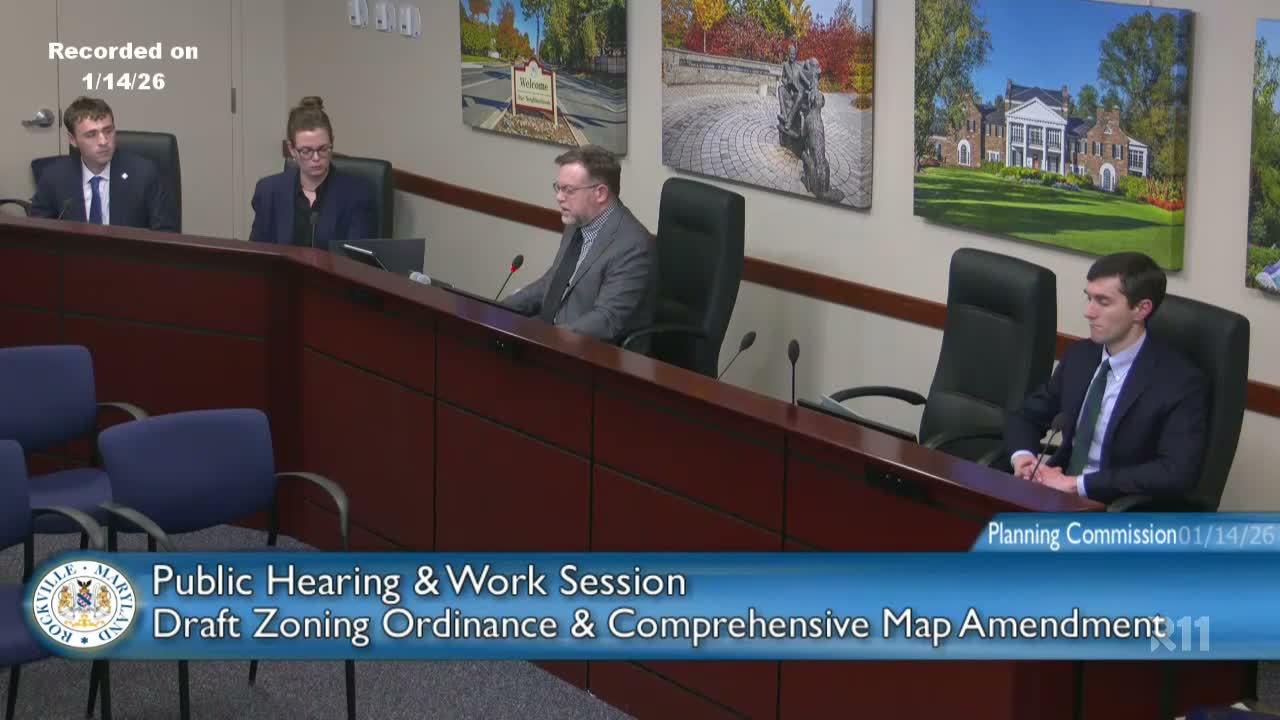
Planning staff and consultants outlined sweeping changes to the zoning code’s transportation and site‑design chapters on Jan. 14, proposing new consolidated bicycle‑parking rules, updated parking minimums and parking maximums, new pick‑up/drop‑off (PUDO) and loading standards, and a tightened amenity‑space definition for many residential projects.
Bicycle and pedestrian rules: Staff presented a new Pedestrian & Bicycle Facilities division that would require bicycle parking for both principal and accessory uses, update short‑ and long‑term parking ratios to current best practices, clarify bicycle‑parking location standards (distance to main entrances) and add simple design standards (e.g., two‑point support, secure anchoring). Staff said administrative waivers would remain available but would require affirmative findings that an alternative design provides safe, efficient facilities.
Parking rightsizing and maximums: Consultant Michael Stein summarized how staff derived new parking minimums by reviewing peer communities and said the draft seeks to allow entitlement‑stage calculations (by gross floor area or unit count as appropriate) rather than deferred counts. Staff proposed parking maximums set at 125% of the minimum in many mixed‑use and residential zones to limit oversupply and support multimodal trips. The draft eliminates long‑standing parking deferrals and introduces a clearer process for small reductions (up to 10% administratively) and requests above 10% by demand study.
Buy‑right adjustments and EVs: The staff draft includes by‑right adjustments that count EV spaces more heavily for planning purposes (each EV charging‑ready served space counts as two parking credits up to a 10% cap), reduces requirements for MPDU apartments when parking is provided in common areas, and allows a 10% reduction where secure long‑term bike parking and shower/dressing facilities are provided.
PUDO, loading and compact spaces: Staff introduced quantitative PUDO standards tied to unit counts (for example, 1 PUDO space per 75–100 units with a small maximum) when minimum parking is reduced or absent, and clarified commercial loading requirements by gross floor area. Compact parking is reintroduced with a 20% cap on a site’s parking to add design flexibility. Staff also proposed explicit pedestrian visibility/safety zones where driveways intersect sidewalks to keep sightlines clear.
Amenity space: Staff recommended replacing broad "public use space" requirements with a defined amenity‑space standard for most residential and mixed‑use projects, with exceptions for small projects and a conditional exception for 100% affordable projects located within a quarter‑mile of a public park or publicly accessible amenity. Commissioners asked staff for more information about feasibility, grant availability for affordable projects and whether the flat 10% amenity requirement should scale with context.
Plain‑language edits and next steps: Commissioners asked staff to perform a plain‑language edit of the draft zoning text; staff said they had begun a line‑by‑line quality‑control review and will reconcile editorial suggestions with legal and policy constraints. Staff also noted schedule constraints and asked commissioners to provide any additional comments on the draft before the next meeting so staff can include them in the commission packet.
Provenance: Pedestrian and bicycle presentations begin at SEG 3038; parking and loading presentation begins at SEG 3304 and continues through implementation discussion at SEG 3671.