Get Full Government Meeting Transcripts, Videos, & Alerts Forever!
Get email alerts on the Signs topic
No spam. Unsubscribe anytime.
Panel weighs new sign code; businesses warn ban on illuminated freestanding signs would hurt Rockville merchants
Summary
Staff proposed reorganized sign regulations that preserve content neutrality, add new sign types and continue a broad prohibition on electronic message centers (with pedestrian‑oriented exceptions); the International Sign Association urged the commission to avoid rules that would make many existing illuminated freestanding signs nonconforming and economically harmful.
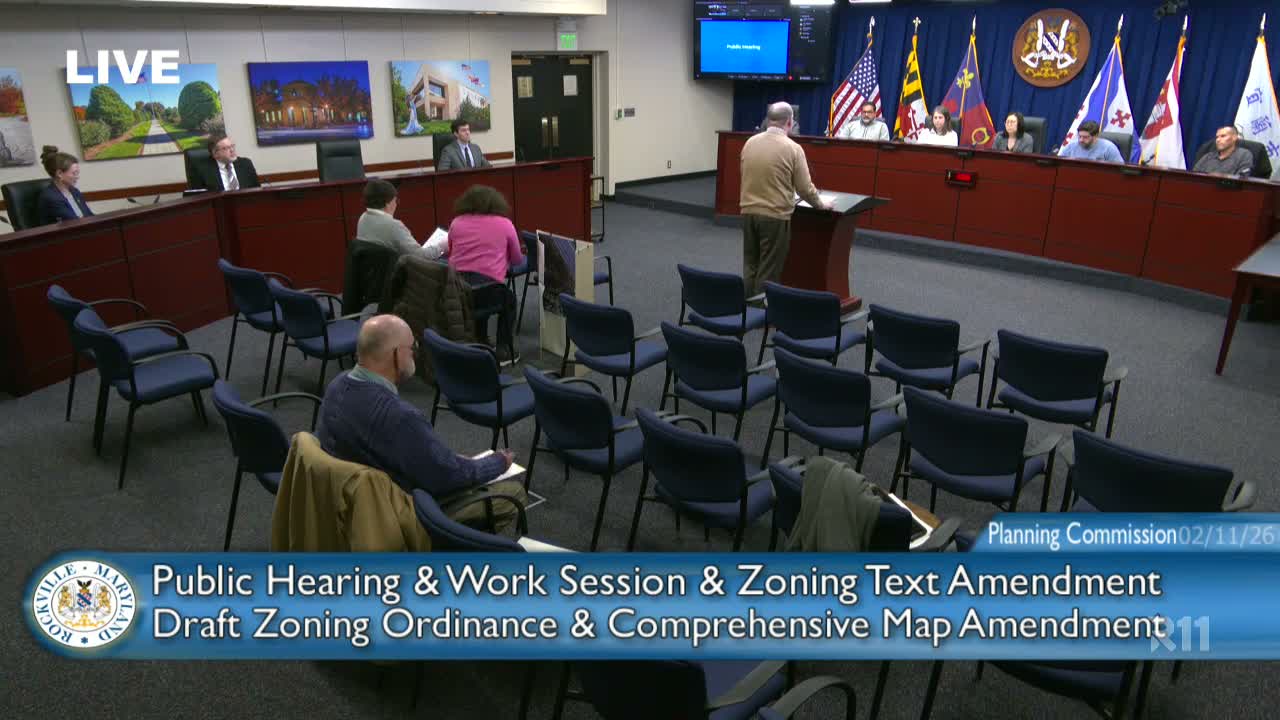
Kenny Peskin, representing the International Sign Association, told the Planning Commission that one of the draft ordinance’s most consequential changes would be a prohibition on internally illuminated freestanding signs in many zones. “The impact of a prohibition on internally illuminated freestanding signs will be significant and will adversely affect businesses in Rockville,” Peskin said, adding that nonconforming‑sign rules in the draft could require removal or darkening of signs within eight years and that routine maintenance that changes copy could trigger immediate removal.
City staff (Mr. Wasilak and colleagues) said the staff draft was not intended to change longstanding policy on internally illuminated signs; staff recommended carrying forward existing allowances for internally illuminated signs in many mixed‑use and industrial zones, while continuing the current ban on electronic message centers (EMCs) except where EMCs are clearly pedestrian‑oriented. Staff also proposed a new comprehensive sign plan process to replace decades‑old sign plans and optional sign packages; the goal, staff said, is to organize and modernize the code while keeping most established policy.
Commissioners pressed for clarity about specific categories of signs (gas‑station price displays, drive‑thru menu boards and window‑mounted electronic kiosks) and raised enforcement and traffic‑safety concerns. Several commissioners said they would not sign off on final language without seeing the redline language for EMC rules; others said the commission could transmit general direction and request staff to draft specific EMC limits (e.g., message duration, non‑motion displays) for review. Staff committed to reflect the commission’s conversation in the recommendation memo and to try to provide draft regulatory language on EMCs if time allows before the next meeting.
What was decided: the commission directed staff to include the tone of the discussion in the recommendation memo and to research and, if feasible within the schedule, draft possible regulatory language for pedestrian‑oriented EMCs (including suggested limits) for the commission to review before forwarding a final recommendation to Mayor & Council.