Get Full Government Meeting Transcripts, Videos, & Alerts Forever!
Get email alerts on the Historic Preservation topic
No spam. Unsubscribe anytime.
Planning staff proposes changes to Rockville historic‑preservation rules, commissioners seek clarifications on owner consent and delisting
Summary
Staff proposed administrative approvals for minor historic certificates of approval, a five‑year COA expiration, limits on who can nominate properties, a delisting process and demolition‑by‑neglect enforcement; commissioners asked staff to refine language on owner silence vs. explicit objection and legal guardrails for hardship.
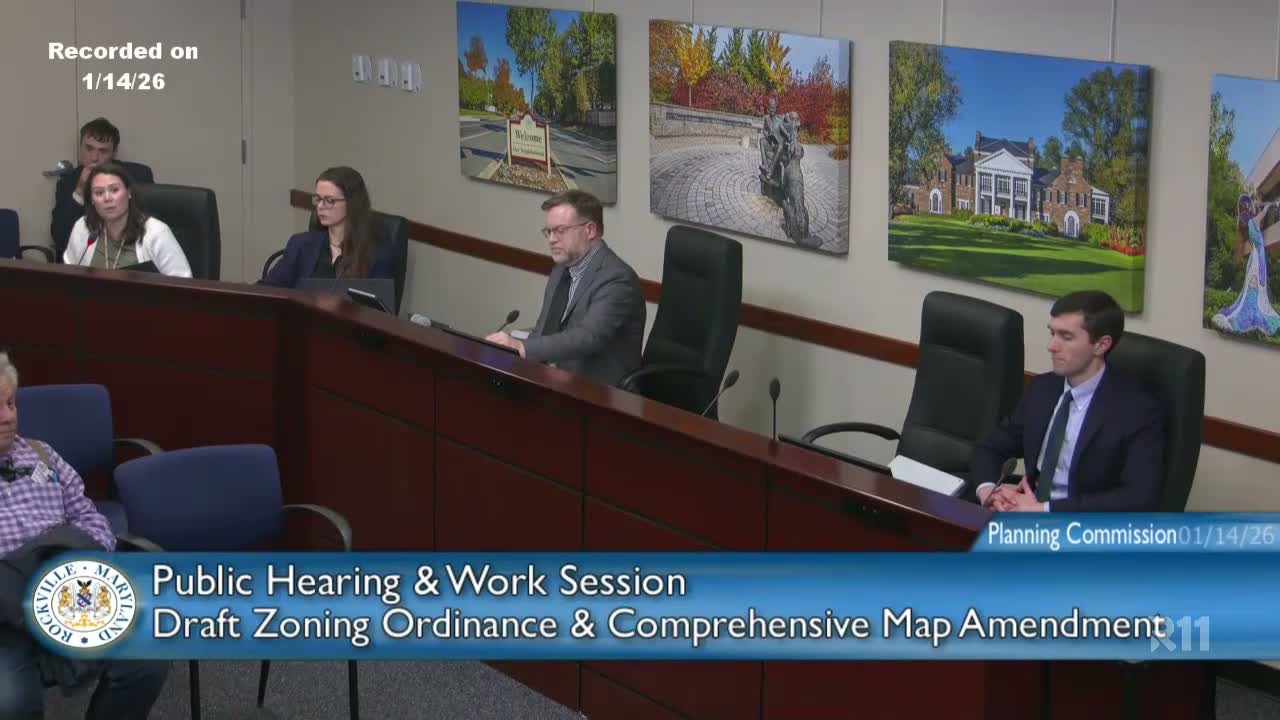
Planning staff presented a package of proposed zoning changes to Rockville’s historic‑preservation rules at the Jan. 14 Planning Commission work session and recommended several procedural and enforcement updates intended to streamline routine approvals and tighten legal clarity.
Lede facts: Katie Gerbis, comprehensive planning manager, said staff wants limited administrative authority to approve minor Certificates of Approval (COAs) for exterior alterations such as storm doors, minor landscaping or HVAC replacements and to extend COA expirations from one year to five years, bringing COAs into alignment with other CPDS permits.
Why it matters: The proposed changes are intended to reduce bureaucratic delay for property owners while maintaining Commission oversight of more substantial changes. "We see a lot of things come through the HDC process that frankly are givens that shouldn't take that long for the property owner to have to wait," Gerbis said, listing mailboxes, minor plan tweaks and replacement utility devices as examples.
Other proposals: Staff said it would limit who can file local designation nominations to a property owner, the Historic District Commission (HDC) or the Mayor and Council, rather than allowing any third party to submit nominations. Staff also proposed raising the majority threshold to a unanimous vote when a property owner formally opposes designation, and creating a delisting process for rare circumstances where a site or structure has lost the physical characteristics that justified its historic overlay.
Demolition by neglect and legal guardrails: Gerbis and staff proposed expressly prohibiting demolition by neglect and allowing municipal infractions for willful neglect that jeopardizes historic integrity. Commissioners pressed staff to add language that recognizes financial hardship as a limiting circumstance, and staff counsel said the city will propose language consistent with state land‑use law and provide a hearing process in the delisting/demolition sequence so owners can demonstrate hardship.
Commissioner concerns: Some commissioners argued that silence from an owner should not be treated as consent for designation and urged that anything short of explicit owner consent require a higher voting threshold. Others noted delisting is consequential and recommended that delisting require a supermajority or unanimous vote; staff pointed out that delisting remains a full public process (sectional map amendment with HDC and Mayor & Council hearings) and that additional language to prevent incentives for self‑destruction can be drafted.
Outcome and follow‑up: Commissioners generally supported staff’s proposals on administrative COAs and the expiration extension in a straw poll, but asked staff to draft clarifying language on owner silence vs. explicit opposition, on what constitutes "other good cause" for delisting, and on financial‑hardship exceptions to demolition‑by‑neglect enforcement. Staff said it will include those clarifications in the materials it returns to the commission and will forward legal‑consistent language to the Mayor & Council as appropriate.
Provenance: Presentation and discussion on historic preservation begin at SEG 917 and continue through the commission’s directions at SEG 2153.