Get Full Government Meeting Transcripts, Videos, & Alerts Forever!
Get email alerts on the Population Estimates topic
No spam. Unsubscribe anytime.
Pflugerville council debates whether to change how the city counts and reports population
Summary
City staff told council that Pflugerville’s internal population estimate is the product of certificates of occupancy multiplied by 2.85 people per unit, creating a higher figure than Census/ACS estimates; council asked staff to study differences and report back before any methodology change.
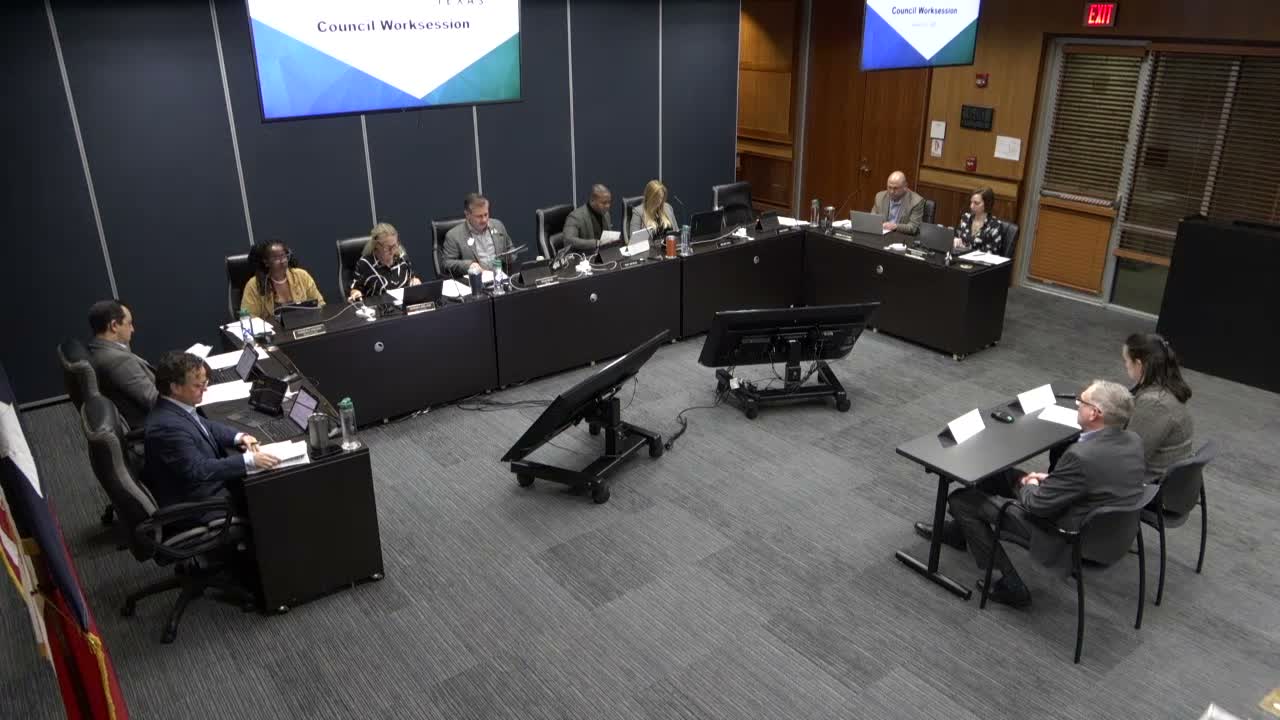
Pflugerville City Council members spent a Jan. 13 work session debating whether the city should change how it calculates and publishes population figures, as staff outlined a CO‑based methodology that yields a substantially higher local estimate than recent U.S. Census and American Community Survey (ACS) numbers.
Ashley Bailey, the city’s Planning and Development Services director, told the council the city multiplies certificates of occupancy (COs) by 2.85 persons per household (the 2020 decennial-census figure) to produce its internal estimate. “That is from the 2020 census. That is our gold standard of what we use when we're getting those numbers,” Bailey said, and reported 29,683 dwelling units as of October 2025, which at 2.85 yields an internal estimate of about 84,597 residents.
Sven Griffin, the city’s GIS manager, explained why that CO‑based count can differ from Census figures: the city supplies address lists and new-unit counts before the Census’s field verification and the Census now relies more on sampling, which can leave recently added units out of some tables. “Between the time they get those addresses… they're only gonna verify what we give them,” Griffin said, noting timing and methodology create gaps between local unit counts and federal tables.
Council members pressed staff on alternate assumptions. One council member asked for a vacancy-rate model; staff ran a scenario using 7% vacancy for apartments and 3% for single‑family units, which reduced the estimate by roughly 1,000 people from the CO × 2.85 figure. Council members also discussed segmenting occupancy and household-size assumptions by housing type (owner vs. renter, single‑family vs. multifamily) rather than using a single blended multiplier.
The ACS and recent multi‑year Census estimates show a lower average household size (about 2.7 in some tables), which would reduce the city’s internal estimate if used. Bailey and Griffin emphasized that the 2020 decennial census remains the most statistically robust benchmark for many planning uses; Bailey said city departments use decennial figures for formal infrastructure planning, licensing and some forecasting while the higher internal estimate is used in public communications and other internal tracking.
The discussion turned to transparency and external comparisons. One council member warned that using a different formula than neighboring cities could make Pflugerville’s growth rates and per‑capita metrics noncomparable and damage credibility: “So, we're cheating,” the council member said, arguing outsiders could view the divergence as misleading. Other council members countered that the internal estimate provides a useful communications number and that any change should be evaluated for material impact before altering long‑standing practices.
Rather than move immediately to change the methodology, the council asked staff to study differences between Pflugerville’s approach and those of nearby cities (including Georgetown, Round Rock, Leander and Cedar Park), to clarify which population figures are used for planning versus communications, and to return with recommendations. The chair closed the work session and the council recessed before the regular meeting.
What happens next: staff will further analyze methodology options and intercity comparisons and report back to council; no formal ordinance or vote was taken at the Jan. 13 work session.