Get Full Government Meeting Transcripts, Videos, & Alerts Forever!
Get email alerts on the Ethics Ordinance topic
No spam. Unsubscribe anytime.
North Richland Hills council reviews draft ethics ordinance and streamlined rules of procedure
Summary
An ad hoc committee presented a draft ethics ordinance and revised council rules aiming to codify house rules, clarify complaint investigations and enforcement by council, and tighten social-media limits; council asked staff to refine definitions (e.g., 'pending issue') and vet penalties and enforcement steps.
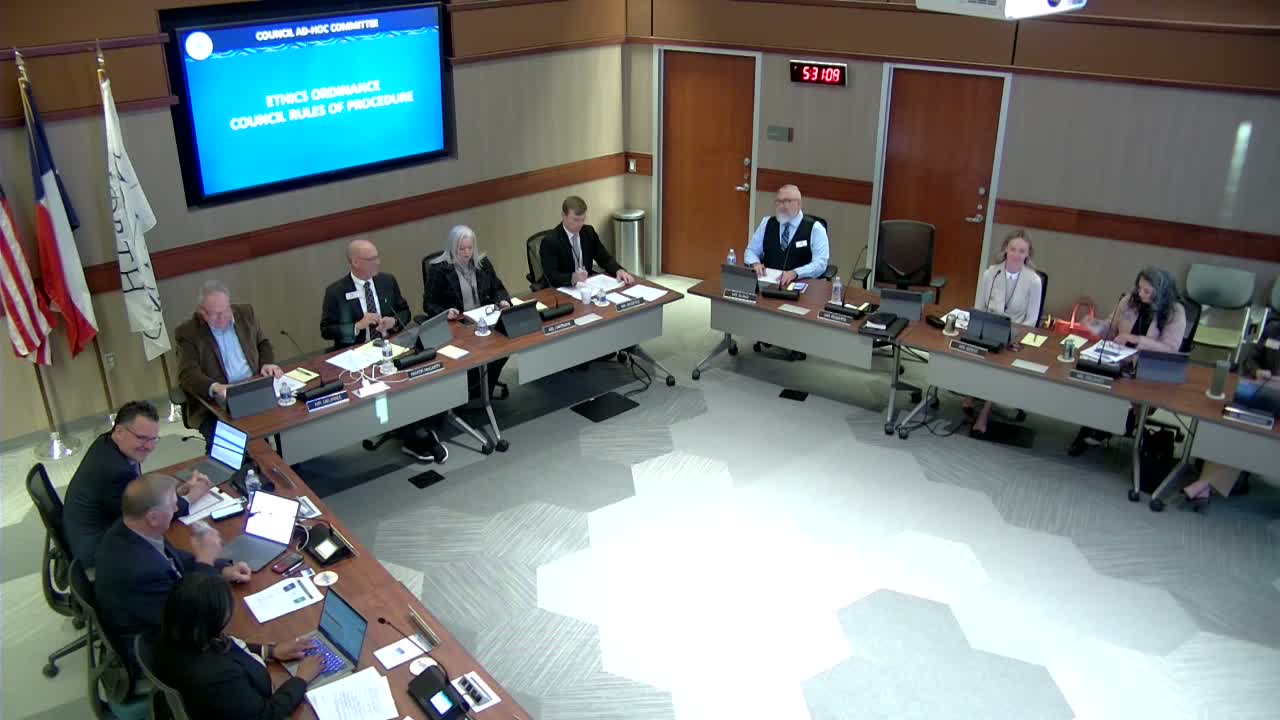
An ad hoc City Council committee presented a draft ethics ordinance and an updated set of council rules of procedure at the Feb. 23 work session, proposing clearer conduct standards, a complaint-and-investigation process and streamlined meeting procedures. Councilmember Roberts, who led the committee’s report, said the draft was intended "to make sure that these issues are clearly articulated" so the council can ‘‘move forward with confidence and integrity."
The draft ordinance, staff said, would apply to elected and appointed officials but not to city employees, who have a separate policy. Committee members said the package codifies expected conduct — transparency, respectful dialogue, confidentiality where appropriate, and training — and lays out a formal complaint process that begins with a written form, an initial vetting step, and potential investigation by the city attorney before any council action. "The ordinance does provide an outline in detail for the investigation and the associated timeline," one staff presenter said.
Council members pressed staff for narrower definitions in several places, especially the provision restricting council members from discussing "pending issues" on social media. One councilmember asked for a tight definitional section to avoid chilling permissible communications; another suggested the ordinance should state that ‘‘council should discuss pending issues only in a council setting, not on social media’’ to make intent clearer. Staff and counsel said they can draft defined language but noted the Texas Open Meetings Act (TOMA) still constrains public discussion of city business outside posted meetings.
On complaints, staff described form requirements and gating language intended to prevent vague or anonymous filings from progressing; the draft also enumerates council remedies ranging from a finding that a complaint lacks merit to letters of notification or admonition, reprimand, removal of non-council officers where law allows, or a resolution of censure or recall recommendation. Councilmember Parks and others asked the committee to add a preliminary-review step to help filter meritless claims and limit legal costs.
The committee also proposed procedural rules to shorten repetitive debate, including a chart of privileged, subsidiary and incidental motions, and a "call for the question" mechanism that would end debate with a two-thirds vote. Supporters said the changes would make meetings more efficient while preserving members’ opportunities to speak.
The council did not vote on the ordinance at the work session and directed staff to return a revised draft addressing the requested clarifications, including a tightened definition of 'pending issue' and a transparent, staged complaint review process.