Get Full Government Meeting Transcripts, Videos, & Alerts Forever!
Get email alerts on the Attorney Discipline topic
No spam. Unsubscribe anytime.
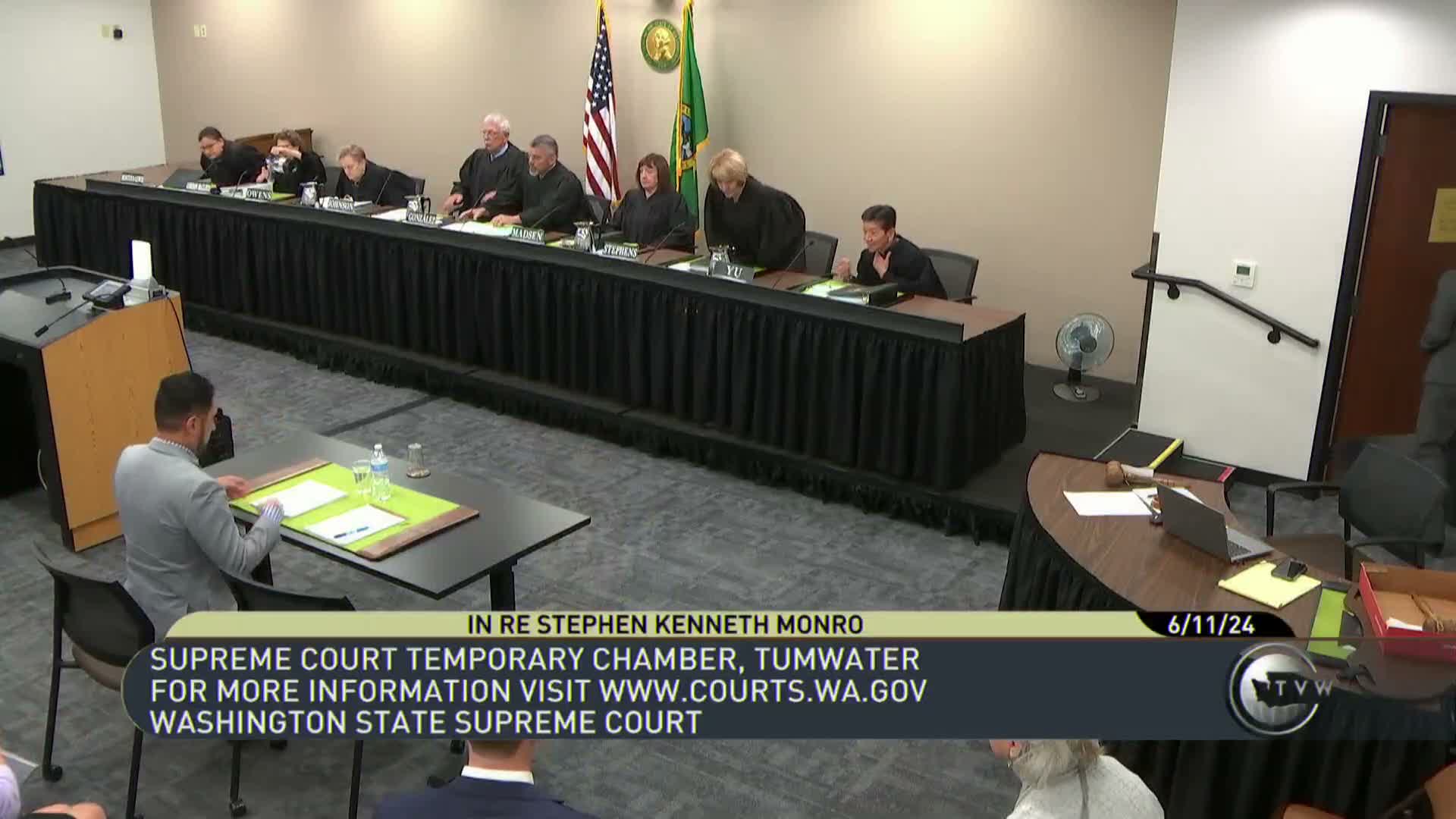
Washington Supreme Court hears arguments over disciplinary boardremand in Steven Monroe case
Summary
The Washington Supreme Court heard oral argument on June 11, 2024, over whether the state disciplinary board properly remanded a recommended disbarment in the disciplinary proceeding against attorney Steven Monroe (WSBA No. 26075) back to the hearing officer for clarification and a proportionality review. Counsel for the Office of Disciplinary Counsel said the hearing officerdecision was adequate for appellate review; respondent counsel said the remand addressed defective findings and conclusions.
The Washington Supreme Court on Tuesday heard competing arguments about whether the state disciplinary board properly remanded a recommended disbarment for attorney Steven Monroe back to the hearing officer for clarification and consideration of proportionality.
Henry Cruz, for the Office of Disciplinary Counsel, told the justices the hearing officerconducted a seven-day hearing with more than 1,000 pages of testimony and over 10,000 pages of exhibits and issued 258 findings of fact and 14 conclusions of law recommending disbarment for theft of client funds and lying under oath. "The hearing officer's findings provided all of the elements that were needed to establish theft," Cruz said, arguing the record is sufficiently specific for meaningful appellate review and that the disciplinary board should proceed to review the decision rather than remand it.
Peter Offenbecker, counsel for respondent Steven Monroe, said the disciplinary board unanimously remanded the matter "for revision to clarify the findings and conclusions of law and to consider the proportionality of the sanction." Offenbecker told the Court that his client had challenged every conclusion of law as defective on the ground that the findings failed to identify the legal standard applied and the specific evidence supporting each statutory factor.
The justices questioned both sides about the practical effect of a remand. Several asked whether sending the matter back to the hearing officer to "clarify" findings could, in effect, require a new hearing or substitute another hearing officera remedy Croix said is not at play here. Counsel for the defense acknowledged that, in some circumstances, clarifying findings could require the hearing officer to revisit credibility and evidence and, in practice, might amount to a de novo reconsideration.
The parties debated whether the disciplinary board must provide specific directions when it remands. Cruz told the Court the board offered no explanation in this case and that remands without meaningful reasons could frustrate the disciplinary system's goals of timely resolution and public protection. Defense counsel replied that where statutory factors or legal standards were not properly articulated in the findings, remand for additional findings is a traditional and established remedy.
Both sides cited precedent and practical limits. Offernbecker pointed to earlier cases in which courts remanded for further findings or a new hearing officer; Cruz raised the volunteer status and resource limits of hearing officers and urged the Court to avoid a precedent that would require repeated revisions absent a clear showing of what is missing.
The Court also discussed proportionality reviewinternal considerations the hearing officer applies when recommending a sanction and the external comparison of sanctions across similar cases. Defense counsel said the board sought assistance because it could not determine how the hearing officer applied legal standards to the record; ODC counsel said the hearing officer had performed the necessary analysis and that the board could and should conduct its de novo review on the merits.
The matter was submitted on the briefs and oral argument; the Court took no immediate action from the bench and adjourned. No final decision was issued at the hearing.