Get Full Government Meeting Transcripts, Videos, & Alerts Forever!
Get email alerts on the Child Welfare topic
No spam. Unsubscribe anytime.
Washington Supreme Court weighs standard for removing children under RCW 13.34.130(6)(a)
Summary
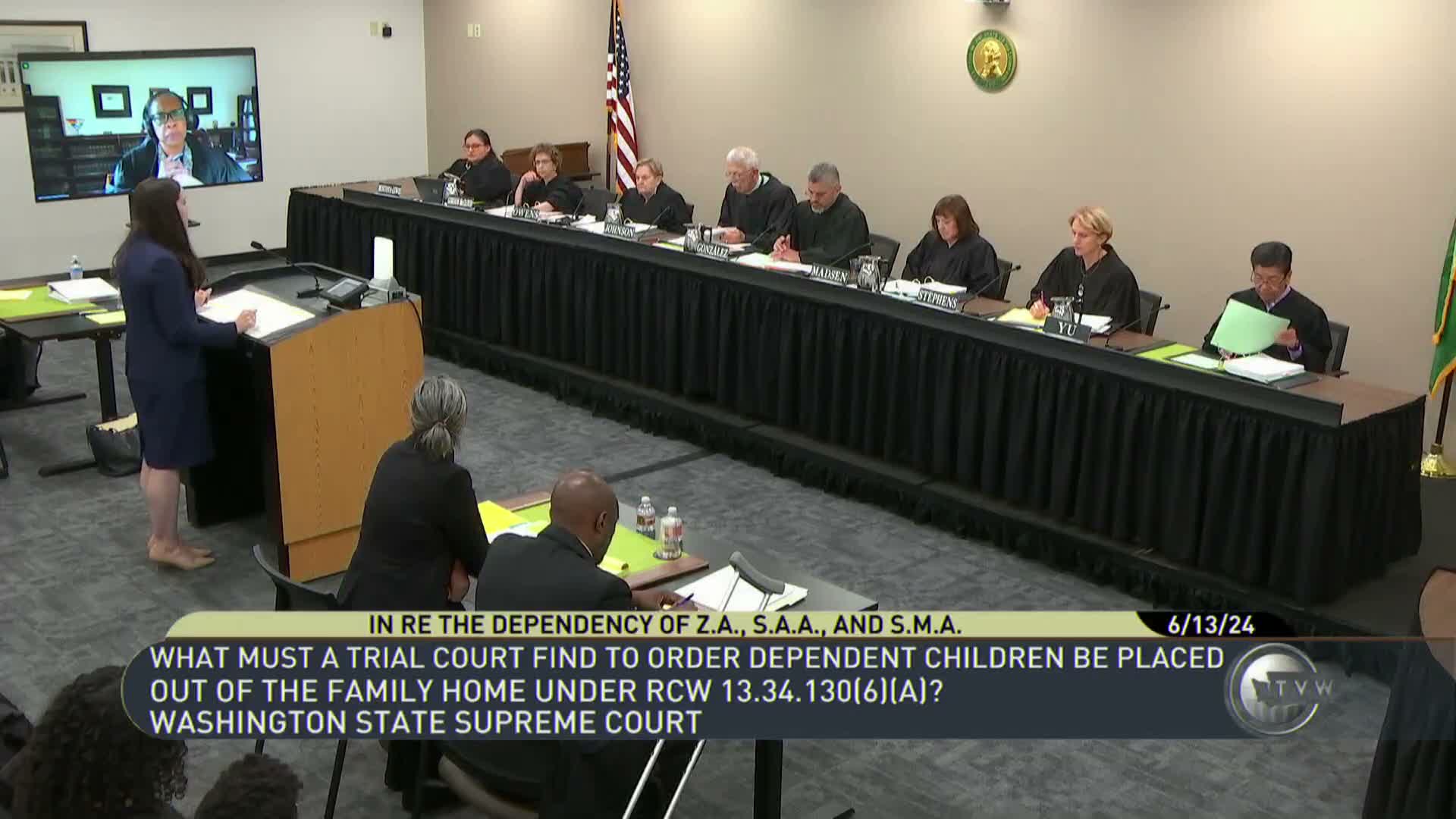
On June 13, 2024 the Washington Supreme Court considered whether subsection (6)(a) of RCW 13.34.130 requires a clear-and-convincing showing and a demonstration of "manifest danger" for out-of-home placement, or whether a preponderance standard suffices; attorneys warned the decision could change how often families are separated and may affect racial disparities.
The Washington Supreme Court heard argument on June 13, 2024, over how courts should read RCW 13.34.130(6)(a) when deciding whether to place a dependent child in out-of-home care. Kristen Vilore, counsel for the Department of Children, Youth, and Families, told the court that the plain text of subsection (6)(a) does not include the phrases “manifest danger” or a requirement of “clear, cogent, and convincing” evidence and that the preponderance standard should apply at disposition unless the legislature provides otherwise.
Vilore said the statute contemplates a multi-step process: a fact-finding hearing that applies the rules of evidence, followed by a disposition hearing and consideration of the department’s social study. “By its plain language, RCW 13.34.130 subsection 6(a) does not require either clear, cogent, and convincing evidence or a manifest danger,” she told the court, adding that subsections (a) and (b) are framed differently from subsection (c) and the legislature distinguished among them.
Several justices pressed Vilore on whether a broad reading of “available” would render subsection (c) (which references serious abuse or neglect and includes higher thresholds and the manifest-danger language) superfluous. A justice asked how a court should assess whether a parent who is physically present is nonetheless unavailable to care for a child; Vilore replied that “available to care for such child” requires more than physical presence and that courts consider whether in‑home services would ameliorate risks.
An attorney speaking on behalf of amici associated with the King County Department of Public Defense urged the Court to require stronger safeguards before approving removal at disposition. That counsel said removal is a separate step from dependency and warned that allowing removal on a mere preponderance showing could permit family separation based on poverty and widen racial disparities. “If the standard can be met by an amorphous view of ‘available,’” the counsel said, “that would make family separation the rule rather than the exception.”
Moses Okeo, counsel for the father in the underlying case, described the father’s proposed in‑home plan — housing within walking distance of school, 24/7 video surveillance, a strict no‑guest policy, parenting coaching, transportation and after‑school care — and argued the trial court nevertheless rejected the plan and removed the children. “At disposition, family separation is an exception, not the rule,” Okeo told the Court, saying the father had been present and prepared to care for his children and that the court’s finding relied on subjective assessments of his parenting skills.
Department counsel responded that poverty alone is not a statutory deficiency and that the statutory scheme requires reasonable efforts and specific findings before out‑of‑home placement may occur. Counsel emphasized that subsection (6)(c) applies to harms that are not limited to a parent’s actions — for example, exposure to someone else in the home — and that the legislature imposed a higher burden for such removals.
The justices’ questioning focused on how to harmonize subsections (a) and (c), how to assess availability in practice, and whether courts can or should find multiple independent bases for removal. The Court took no immediate action at the hearing and adjourned after arguments concluded.
The case turns on statutory interpretation of RCW 13.34.130 and related definitions in RCW 26.44.020; the decision could affect how trial courts weigh evidence at disposition and may have implications for families, child welfare practice, and racial disparities in dependency proceedings.