Get Full Government Meeting Transcripts, Videos, & Alerts Forever!
Get email alerts on the Military Pensions topic
No spam. Unsubscribe anytime.
Washington Supreme Court hears dispute over whether post‑divorce military recall raises pension into marital property
Summary
At oral argument in Ray (marriage of Porter and Porter), attorneys disagreed over whether pension increases earned during an involuntary military recall are separate property under RCW 26.16 or part of the marital share; the court took the arguments and the case was submitted for decision.
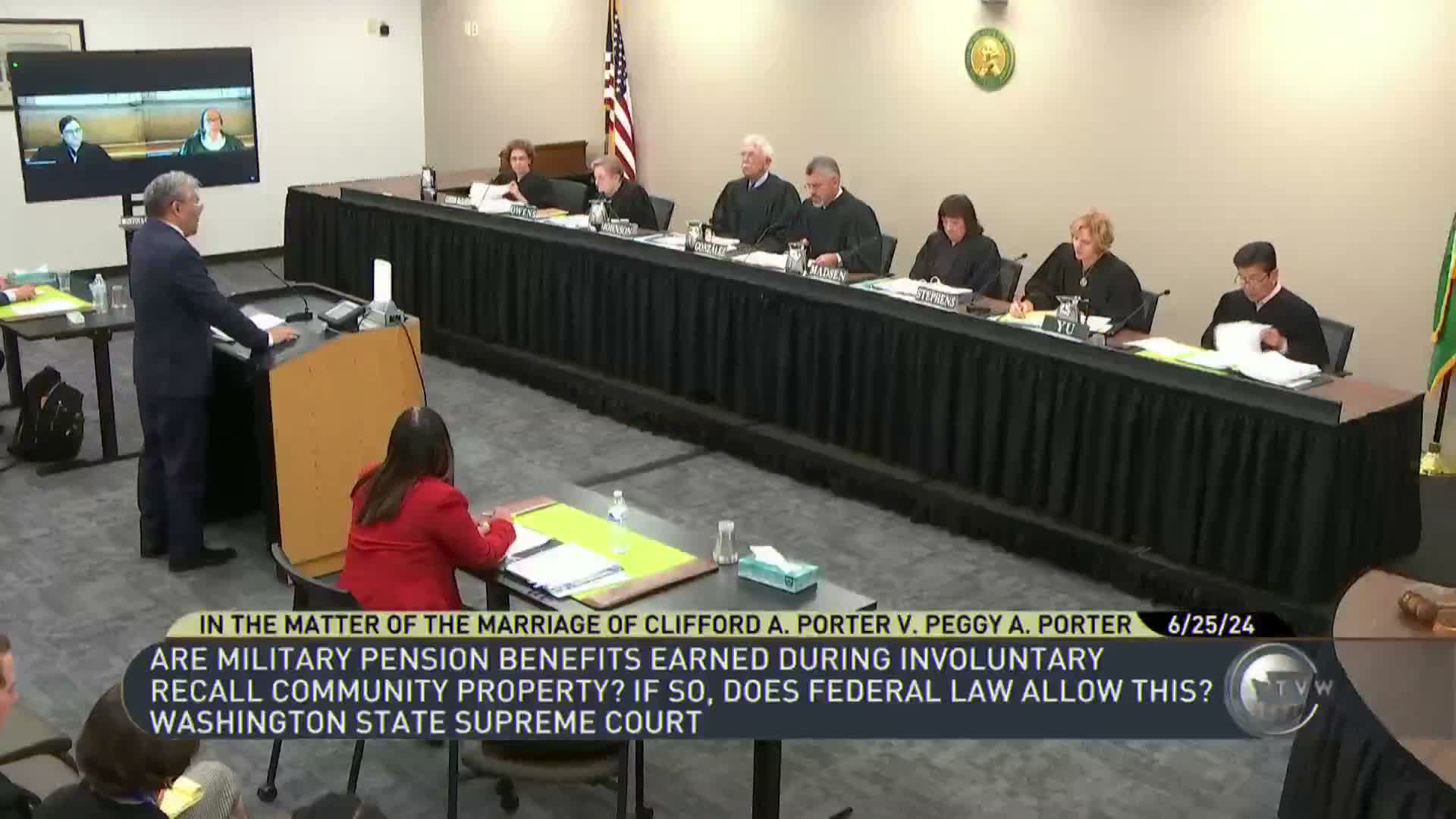
The Washington Supreme Court on June 25, 2024 heard argument in Ray, the marriage of Porter and Porter, over whether pension increases earned during an involuntary military recall after a 1994 divorce should be treated as the servicemember’s separate property or included in the marital portion subject to division.
Appellant counsel John Higa argued that increases arising from the recall are separate property under state law and that the Court of Appeals erred in applying the community‑efforts doctrine. "Under RCW 26.16, the presumption is that the increase in the pension earned during the recall is his separate property because it was acquired after marriage," Higa told the court, warning that the appellate approach would "essentially allow the courts to usurp the statutes." Higa said the trial court’s 27% figure reflected a calculation method the appellant disputes and urged treating valuation "as though he retired in 2002" to exclude recall‑era increases.
Respondent counsel Stacy Swenshagen urged the court to affirm the Court of Appeals. She described the military pension as a single asset and said the trial court correctly adjusted the coverture fraction to reflect additional service credits, yielding a 27.273% entitlement for the respondent. "The asset is Dr. Porter’s military pension, and that's made up of 54.5% of community characterization and 45.5% of separate property characterization," Swenshagen said, and she argued the burden lies with Dr. Porter to show the post‑divorce increase was the result of non‑community factors.
The justices pressed both sides on several technical points. One justice asked whether promotions or rank changes during recall reflect time‑in‑service or merit; Higa responded that the recall‑period increase came from the servicemember’s labor during recall and therefore should not automatically convert to community property. Swenshagen and the bench discussed prior state decisions that presume post‑separation increases stem from "community efforts" absent substantial evidence to the contrary and explored whether that presumption has a temporal limit where many intervening years and intervening private employment exist.
In rebuttal, Bruce Clement, co‑counsel with Higa, identified three central issues he said the court should decide: whether the Court of Appeals expanded community‑property law; whether federal law preempts division of benefits earned during a recall; and whether the Court of Appeals' result was inequitable. Clement warned that involuntary recall can be "more like a second employment" and argued Congress did not clearly authorize division of recall benefits, raising a potential preemption argument.
The attorneys cited a range of authorities during argument, including RCW 26.16 and state precedents the parties discussed by name (Chavez; Hurd/Heard; Bullacek/Bulacheck; Ratanaba; Wilder) as well as out‑of‑state cases and federal preemption decisions. Counsel for the respondent urged the court not to adopt a bright‑line rule that would exclude consideration of increases tied to recall service; counsel for the appellant asked the court to reverse or hold that preemption prevents division of recall benefits.
The justices took several technical questions from the bench about timing, the trial court’s calculation method, the standard of review for equitable division and the allocation of the burden of proof. The court submitted the case for decision at the close of argument and adjourned.