Get Full Government Meeting Transcripts, Videos, & Alerts Forever!
Get email alerts on the Plea Withdrawal State V Blake topic
No spam. Unsubscribe anytime.
Defense urges Washington Supreme Court to allow Christopher Olson to withdraw pleas tied to State v. Blake
Summary
At a June 27 argument, defense counsel asked the Washington Supreme Court to reverse and remand so Christopher Olson can withdraw guilty pleas that included a conviction the court later found unconstitutional in State v. Blake; the state urged finality and argued voluntariness is judged at the time of a plea.
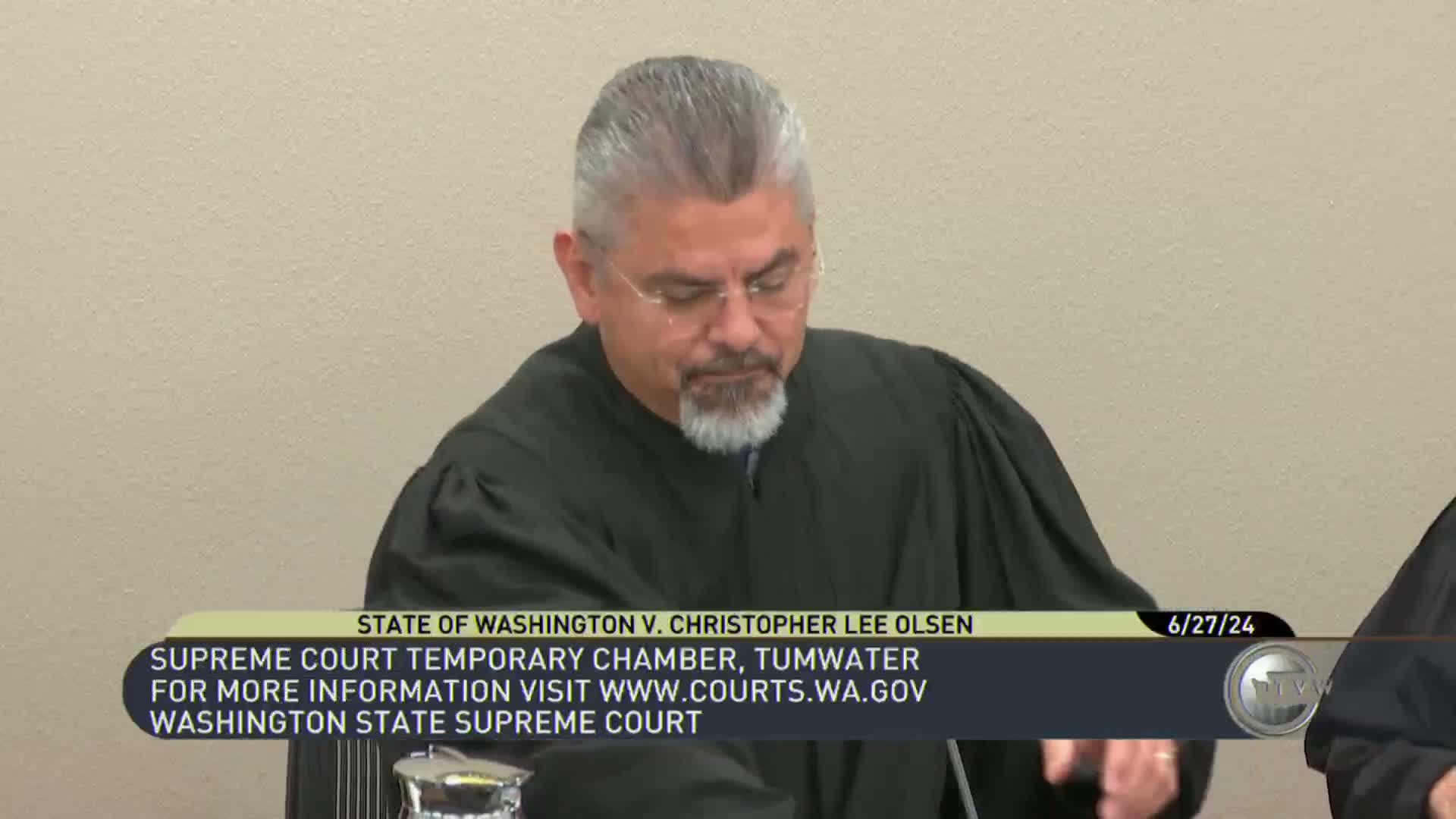
The Washington Supreme Court heard argument June 27 in State of Washington v. Christopher Lee Olson over whether Olson may withdraw guilty pleas that included an unlawful-possession conviction later held unconstitutional in State v. Blake.
Jody Backlund, defense counsel for Christopher Olson, asked the court to “reverse the trial court’s order and remand Christopher Olson’s cases so that he can withdraw his pleas,” arguing Olson entered two indivisible global bargains and that each package contained an unconstitutional Blake-affected offense.
Backlund told the court that Blake is retroactive and therefore a “significant and material change in the law” that can render prior pleas not knowing, intelligent, and voluntary. She argued the trial court erred in finding one set of offenses divisible and urged the court to apply rules for indivisibility so that Olson may be placed “in the position that he would have been in had the state not exercised authority it did not have.”
The state, represented by Joseph Jackson, deputy prosecuting attorney of Thurston County, countered that “the voluntariness of a plea is determined at the time of the plea,” and that a post-plea change in law does not invalidate an otherwise valid plea agreement. Jackson said Blake required vacatur of the unlawful possession convictions but did not create a general pathway to withdraw otherwise voluntary pleas. He told the court the state’s concerns include both a potential “floodgates” effect and the finality of judgments that plea bargaining provides to both sides.
Justices pressed both sides on two central questions: (1) whether a global bargain that includes an unconstitutional conviction must be treated as indivisible so the entire package can be withdrawn, and (2) whether procedural time bars or standards for collateral review permit relief years after the plea. Backlund argued multiple exceptions to the one-year procedural time bar apply here and that the trial court’s finding that the time bar did not apply was not challenged by the state. Jackson replied that many voluntariness claims are time-barred and that Blake’s remedy in many cases is vacatur or resentencing rather than plea withdrawal.
The parties debated precedent and standards at length: Backlund cited cases she said support retroactive relief when a change in the law is material to voluntariness; Jackson cited Brady v. United States and other authorities emphasizing that voluntariness is assessed when the plea was entered.
After rebuttal from Backlund, the court submitted the case and recessed for 10 minutes. The justices did not announce a decision at the hearing.
The argument centered on narrow legal questions about plea withdrawal, retroactivity following State v. Blake, and the interplay between finality and fairness in long-closed criminal cases. The court’s upcoming opinion will determine whether the Blake decision permits remand for withdrawal of global plea bargains in Olson’s circumstances.