Get Full Government Meeting Transcripts, Videos, & Alerts Forever!
Get email alerts on the Criminal Justice topic
No spam. Unsubscribe anytime.
Washington Supreme Court considers whether defendants can withdraw pleas after Blake decision
Summary
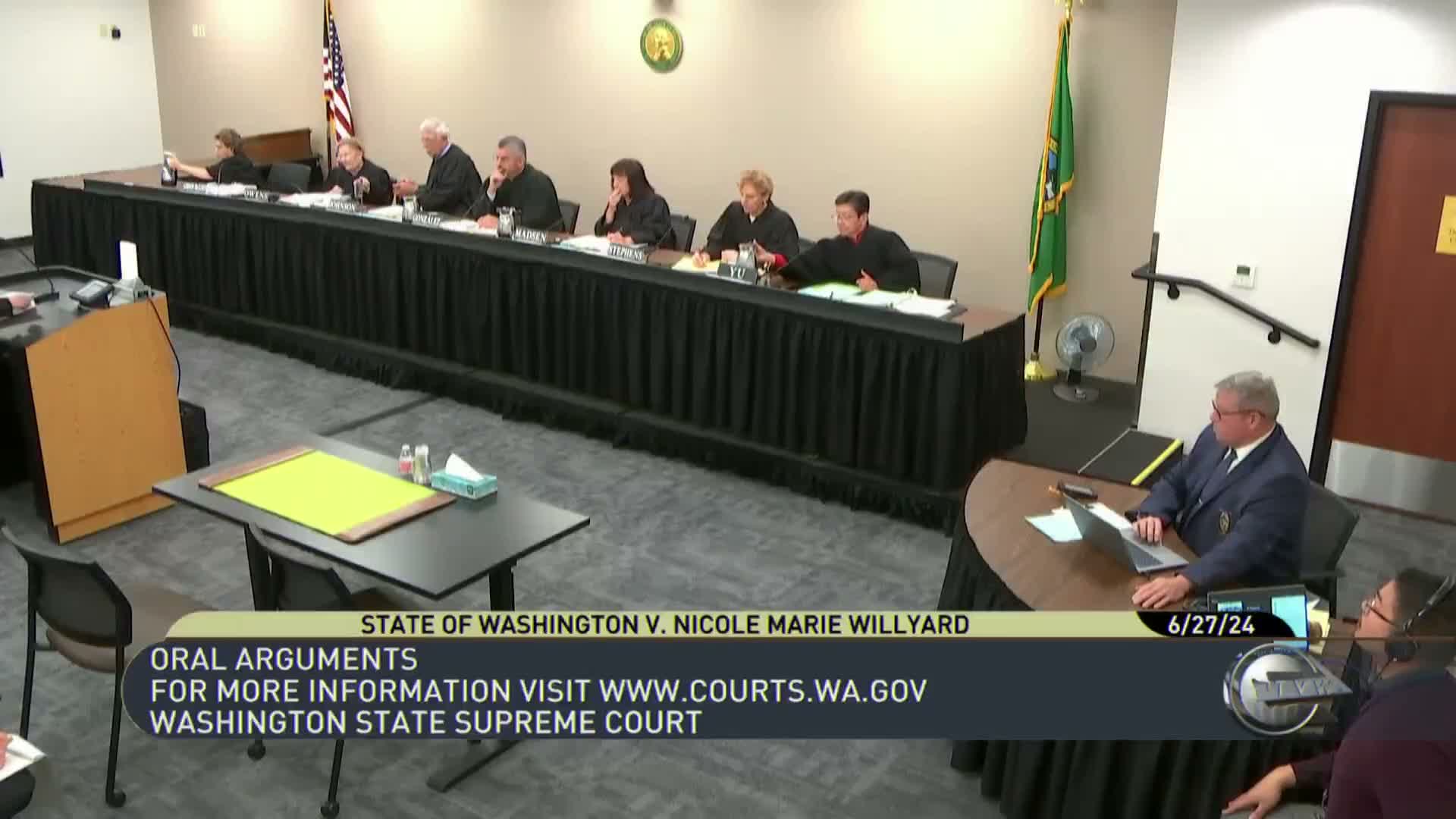
In oral argument June 27, 2024, the Washington Supreme Court heard State v. Nicole Marie Williard, focusing on whether a defendant who pleaded guilty under a statute later held unconstitutional may withdraw that plea or should receive narrower relief such as vacatur of the possession conviction or resentencing.
The Washington Supreme Court heard argument June 27, 2024, in State v. Nicole Marie Williard over whether a defendant who pleaded guilty under a statute later declared unconstitutional may withdraw the plea. Petitioner counsel Aaron Moody asked the court to remand with instructions allowing Williard to withdraw an indivisible plea, while respondent counsel Joseph Jackson argued the Court of Appeals correctly found the pleas voluntary and that vacating the unlawful-possession count was the appropriate remedy.
Moody told the court that Williard concedes the codified simple-possession offense existed in 2003 but that the central question is whether a defendant who "agree[s] to be convicted and punished under a statute that completely exceeded the state's legitimate police power" may nonetheless be held to that bargain for life without a case-specific inquiry into equitable relief. He characterized the problem as a conviction error rather than a sentencing error and urged the court to apply precedent (including Hinton and Thompson) to permit withdrawal where a facially invalid statute tainted a plea.
Jackson responded that voluntariness is assessed at the time a plea was entered and that this court’s post-Blake orders have often removed offending possession convictions without reopening plea bargains. He said the trial court properly vacated the unlawful-possession conviction here and that, in many cases, vacatur (and, if necessary, resentencing when offender scores change) is the correct remedy rather than wholesale withdrawal.
Justices pressed both sides with hypotheticals on fairness and practical consequences: whether withdrawing a plea decades later could permit refiling of more serious charges if witnesses reappear, whether stale evidence would defeat retrial, and how vacatur of a possession conviction interacts with related charges such as bail jumping. Counsel agreed these concerns are fact dependent; Moody said the state can raise stale-evidence or prejudice defenses, but those defenses must be assessed case by case rather than used as a categorical bar.
The argument touched on multiple prior decisions, including Blake (invalidating the unlawful-possession statute), Snively and Adams (on facial invalidity and offender-score consequences), Downing and Paniagua (bail-jumping implications), and Coats/Richardson (when sentencing remains within the standard range). Counsel debated whether those precedents distinguish misinterpretation-based errors from statutes that were unconstitutional on their face and whether that distinction should change the remedy.
Moody acknowledged remedies such as resentencing may be moot for defendants who have completed served sentences long ago, but he renewed the request that the court allow Williard to withdraw her plea in light of a facial invalidity. Jackson urged caution about broad remedies that could unsettle finality in numerous cases. After final questioning the court submitted the case for decision and recessed until 1:30 p.m.
The court did not issue a ruling at argument; the panel will issue an opinion at a later date that will resolve whether withdrawal, vacatur, resentencing, or another remedy is required where a conviction rests on a statutory provision later declared unconstitutional.