Get Full Government Meeting Transcripts, Videos, & Alerts Forever!
Get email alerts on the Juvenile Sentencing Plea Effects topic
No spam. Unsubscribe anytime.
Washington Supreme Court weighs whether negotiated plea bars juvenile-sentencing relief in State v. Harris
Summary
Justices heard arguments over whether Darren Harris, who accepted a 244-month joint recommendation in 2012, may receive the benefit of later juvenile-sentencing precedent or whether the negotiated plea bars resentencing; the State urged affirmance, the defense sought a remedy allowing consideration of youth.
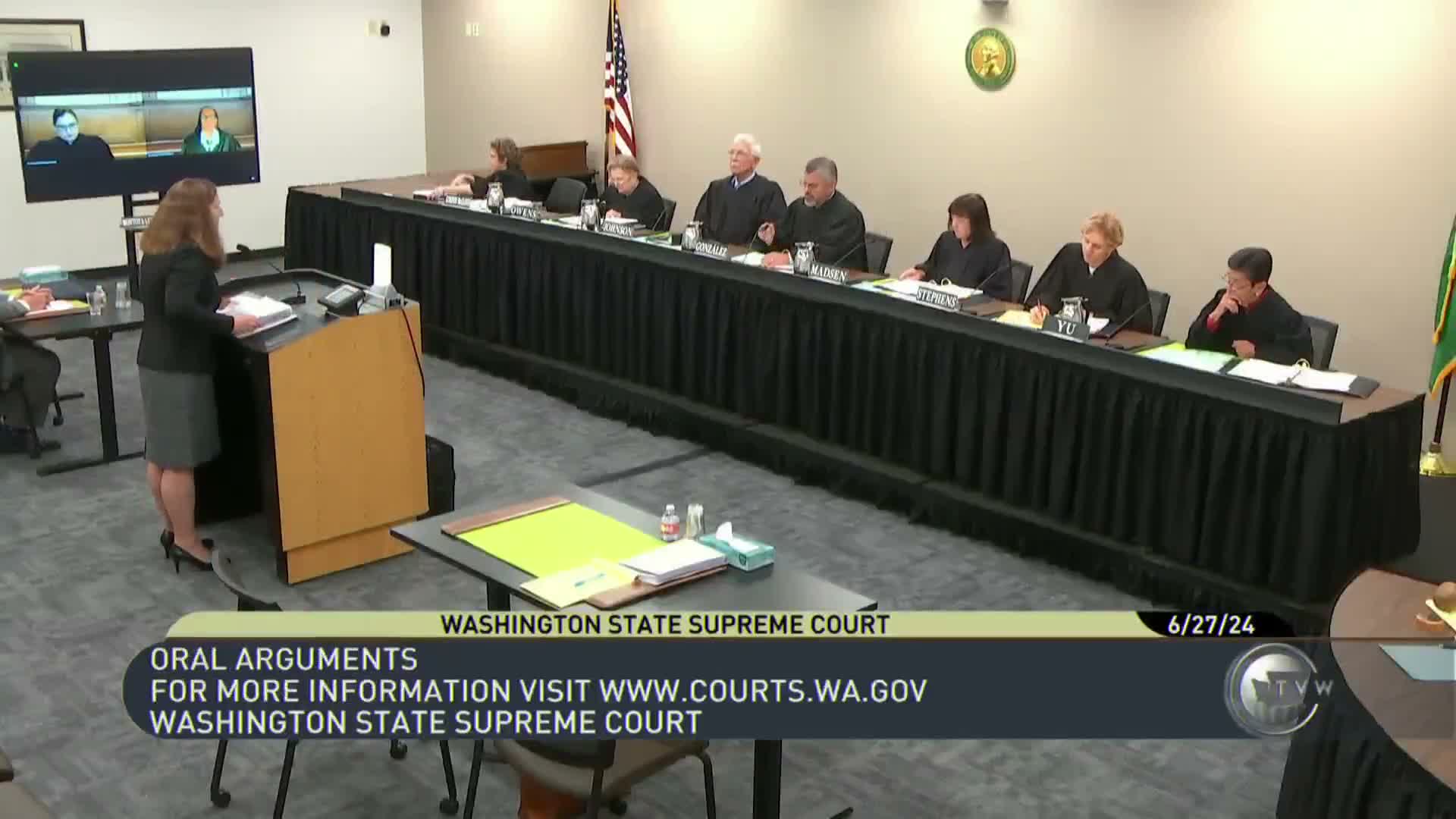
The Washington Supreme Court heard argument on June 27 in State of Washington v. Darren Stanley Harris over whether a negotiated guilty plea entered in 2012 precludes the later application of juvenile-sentencing decisions and whether resentencing or withdrawal is an available remedy.
Deputy Prosecutor Jill Reuter, representing Yakima County and the State, told the court Harris pleaded guilty in August 2012 under a joint standard-range sentencing recommendation of 244 months and urged that the judgment and sentence be affirmed. "He got exactly what he asked for," Reuter said, arguing that allowing later judicial decisions to undo negotiated pleas would "open the floodgates" to widespread collateral challenges.
Defense attorney Jeffrey Ellis, who identified himself as counsel for Harris, said the case presents a narrower question: this is a direct appeal and not a request to withdraw the plea. Ellis argued the constitutional requirement in juvenile-sentencing cases obliges courts to consider the mitigating qualities of youth and that a reviewing court must be able to assess whether those qualities were weighed. "We're not interested at all in a pyrrhic victory," Ellis said, urging the court to craft a remedy that would permit consideration of youth without producing a result that merely reimposes the same negotiated sentence.
Justices pressed both sides on the practical implications. Several asked whether, on resentencing, the defendant would be free to argue for any sentence or would remain bound to the original 244-month recommendation. Reuter answered the State's position is that Harris would be prohibited from arguing for a lower sentence, while Ellis contended nothing in the plea barred presentation of mitigating evidence and suggested the parties could present agreed mitigating facts for the judge to weigh.
The lawyers debated whether the court should measure harmlessness against the parties' bargain or against the possibility that different evidence might have produced a different result. Ellis emphasized that because this is a direct appeal, the State bears the burden to prove harmlessness beyond a reasonable doubt and that a bare agreed number in the record does not necessarily show how the court weighed youth-related mitigation.
Both sides cited precedent. The State referenced Sledge and Williams to support adherence to plea bargains; counsel for Harris invoked the line of juvenile-sentencing cases that require a court to consider mitigating qualities of youth and argued that an agreed recommendation should not automatically foreclose that constitutional inquiry. The parties also discussed practical obstacles — such as witness availability and the passage of time — if the court were to order resentencing.
In rebuttal, Reuter pointed to trial-court findings and a declaration in the record she said establish that Harris signified agreement to the State's recommendation and agreed not to seek a lesser sentence. She urged the court to view any constitutional error as harmless because Harris received the negotiated 244-month sentence.
The court heard argument from both sides but did not issue a ruling at argument. The justices' questions focused on whether courts can reconcile the contractual nature of plea bargains with the constitutional duty to ensure juvenile sentences are not disproportionate, and on what remedy — if any — best preserves both plea reliability and juvenile-protection principles.