Get Full Government Meeting Transcripts, Videos, & Alerts Forever!
Get email alerts on the Judicial Discipline topic
No spam. Unsubscribe anytime.
Judge Flood asks Washington Supreme Court to halt Commission on Judicial Conduct proceedings
Summary
At a virtual hearing, Judge Tracy S. Flood petitioned the Washington Supreme Court for a writ of prohibition, saying the Commission on Judicial Conduct exceeded its authority and deprived her of an adequate record; the Commission urged dismissal, saying a direct de novo appeal is the appropriate remedy.
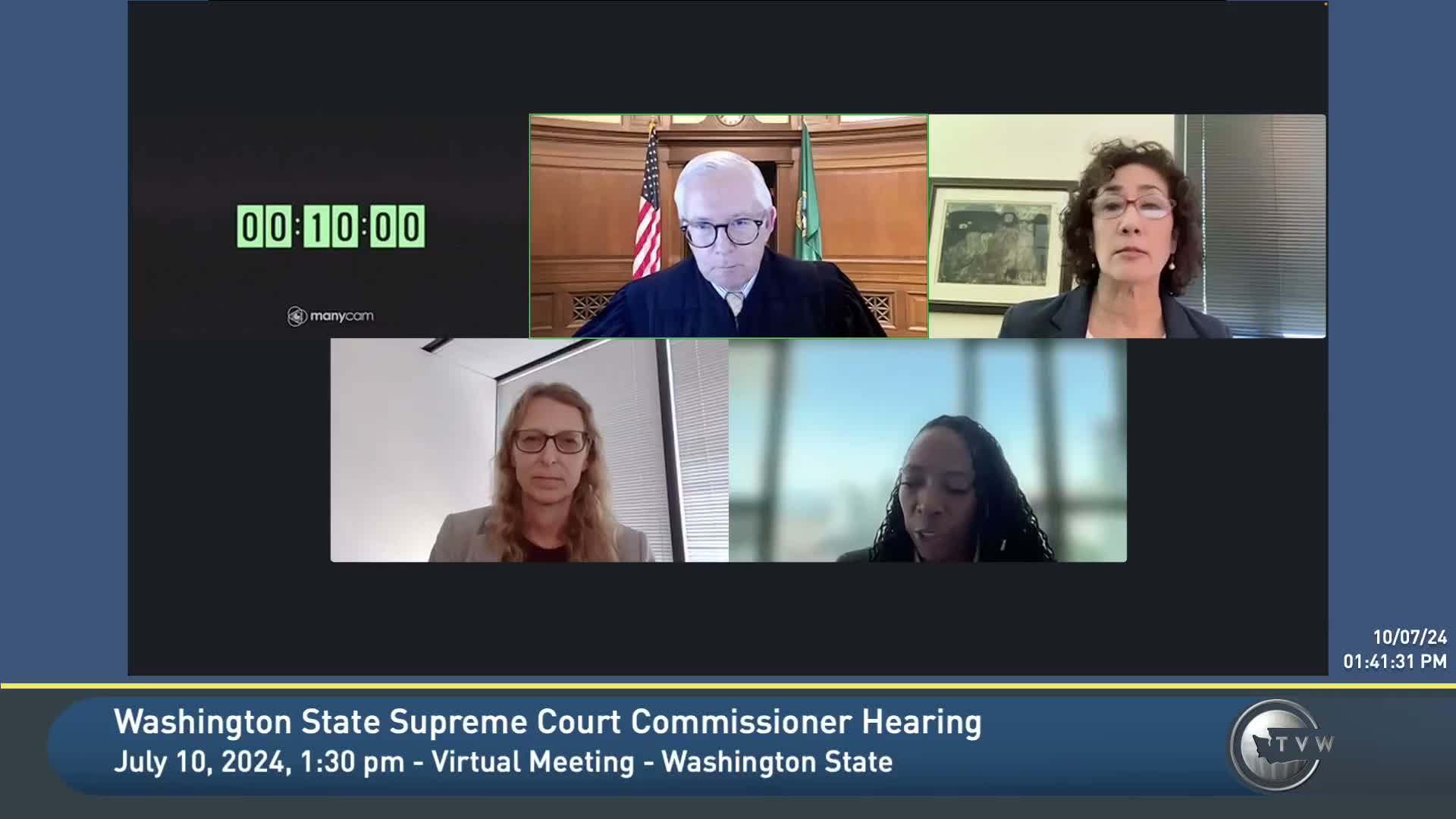
At a virtual hearing, Commissioner Michael Johnson of the Washington Supreme Court heard argument on a petition by Judge Tracy S. Flood asking the court to issue a writ of prohibition to stop the Commission on Judicial Conduct from pursuing disciplinary proceedings.
Ms. Sargent, counsel for Judge Flood, told the court that the commission exceeded its constitutional authority and failed to follow required procedures. She said the commission did not provide proper notice of the charges, allowed the partner of a decisionmaker to be hired in a way she described as an ethical lapse, had alternates and staff present during decision steps, and improperly delegated discovery decisions to disciplinary counsel. "We would like this court to issue a writ of prohibition to prohibit the Commission on Judicial Conduct from continuing with its proceedings against Judge Flood, dismiss the case with prejudice because they acted outside of the constitutionally permitted authority," Ms. Sargent said.
Commissioner Michael Johnson questioned whether the petition met the high bar for a writ and whether Judge Flood already has an adequate remedy through a direct de novo appeal to this court. Ms. Sargent replied that, in this case, the commission's procedures prevented Judge Flood from creating an adequate record for de novo review and that the commission used claims of privilege to withhold evidence relied on to find probable cause.
On behalf of the commission, Ms. Peterson argued that a writ of prohibition is an extraordinary remedy reserved for narrow circumstances and that the petition fails on two independent grounds. She urged the court to dismiss the petition on threshold jurisdictional grounds, saying the commission is not a "state officer" within the meaning of Article IV, Section 4 of the Washington Constitution and pointing to recent cases she said were instructive. "A writ is an extraordinary remedy, which this court uses with great caution and only when specific elements are met. None of those elements are present here," Ms. Peterson said, adding that "the plain, speedy and adequate remedy here is direct de novo review to the Supreme Court."
Ms. Peterson told the court that the commission's fact-finding hearing process — testimony, cross-examination and creation of a record — is the appropriate forum to resolve the allegations and produce a record the Supreme Court can review. She also emphasized the public interest in timely resolution of misconduct charges and noted the disciplinary matter has been pending for almost two years.
The court did not rule from the bench. Commissioner Michael Johnson said he would prepare a written ruling and attempt to issue it expeditiously, asking the participants to check their inboxes and suggesting he would try to issue something within about a week.
The hearing covered legal arguments about the scope of the court's original jurisdiction under Article IV, Section 4 of the Washington Constitution, the statutory writ provisions in the Revised Code of Washington, and precedent the parties cited. No formal action was taken at the hearing; the court took the petition under advisement and will issue a decision in due course.