Get Full Government Meeting Transcripts, Videos, & Alerts Forever!
Get email alerts on the Eviction Right To Counsel topic
No spam. Unsubscribe anytime.
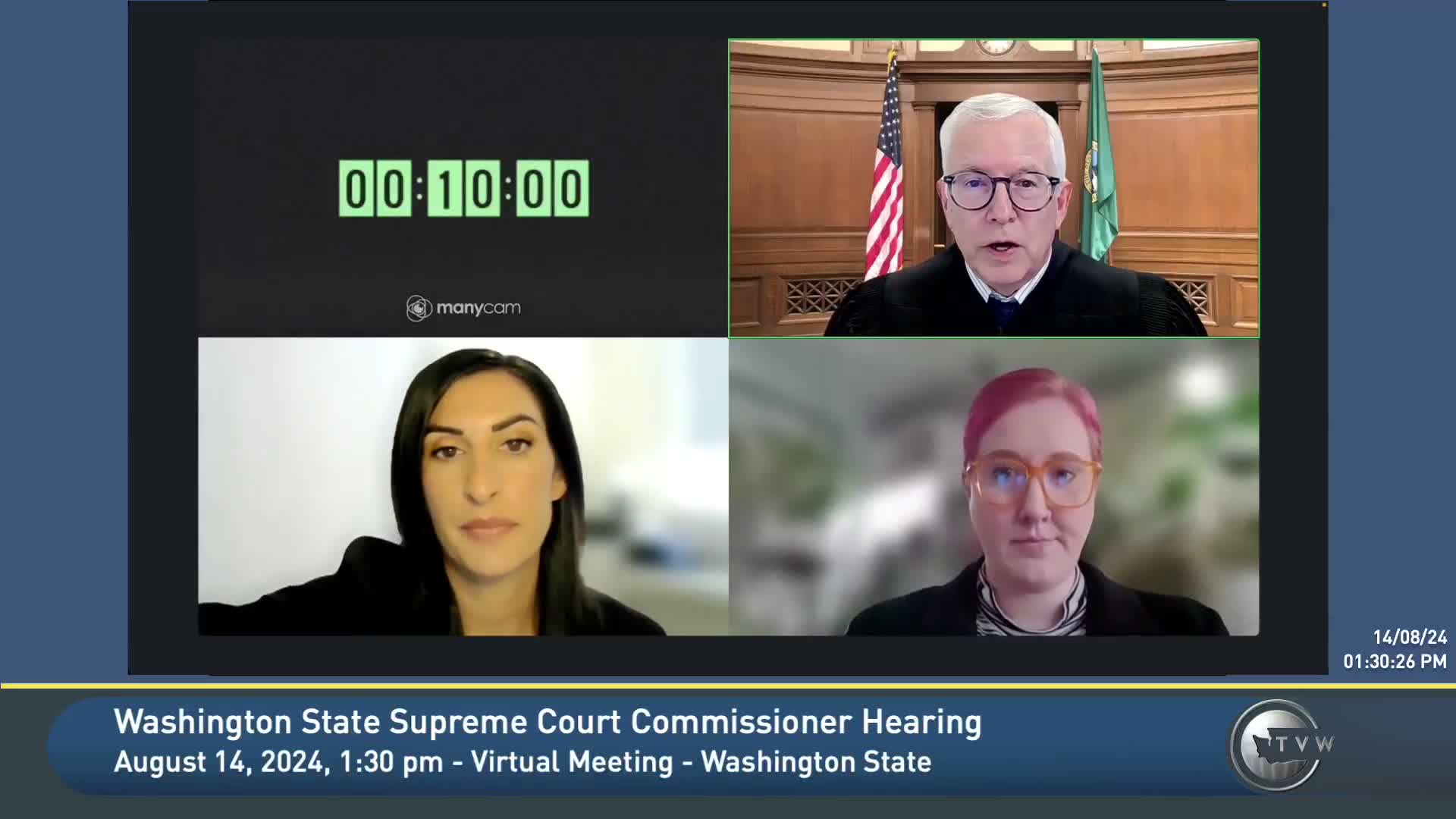
Washington Supreme Court hears emergency motion in Sangha v. Keane over eviction and right-to-counsel
Summary
The court heard arguments on an emergency motion seeking restoration of possession after an Aug. 2 eviction; counsel for the tenant argued the eviction violated newly implemented right-to-counsel procedures, while the landlord’s counsel said statutory law requires a supersedeas bond. The commissioner said he cannot grant affirmative relief today and will issue a ruling within roughly a week.
The Washington Supreme Court heard argument on an emergency motion in Sangha v. Keane (No. 103332-0), with appellant counsel asking the court to restore possession after an Aug. 2 eviction and respondent counsel arguing that the statutory requirement for a supersedeas bond precludes immediate restoration.
"Appellant respectfully requests that this court enter an emergency order restoring possession of the premises to Mr. Keane so as to preserve the status quo of the parties that existed at the time written findings were entered by the trial court on July 31," said Caitlin Heinen of the Housing Justice Project, counsel for the appellant.
The motion centers on whether the trial court granted a CR 55 default judgment and executed a writ of restitution without complying with court rules that implement the right to counsel. Heinen told the court that the appellant filed a notice of appeal and that execution followed roughly an hour later, and she argued trial-court practice in King County often allows CR 55 defaults to issue without inquiring whether a tenant qualifies for appointed counsel under the newly implemented rule (SPR 98.24W) and RCW 59.18.640.
Respondent counsel Julie Martinello said the trial court retains the proper statutory route for restoring possession and that RCW 59.12.200 requires posting a bond before possession may be restored after a final order. "What appellant is trying to do here is to circumvent the requirement to post a bond to be restored to possession," Martinello said, adding that the trial court determines any supersedeas bond amount and that an appellate court typically does not substitute its own bond calculation.
The parties disputed how earlier precedent applies. Commissioner Michael Johnston cited Reynolds v. Harmon as allowing CR 55 defaults in cases where no answer was filed, while counsel for the appellant said Reynolds addressed a different gap in the law that has since been altered by the right-to-counsel rules effective Oct. 31, 2023.
The arguments included factual claims about the tenancy: the property is a four-unit fourplex; counsel referenced roughly nine months of unpaid rent and a monthly rent figure of about $2,100. Respondent counsel said the landlord had spent an estimated $10,000 on repairs and warned that restoring the tenant could lead to additional vacancies and increased financial harm to the owner, including mortgage risk.
Heinen emphasized that the appellant is indigent and cannot afford a bond and argued that post-appeal monetary remedies would not preserve the status quo necessary to make appellate review meaningful. Martinello countered that the appellate rules do not override the statute and that bond requirements protect landlords from unrecoverable losses while an appeal proceeds.
Commissioner Johnston said he lacks authority to grant affirmative relief from the bench today and explained that the court’s process may require additional steps to reach any injunctive outcome. He said he would examine the briefing and the cited rules and statutes and try to issue a determination within about a week, sooner if possible.
The court’s handling of the motion will determine whether Keane can be restored to possession pending appeal or whether the appellant must pursue a bond at the trial-court level before any such relief is granted. The commissioner concluded the hearing and said the parties would hear back from the court with a ruling or other direction in the coming days.