Get Full Government Meeting Transcripts, Videos, & Alerts Forever!
Get email alerts on the Community Custody Conditions topic
No spam. Unsubscribe anytime.
Washington Supreme Court weighs whether common probation condition barring 22sexually explicit22 materials is vague
Summary
The court heard competing arguments over a boilerplate probation condition that cites multiple RCW definitions; counsel for a juvenile asked the court to strike the clause as vague and overbroad, while the state urged affirmation and guidance for consistent application.
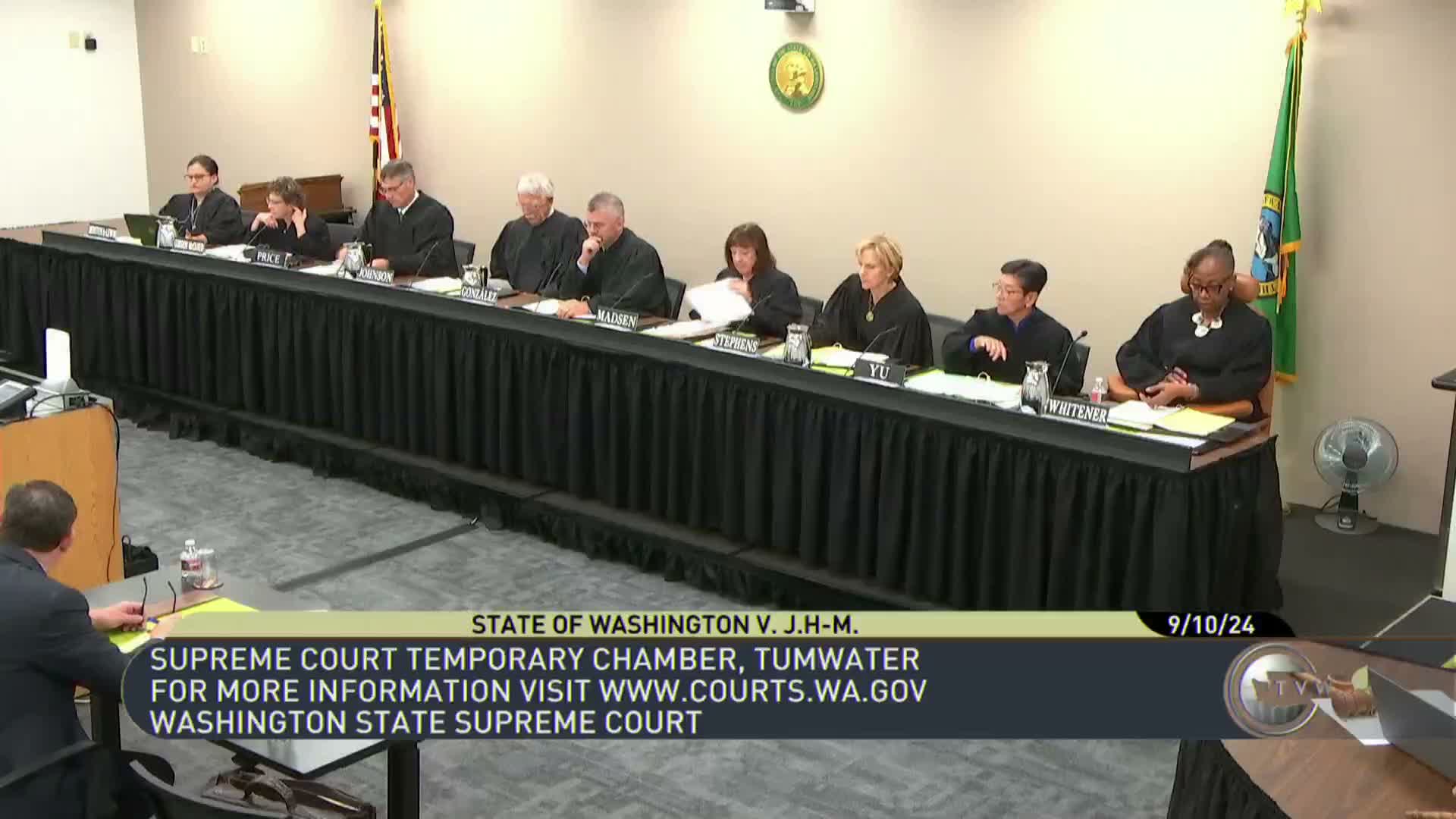
The Washington Supreme Court heard oral argument on Sept. 10 over whether a standard community-custody condition (commonly listed as condition 5) that bars possession or viewing of “sexually explicit” materials is unconstitutionally vague or overbroad when it cites a definitional RCW subsection.
Aaron Moody, counsel for the petitioner J.H.M., told the court the clause is “vague and overbroad” and that the juvenile court did not intend to impose the final clause in this case; Moody urged the justices to strike the statutory reference (the portion of condition 5 citing the definitional subsection) or the condition in its entirety in this juvenile's judgment and sentence.
Why it matters: the challenged clause appears as boilerplate on Appendix H in many community custody orders. If left uncertain, Moody argued, probation officers across counties could reach divergent conclusions about what materials are prohibited, chilling lawful expression and producing arbitrary enforcement.
Ian East, representing the State of Washington, urged the court to affirm the Court of Appeals and provide guidance rather than wholesale invalidation. "The term 'sexually explicit' is not unconstitutionally vague," East said, and community-custody conditions must be read in context with other judgment-and-sentence provisions and the role of a community custody officer in tailoring monitoring and limits for rehabilitation and public safety.
Throughout the argument the justices pressed both sides over two related constitutional doctrines. Several justices questioned whether reliance on context'the J&S, neighboring conditions, the nature of the offense and the defendant'makes the clause workable or whether that dependence itself creates unacceptable variability across defendants.
Moody pointed to precedents including State v. Padilla and PRP of Ansell to argue for narrow drafting that targets materials designed primarily for sexual stimulation, not mainstream films or television. East countered that the statutory definitions cited in the condition (as discussed in argument) enumerate highly explicit conduct and that common-sense readings and supervisory oversight can keep the restriction targeted.
The arguments also turned on remedy. Moody said striking the statutory reference or the clause would align the J&S with the trial judge's stated intent in this case; East said the court should instead clarify the acceptable, contextual reading so lower courts and probation officers face fewer recurring disputes.
The justices noted a practical urgency: the juvenile at issue is nearly through probation, raising a mootness concern, but both sides urged the court to resolve the broader legal question because the condition is widespread. The case was submitted after rebuttal and the court adjourned.
Key facts from the oral argument: counsel for the petitioner argued the clause could sweep in mainstream media; the state said the condition targets explicit conduct set out in statute and is compatible with rehabilitation goals. Neither side asked the court to adopt a specific substitute clause on the record; Moody sought striking the clause in this case as an available remedy. The court did not issue an opinion at argument's close.