Get Full Government Meeting Transcripts, Videos, & Alerts Forever!
Get email alerts on the Child Welfare Immunity topic
No spam. Unsubscribe anytime.
Washington Supreme Court hears arguments over DCYF immunity in child‑welfare case
Summary
The court heard competing interpretations of a 2012 law that governs liability for Department of Children, Youth and Families caseworkers during "emergent placement investigations," with petitioner arguing for a narrow, time‑limited gross‑negligence rule and the state urging a broader reading covering the early 90‑day investigatory phase.
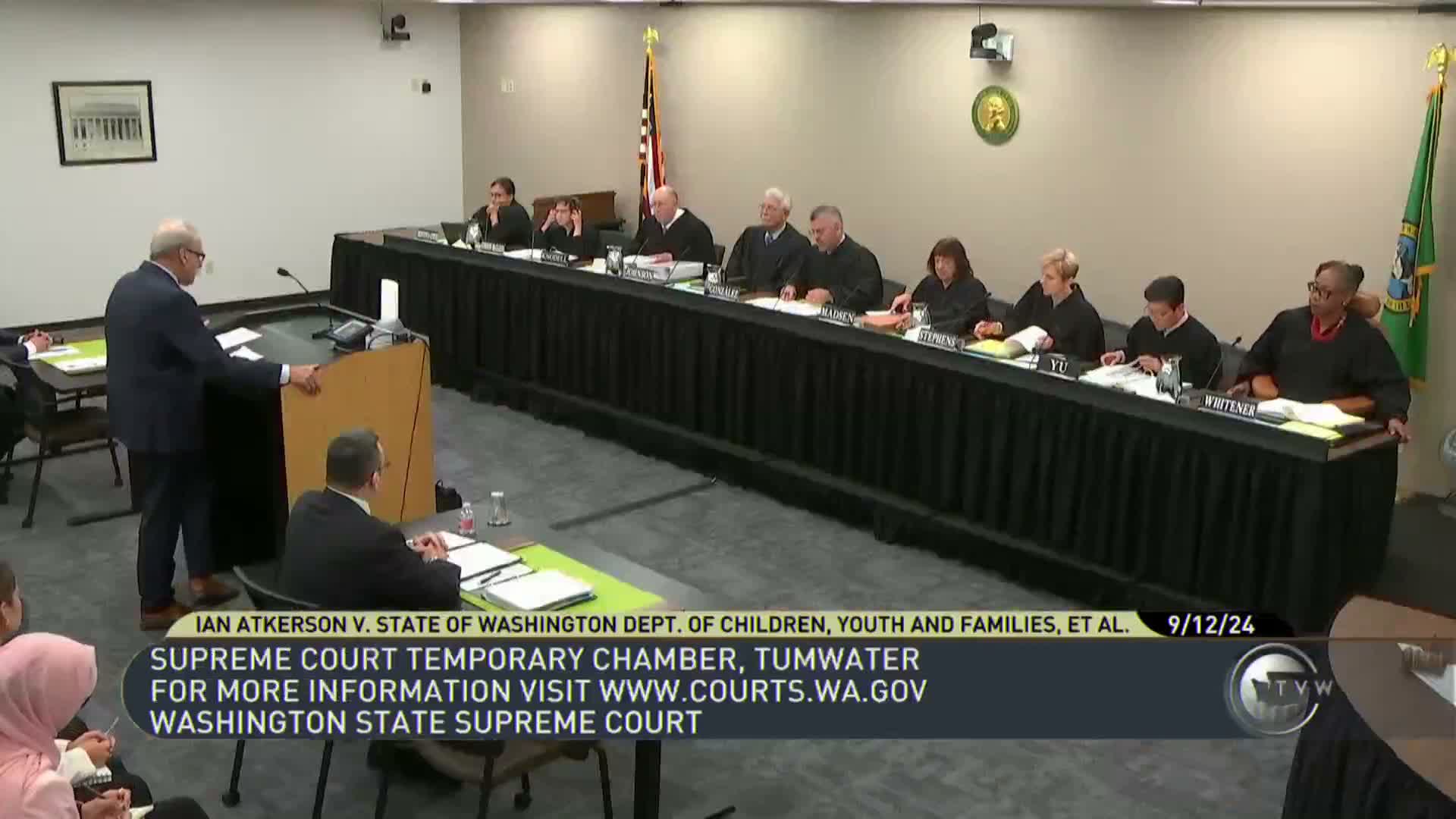
The Washington Supreme Court heard argument Sept. 12 in Atkerson v. State of Washington Department of Children, Youth and Families over whether a 2012 statute limits lawsuits against caseworkers to a gross‑negligence standard only during very short, shelter‑care‑related windows or whether the statute covers a broader, early investigatory phase.
Petitioner counsel Phil Talmadge told the court he represents petitioner Ian Atkerson, acting for the estate of the child at issue, and described the facts as "horrific," saying the two‑year‑old suffered a traumatically induced broken arm and extensive bruising and that "there was nothing done by CPS to treat this matter as an emergency" — no voluntary placement, no pickup order and no shelter‑care hearing. Talmadge argued the statute should be read narrowly to preserve a gross‑negligence standard for only the emergent placement context tied to shelter‑care procedures and short windows such as the 72‑hour pickup/shelter‑care period.
The state, through Assistant Attorney General Joshua Sher, asked the court to affirm the Court of Appeals and urged a plain‑text reading. Sher said the statutory phrase "emergent placement investigations" can encompass investigations that leave a child at home during a case worker's inquiry and argued that the first 90 days of an investigation function as the emergent phase when caseworkers face limited information. "That first 90 days really is the emergent investigation phase," Sher told the justices, and he said ordinary negligence is more appropriate later, once more facts are developed.
The justices probed both sides on textual meaning and timing. One justice asked whether "emergent" should be equated with "emergency" and pressed counsel for authorities; another asked how the statute's 24‑, 72‑ and 90‑day time references interact with liability standards. Petitioner emphasized legislative history for Senate Bill 655 and argued the legislature intended a limited immunity tied to placement decisions and shelter‑care hearings. The state countered that a narrow reading could perversely incentivize removal of children by lowering liability for leaving a child at home versus removing a child, and it cited more recent legislative trends favoring family preservation.
The court also considered a related evidentiary dispute: whether the trial court erred in excluding testimony from retired judge Kitty Ann Van Dornick as an expert on what a reasonable judge might have done at a hypothetical shelter‑care hearing. The parties debated whether the exclusion should be reviewed de novo or for abuse of discretion and whether Van Dornick's testimony would improperly offer legal conclusions. Sher argued such retired‑judge testimony is routine to rebut opposing expert declarations about likely judicial action; petitioner argued the exclusion was within the trial court's discretion under ER 403 and related rules.
Justice questioning also touched on constitutional parental‑rights interests and the balancing the legislature has sought between protecting children and preserving family integrity through statutes such as the "keeping families together" law cited by the state. A justice raised concerns about whether any statutory interpretation might create incentives that disproportionately affect communities of color; counsel for Atkerson responded that the 2012 statute prioritized child safety while later laws addressed family preservation.
Both sides asked the court to rule in their favor: petitioner to affirm the trial court's interpretation and exclusion of the expert, and the state to affirm the Court of Appeals' broader reading and reversal of the exclusion. The cases were submitted and the court adjourned.
The court did not announce a decision from the bench. Timing and standard‑of‑care issues remain the central legal dispute: whether gross negligence applies only during short, placement‑driven shelter‑care circumstances or more broadly to the early investigatory period, and whether the excluded expert testimony should have been allowed on the record. The court took the matter under advisement.