Get Full Government Meeting Transcripts, Videos, & Alerts Forever!
Get email alerts on the Forum Selection Unconscionability topic
No spam. Unsubscribe anytime.
Washington Supreme Court hears dispute over Nu Skin forum-selection clause and unconscionability claims
Summary
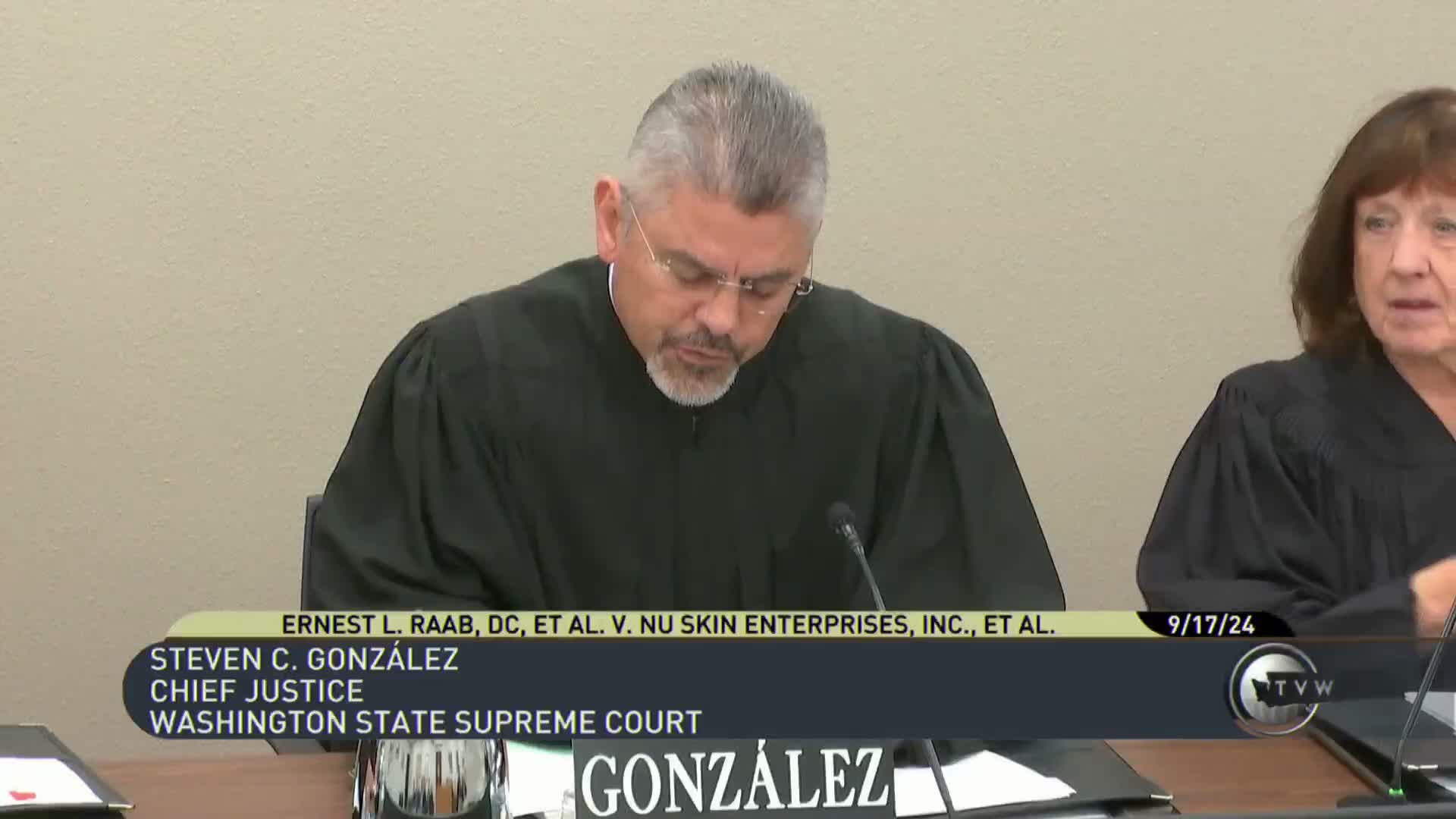
The Washington Supreme Court heard argument in Ernest Rab, DC, et al. v. Nu Skin Enterprises, a dispute over whether a contract clause requiring Utah as the exclusive forum should be enforced when plaintiffs say the agreement’s dispute-resolution provisions are unconscionable and undermine Washington consumer-protection rights.
The Washington Supreme Court on Sept. 17 heard oral argument in Ernest Rab, DC, et al. v. Nu Skin Enterprises, Inc., a case testing whether a contractual forum-selection clause naming Utah as the exclusive forum is enforceable when respondents say the contract’s dispute-resolution provisions are unconscionable and would strip Washington consumers of statutory protections.
In her opening, Lori Mazzucchetti, counsel for petitioners Nu Skin Enterprises Inc. and Pharmanix LLC, told the court the forum-selection clause “requires that Utah is the exclusive forum for all disputes between plaintiffs and Nu Skin, including disputes with respect to arbitrability,” and argued that the Court of Appeals erred by considering unconscionability challenges that petitioners contend were not properly raised below. Mazzucchetti said the proper procedural vehicle under Washington precedent was CR 12(b)(3) and that plaintiffs failed to meet the evidentiary burden required to show the clause is unenforceable.
George Arend, counsel for respondents, urged the court to affirm the Court of Appeals or, on the existing record, to hold the contract’s dispute-resolution provisions unconscionable and unenforceable. Arend said the contract contains multiple interlocking provisions — including a shortened limitations period for plaintiffs, limits on damages, constraints on discovery, a class-relief bar, and arbitration procedures respondents say favor Nu Skin — that together “permeate” the dispute-resolution framework and risk undermining Washington’s consumer-protection laws.
Justices pressed both sides on procedure and substance, asking whether the U.S. Supreme Court’s Atlantic Marine decision (addressing forum non conveniens and procedural vehicles in federal practice) controls here and whether deciding unconscionability at the interlocutory stage would improperly require factual findings best left for summary judgment or trial. Counsel for petitioners emphasized Washington precedents such as DICKS and related Court of Appeals authority that, they said, make CR 12(b)(3) the appropriate vehicle for resolving the venue or forum question. Respondents’ counsel countered that the record contains sufficient contractual evidence to resolve unconscionability as a matter of law and that remanding for further findings would waste judicial resources.
The arguments centered on two discrete questions: (1) whether Washington courts should limit review to the forum-selection clause itself at this stage, and (2) if unconscionability may be considered, whether Washington or Utah law governs the analysis — a choice the contract’s choice-of-law provision says favors Utah law. Respondents told the court that even if sent to Utah, the selected forum might be required to apply Washington law where doing otherwise would violate Washington public policy, but petitioners said the contract’s selection of Utah and related choice-of-law language constrains that remedy.
Counsel discussed precedent where courts refused to enforce forum-selection clauses because class relief would be unavailable or other statutory protections would be substantially impaired. Respondents pointed to Washington cases that denied enforcement of dispute-resolution provisions when they effectively eliminated remedies or access to the courts. Petitioners repeatedly urged fidelity to procedural rules and argued the plaintiffs did not present the required factual evidence to meet the DICKS standard.
After the exchange of questions and final remarks from counsel, the court announced the case was submitted. The court recessed for 10 minutes before returning to other business.
Next steps: The Supreme Court takes the case under advisement following oral argument; the court will issue a written opinion that may affirm, reverse, remand with instructions, or otherwise direct the lower court. No decision was announced at the hearing.