Get Full Government Meeting Transcripts, Videos, & Alerts Forever!
Get email alerts on the Initiative Scope topic
No spam. Unsubscribe anytime.
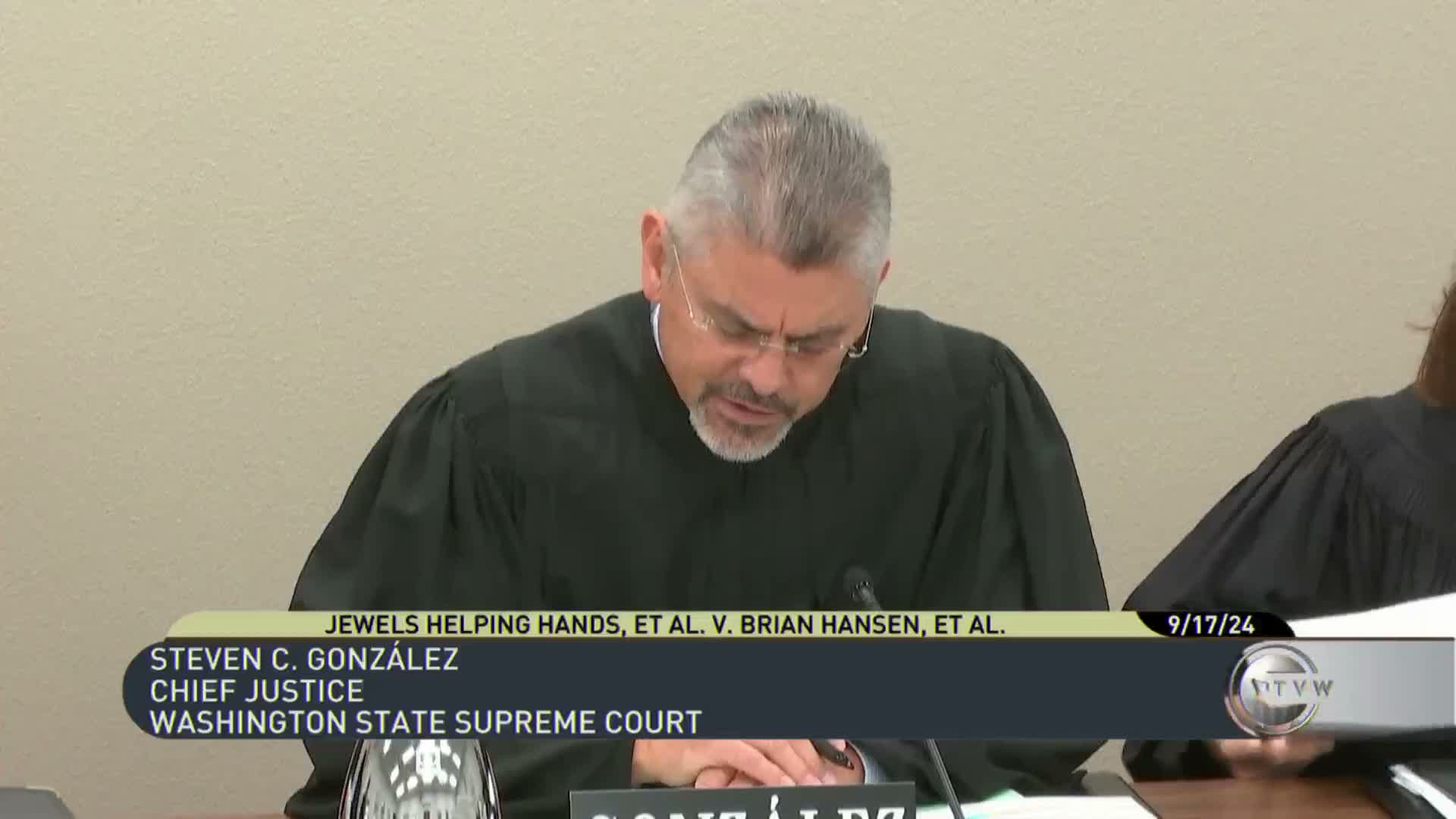
Washington Supreme Court hears challenge to Spokane homeless-camping initiative
Summary
In oral arguments Sept. 17, 2024, petitioners urged the court to strike Spokane's homeless-camping initiative as precluded by state homelessness planning statutes; respondents argued the measure is a permissible exercise of local police power and that a superior-court ballot ruling was final under RCW 29A.68.011.
The Washington Supreme Court heard competing arguments Sept. 17 over whether Spokane's voter-approved restrictions on public camping go beyond the scope of local initiative power and conflict with state homelessness-planning law.
Noel Loney, counsel for the petitioners, told the court the initiative must be overturned because it intrudes on a state-mandated, coordinated planning process that assigns final homelessness-policy decisions to local elected bodies. "We're asking the court to reverse the court of appeals and hold that Spokane's homeless camping initiative exceeds the scope of the local initiative process," Loney said, arguing the initiative fails the court's multi-part test for scope challenges.
Loney urged the justices that when the legislature prescribes a comprehensive planning and implementation scheme, that procedural allocation can preclude local initiatives and referendums on the same subject. He pointed to precedent the parties cited and told the court the homelessness statute creates a coordinated planning regime administered by state and local authorities and does not contemplate preemptive exclusion by initiative.
Mark Lamb, counsel for respondents including Brian Hansen and Citizens for Clean and Safe Spokane, framed two threshold issues: whether the superior court's expedited ballot ruling was final under RCW 29A.68.011 and whether the initiative is an appropriate exercise of the city's police power that voters may enact. "There are, first of all, two issues in front of the court," Lamb said, urging the justices to respect the trial court's final written order under the ballot-challenge statute.
On the merits, Lamb argued the initiative is narrowly targeted and practical, not an administrative takeover of a state program. He told the court the change at issue was "only 27 words" that address where camping may be enforced, and he drew a distinction between the statutory homelessness planning process and the Growth Management Act line of cases that preclude initiatives. Lamb also cited record evidence he said showed public-safety harms tied to a specific encampment, telling the court the record reflected a "65% increase in crime" in the area around that site.
Justices pressed both counsel on whether the dispute is principally procedural (finality and which forum decides) or substantive (whether the initiative is administrative in character and therefore outside initiative power). They queried how the homelessness statute's planning requirements intersect with initiative power and whether the initiative removes tools the city needs to comply with state planning and maintain eligibility for state funding.
In rebuttal, Loney reiterated that encampments fall within the homelessness act's planning scope and that the act's planning documents (including the Ruckelshaus report and multi-year local plans) address encampments and service coordination; he argued an initiative that narrows enforcement options could undermine coordinated planning and the flow of state funds to local jurisdictions.
The court took the case under submission. Two justices were recused for the argument (Justice Owens and Justice Montoya Lewis) and Judge Mann sat pro tempore for this session.