Get Full Government Meeting Transcripts, Videos, & Alerts Forever!
Get email alerts on the Upepa Application Defamation topic
No spam. Unsubscribe anytime.
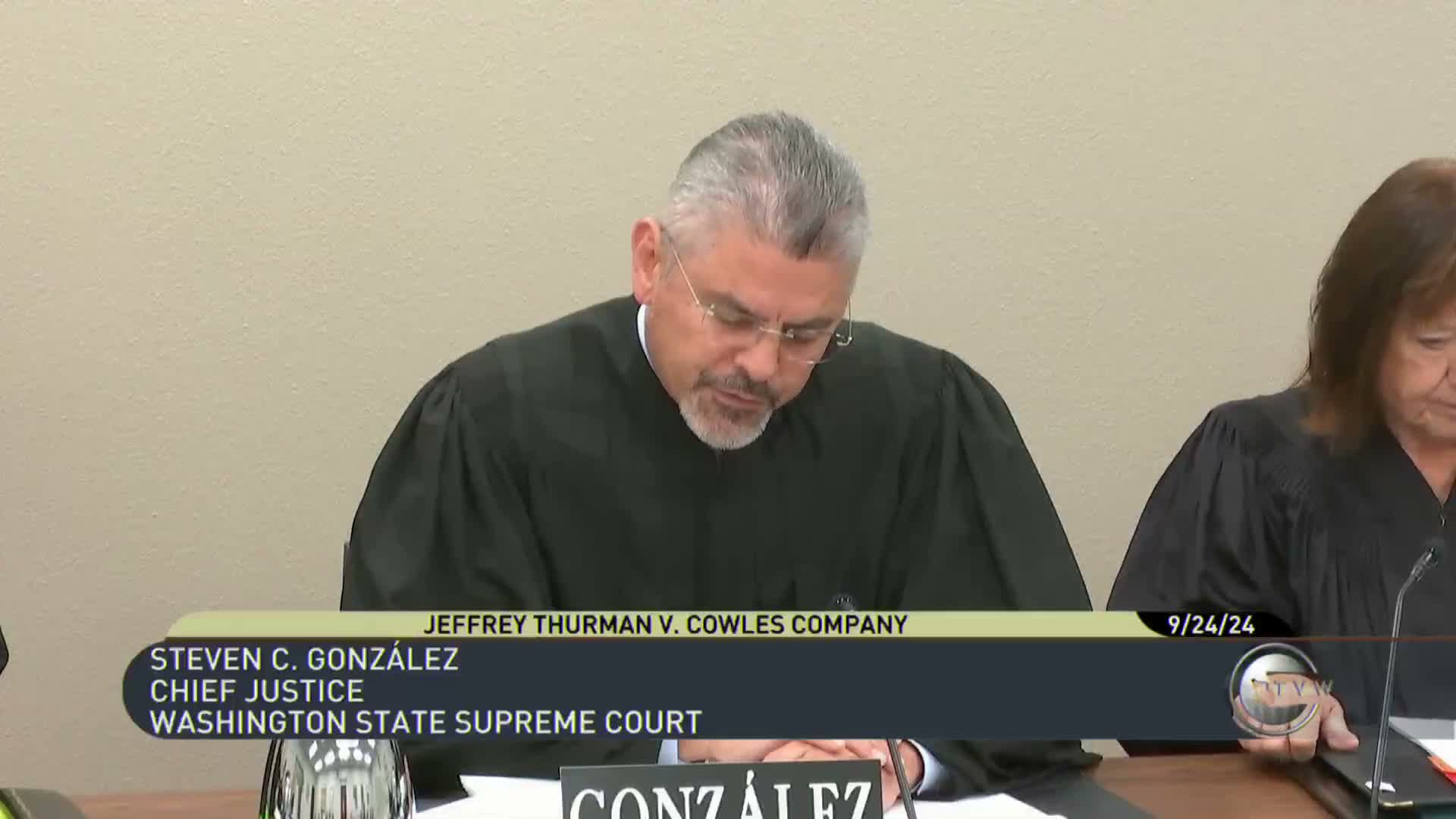
Washington Supreme Court hears arguments over scope, procedure of new anti-SLAPP statute in Thurman v. Cowles Company
Summary
At oral argument Sept. 24, counsel for petitioner Jeffrey Thurman urged the court to rule RCW 4.105 does not apply to defamation claims filed before the statute's effective date and to strike fee provisions as punitive; counsel for respondent Kohl's said amended allegations may be new causes of action subject to the 60-day expedited-review process.
The Washington Supreme Court on Sept. 24 heard competing arguments over whether RCW 4.105 (referred to at argument as UPEPA/UPPA) applies to defamation claims filed before the law took effect and whether the statute's expedited-review procedures and fee provisions undermine civil rules and petitioning rights.
Mary Schultz, counsel for petitioner Jeff Thurman, told the court she sought reversal of the Court of Appeals and reinstatement of a trial-court ruling that Thurman's defamation claims are exempt because they were filed before the statute's effective date. Schultz argued the statute is "unconstitutional on its face" because it displaces critical civil rules ' including CR 12(b)(6), CR 15, CR 26 and CR 56 ' by reversing burdens, suspending ordinary discovery, and creating immediate appellate consequences that make meaningful discovery illusory. "The statute...punishes a First Amendment petition right without any showing that the action is frivolous or sham litigation," Schultz said, arguing the fee provision chills petitioning.
Counsel for Kohl's, Casey Bruner, replied that the statute's separate clauses ' actions "filed on or after July 25" and causes of action "asserted after July 25" ' must have distinct meanings under canons of statutory interpretation. Bruner told the court that under Washington's single-publication rule, an amended complaint that adds new publications or dates can assert new causes of action subject to the statute's 60-day expedited-review window. "All of the new matters that were asserted, the new allegations of defamation should fall under the act," Bruner said, urging the court to affirm Division 3's decision.
Justices pressed both sides on how the statute interacts with the civil rules. Petitioner's counsel said Washington precedent ' including decisions cited at argument such as Stratford v. Umpqua Bank, Martin v. Washington State Department of Corrections and Davis v. Cox ' recognizes discovery under the civil rules as part of the right of access to courts, and that reading the statute to sweep in related amendments would retroactively strip vested rights and nullify amendment practice under CR 15. The petitioner emphasized practical effects: discovery responses are returnable in 30 days, stays and automatic appeals can truncate time for meaningful fact development, and the requirement to show malice in defamation claims cannot be met without discovery.
Respondent's counsel conceded the statute imposes a default 60-day timeline for expedited hearings but said courts retain authority to extend that timeline for good cause and to permit limited discovery where warranted. Bruner stressed that a defendant who receives notice of expedited relief has a right to seek that relief within the statutory period and that many alleged new publications in the amended complaint occurred after the statute's effective date.
In rebuttal, Schultz urged the court to hold the statute inapplicable to Thurman's pre-effective-date defamation claims and to invalidate the fee provision that she said punished petitioning without a finding of frivolousness. "We are asking that this court reverse both lower courts and find that RCW 4.105 is not constitutional," she told the justices.
The court took the case under advisement and recessed for 10 minutes; the justices did not announce a decision from the bench.
What happens next: the court will issue a written decision at a later date resolving whether RCW 4.105 applies to Thurman's claims, whether parts of the statute are constitutional, and what remedy (if any) should follow.