Get Full Government Meeting Transcripts, Videos, & Alerts Forever!
Get email alerts on the Noncompete Law topic
No spam. Unsubscribe anytime.
Washington Supreme Court hears challenge to broad noncompete for low-wage workers
Summary
The Washington Supreme Court heard arguments Sept. 24 in Jeremy David and Mark Springer v. Freedom Vans over whether RCW 49.62.070 bars employers from imposing sweeping noncompete clauses on lower-wage employees. Petitioners say the clause exceeds the common-law duty of loyalty; the respondent invokes statutory exceptions and record evidence of direct competition.
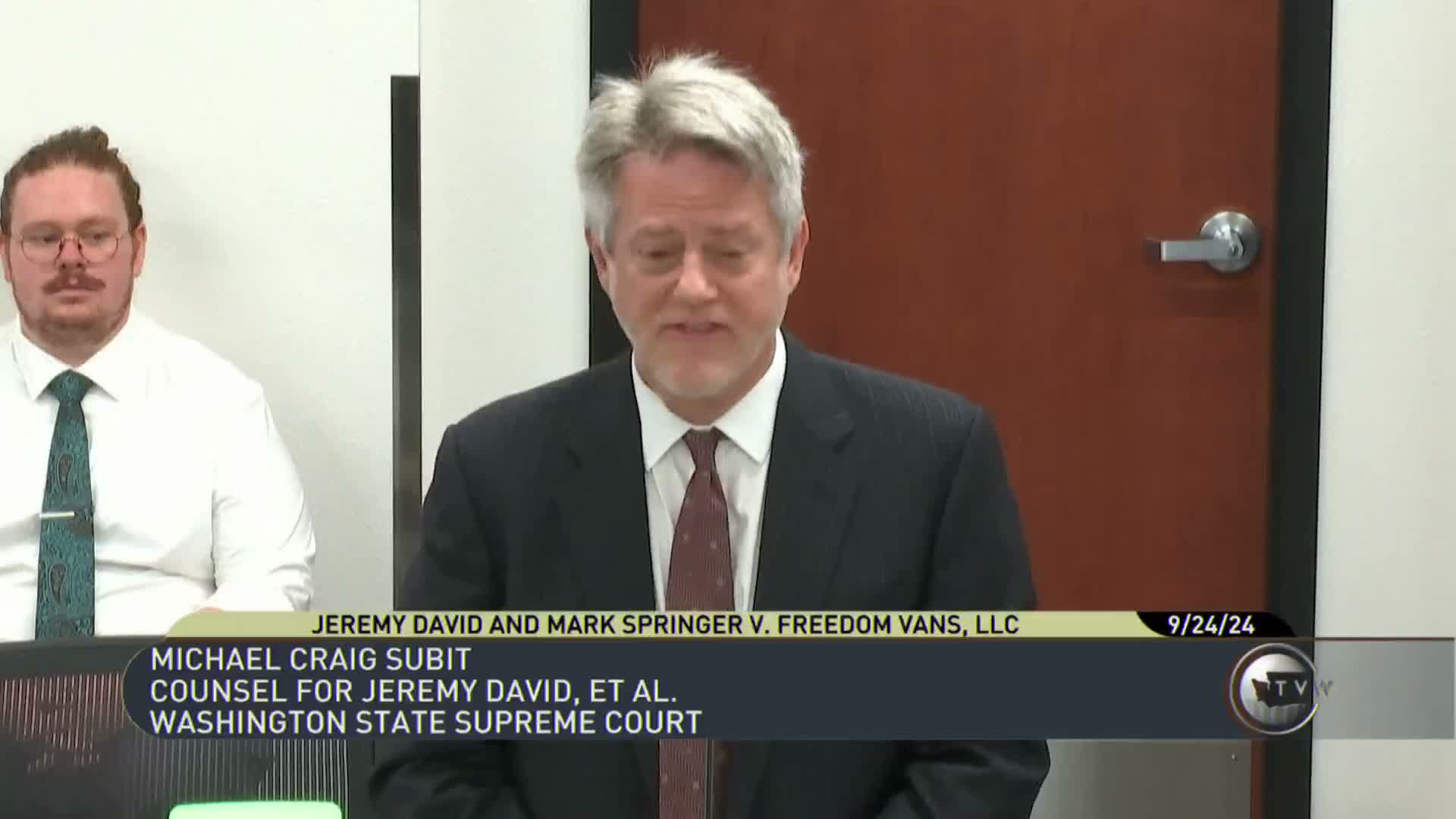
The Washington Supreme Court on Sept. 24 heard oral argument in Jeremy David and Mark Springer v. Freedom Vans, a dispute over whether RCW 49.62.070 prohibits employers from imposing broad noncompete or 'moonlighting' clauses on lower-wage employees.
Petitioners’ counsel, Mike Zubit, told the court the legislature amended noncompetition law to increase workforce mobility and that, “an employer may not restrict, restrain, or prohibit an employee earning less than twice the applicable state minimum hourly wage from having an additional job or supplementing their income,” except as provided in the statute’s limited exceptions. Zubit argued that Freedom Vans’ agreement required two employees — a carpenter and an electrician — to sign a nonnegotiable covenant barring any second job with any employer that competes with Freedom Vans, and that the agreement goes “far beyond the common law duty of loyalty.”
Why it matters: The case tests whether employers may rely on statutory exceptions to preserve common-law limitations on employee conduct, or whether the statute’s broad prohibition on moonlighting should be applied to invalidate unusually broad contractual restrictions as a matter of law. The outcome could affect lower-wage workers’ ability to take secondary employment and the scope of enforceable noncompetes for small employers.
Respondent counsel Jeff Fairchild said all three exceptions identified in the statute — the duty of loyalty, conflicts-of-interest rules, and corresponding employer policies consistent with the common law — are at issue. Fairchild pointed to declarations in the trial-court record and argued those show the petitioners intended to directly compete with Freedom Vans, a fact he said could make the agreement lawful under the statute’s exceptions. “The legislator provides examples of permissible topics,” Fairchild said, and employers may enact policies that are consistent with common-law duties.
Justices repeatedly pressed both sides with hypotheticals. One justice asked whether a low-wage fast-food worker could be barred from taking the same fry-cook job across the street; the answers diverged on whether the statute’s exceptions permit restrictions tied to the employer’s broader subject matter or only to the employee’s specific duties. Zubit argued the common-law duty of loyalty focuses on the employee’s agency and what the employee was doing; Fairchild maintained that certain subject-matter restrictions tied to the employer’s business are permissible and that reasonableness could be litigated in an as-applied challenge.
Petitioners requested reversal of the Court of Appeals and remand to the superior court. Zubit said the issue here was one of law decided on early summary judgment and that, if reversed, further factual proceedings (discovery or cross-motions) would follow. In rebuttal, Zubit reiterated that opposing counsel had “misstated the statute” and precedent and urged that the covenant be held unlawful as a matter of law under the statute’s protective construction.
The court took the arguments and adjourned. The justices did not announce a decision at the hearing; any opinion will be issued in due course.
Quotes used in this article are taken from counsel during oral argument: Mike Zubit (petitioners’ counsel) and Jeff Fairchild (counsel for Freedom Vans).