Get Full Government Meeting Transcripts, Videos, & Alerts Forever!
Get email alerts on the Ferrier Warnings topic
No spam. Unsubscribe anytime.
Justices press attorneys on whether Ferrier warnings must be given before searching fenced pasture
Summary
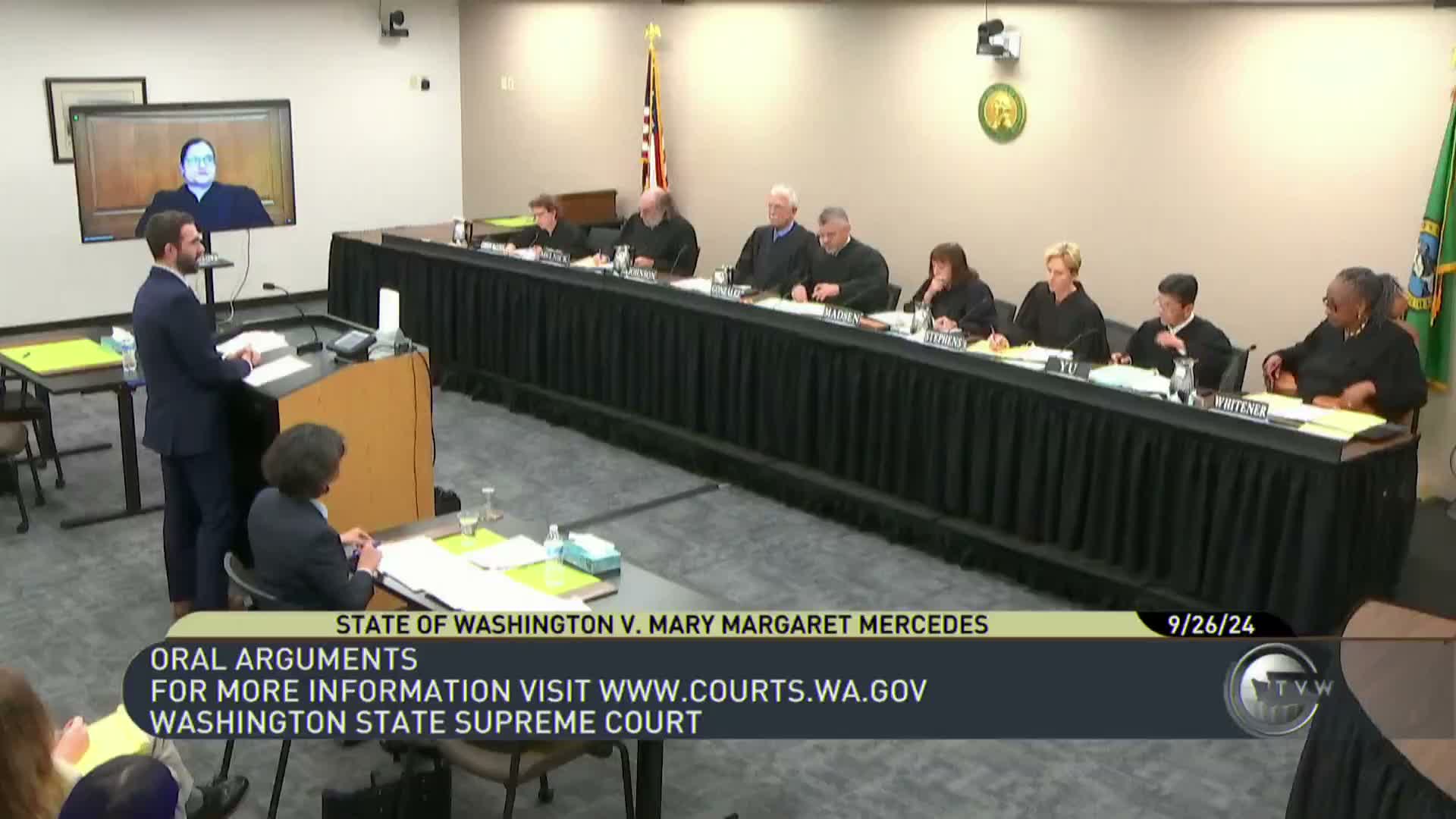
At oral argument in State v. Mercedes on Sept. 26, 2024, defense counsel Matthew Catalo urged the Washington Supreme Court to require Ferrier warnings before officers seek consent to search private fenced pastures; the state—s Amanda Campbell countered that Ferrier is limited to homes and curtilage. The justices probed how a rule would work in rural settings and whether it would encourage law enforcement to relabel investigative contacts as welfare checks.
SEPT. 26, 2024 — The Washington Supreme Court considered whether a longstanding protective rule known as Ferrier warnings must apply when police ask to search fenced private land outside a home.
Matthew Catalo, defense counsel for Mary Margaret Mercedes, told the court that "Under Article 1, section 7, miss Mercedes had a constitutional protection against warrantless searches of her private property." Catalo said officers visited Mercedes—s property on seven occasions, drove down her long driveway and, without informing her of the right to refuse or limit consent, asked to search the fenced pasture.
Amanda Campbell, deputy prosecuting attorney for Snohomish County, urged a narrower reading. "Law enforcement must provide additional warnings first" only in the knock-and-talk context tied to a home, she said, arguing the Ferrier line of cases has been limited by this court to searches implicating the dwelling and its immediate curtilage.
Why it matters: The court—s decision could change when officers must give a specific warning designed to prevent coercive consent in situations the court has previously described as especially coercive. Extending Ferrier beyond homes could require law enforcement to change practices in rural areas and on properties where owners use fences and gates to mark privacy.
What the justices asked: Several justices probed whether the court should apply a location-based rule (home/curtilage) or a broader "private affairs" approach under Article I, section 7. Justices asked whether modern aerial imagery (Google Earth, Zillow) alters privacy expectations, whether visibility from a driveway or neighbors matters, and at what point a welfare visit becomes a knock-and-talk investigation that triggers Ferrier protections.
Operational concerns: The bench repeatedly returned to practical hypotheticals: a detached garage, an attached barn, a locked gate versus an open one, and a rented pasture with no residence. Campbell emphasized a totality-of-the-circumstances consent inquiry for searches that are not classic knock-and-talks; Catalo pushed a rule that, at minimum, would require warnings where officers request consent to search private property around a house.
Representative arguments and exchange: Catalo argued the fenced pasture—s combination of locked gates, limited public view and a long driveway demonstrates a heightened privacy interest and merits Ferrier protection. Campbell responded that "the officers in Ferrier were on the curtilage when they asked for consent" and that the coercive features of Ferrier involved entry into the dwelling itself.
After oral argument the court submitted the case. The justices thanked counsel and adjourned.
Next steps: The court will issue an opinion at a later date; no vote or ruling was made from the bench at the hearing.