Get Full Government Meeting Transcripts, Videos, & Alerts Forever!
Get email alerts on the Civil Legal Aid State Plan topic
No spam. Unsubscribe anytime.
Access to Justice board highlights revised 'hallmarks', launches scoping for statewide civil legal needs study
Summary
The Access to Justice Board described a newly revised set of 14 hallmarks intended to guide equity, rural access and language services, and said the Office of Civil Legal Aid is scoping a statewide civil legal aid study and state plan that will take several months to develop.
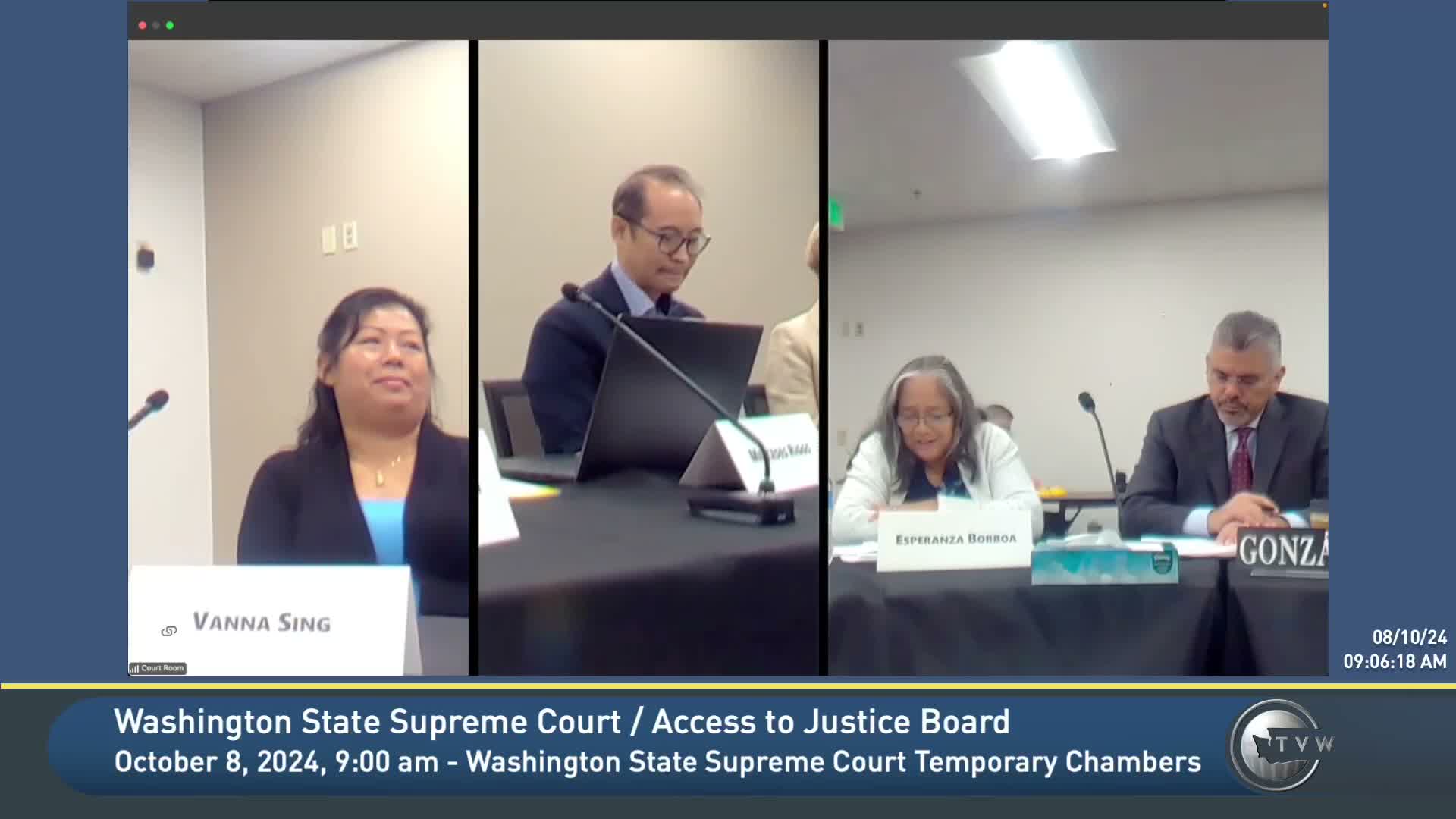
The Access to Justice (ATJ) Board presented its revised set of hallmarks and outlined a scoping process for a statewide civil legal aid study during its annual meeting with the Supreme Court.
Chief Justice Gonzales opened the session and the ATJ chair said the hallmarks — a set of 14 principles approved in January after a year of work — are meant to "foster a legal system that prioritizes equitable access, dismantle systemic racism, and embrace diversity and inclusion." The hallmarks cover topics such as continuous education, language access, trauma‑informed practices and technology guidance for courts and providers.
Why it matters: The hallmarks are intended to guide court and nonprofit practice statewide and feed into a state plan that local providers and funders are expected to use when prioritizing services.
The board said the Office of Civil Legal Aid (OCLA) is currently conducting scoping for a civil legal aid study and that the scoping phase will likely take another six to seven months before an RFP and research team are selected. "We're spending more time up front asking important questions about what we want to know," the ATJ chair said, describing efforts to avoid repeating past omissions from earlier studies (for example, gaps in capturing needs of LGBTQ, Native and disability communities).
Board members emphasized that listening sessions and outreach to rural communities—sometimes described in the meeting as "legal deserts"—informed the hallmarks. Participants said the delivery systems committee intentionally held listening sessions in rural areas and engaged local community organizations to ensure diverse input.
The board also described steps to make the state plan useful to on‑the‑ground organizations rather than a report that sits on a shelf, including working with the Washington State Center for Board Research to help design an RFP for researchers.
Fieldwork and community outreach were highlighted as central to the board's approach. One presenter summarized a recent trip to Port Angeles, noting small providers with limited staff, gaps in language access, and opportunities to strengthen coordination with tribal partners.
The meeting closed with the court and justices thanking ATJ members for their work and pledging continued support as the board moves toward finalizing values, priorities and the state plan.