Get Full Government Meeting Transcripts, Videos, & Alerts Forever!
Get email alerts on the Informant Reliability topic
No spam. Unsubscribe anytime.
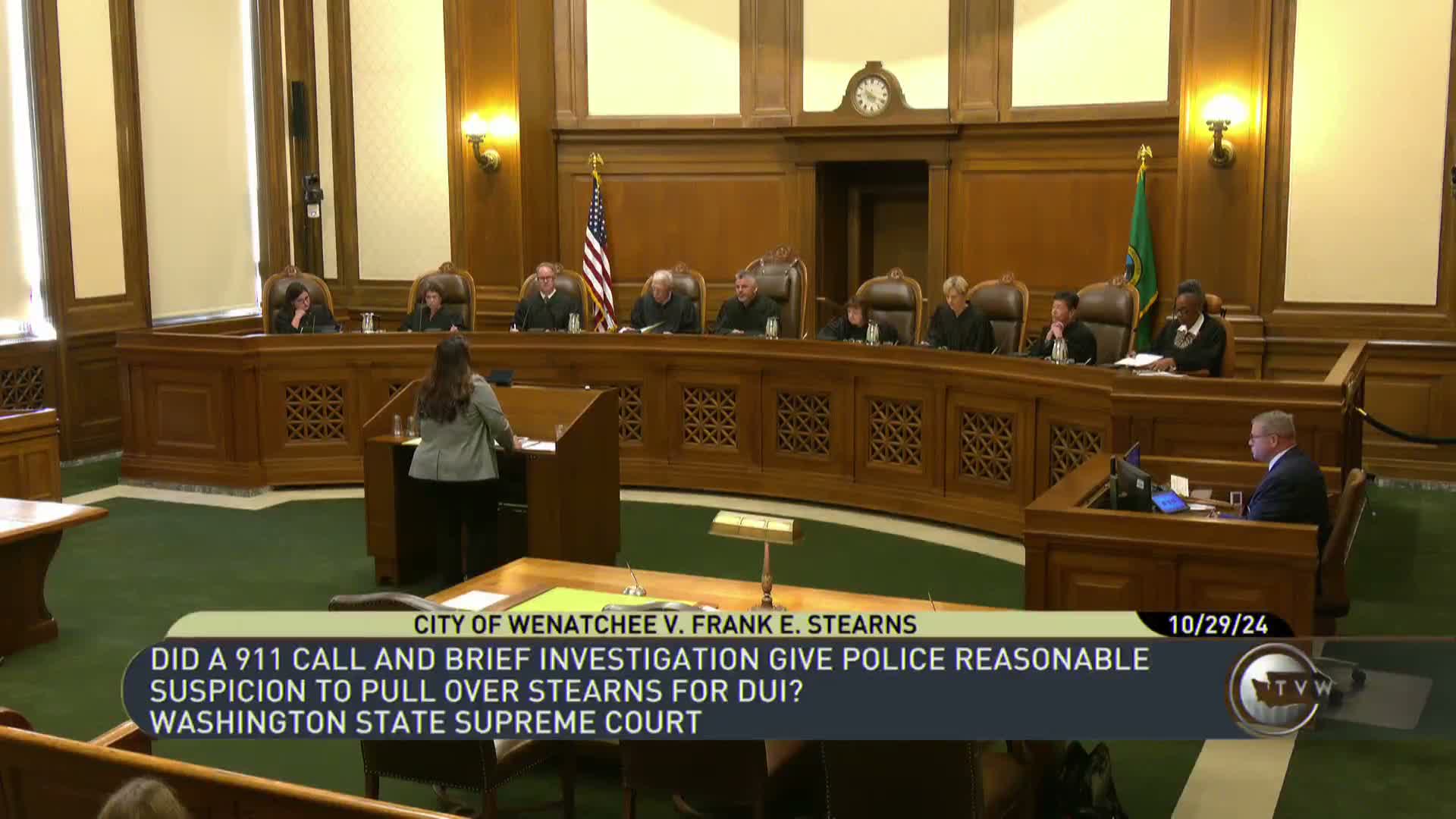
Washington Supreme Court hears arguments on whether 911 tip justified DUI stop
Summary
At a hearing Oct. 29, the Washington Supreme Court considered whether a 911 callers report that a driver was "staggering," together with observed irregular driving, supplied reasonable suspicion for a Terry stop in City of Wenatchee v. Frank Stearns. Attorneys debated the reliability of named-but-unknown 911 callers and the protection of Article I, Section 7.
The Washington Supreme Court heard argument Oct. 29 at the Temple of Justice in City of Wenatchee v. Frank Stearns over whether a 911 callers report that a driver was "staggering" provided officers with reasonable suspicion to stop the vehicle.
Danielle Marchant, counsel for the City of Wenatchee and the Wenatchee Police Department, told the court the 911 caller gave a name, location and a vehicle description and said the driver was staggering. "The staggering and the driving," Marchant said, arguing that the callers observations, combined with the officers subsequent observation of irregular driving (weaving, jerking motions and nearly hitting a curb), amounted to corroboration that supplied reasonable suspicion.
Marchant asked the justices to view the incident in light of the totality of the circumstances and public-safety interests. She pointed to precedent recognizing that suspicious or irregular driving can indicate intoxication and said the ongoing danger of drunk driving creates exigent considerations that officers may weigh when deciding whether to intervene.
Ken Miller, attorney for the respondent Frank Stearns, countered that a named-but-unknown 911 caller should not automatically be treated as reliable and urged the court to require a stronger showing under Article I, Section 7 of the Washington Constitution. Miller criticized reliance on conclusory phrases such as "he's wasted," and flagged modern concerns about malicious or misleading 911 calls, telling the court that relaxing corroboration could "call down the state's police power on anyone else anywhere at any time." He invoked state decisions including Siler and ZUE and cautioned that precedent distinguishing informant types counsels against lowering the corroboration bar.
During both sides' arguments, multiple justices pressed on the facts and legal standards. They asked whether staggering could be the product of a disability rather than intoxication, whether the officer personally observed the staggering, and whether dashcam or other video evidence in the record corroborates the officers account. The court discussed standards of review, including substantial-evidence considerations for trial-court factual findings, and the distinct tests applied in recent cases addressing 911 tips and citizen informants.
Marchant used rebuttal time to reiterate that the stop met both the tests pressed on by the court and Washington precedent, stressing multiple, discrete instances of irregular driving and urging the court to affirm the trial courts decision. The case was then submitted and the court recessed for 10 minutes. No decision was announced at the hearing.
The arguments centered on two core questions for the court: how to treat a 911 caller who gives a name but whose identity is not otherwise verified, and how to balance Washington's heightened state-constitutional protections under Article I, Section 7 against the public-safety interest in allowing officers to act on credible tips about unsafe driving. The court did not indicate a timetable for ruling.