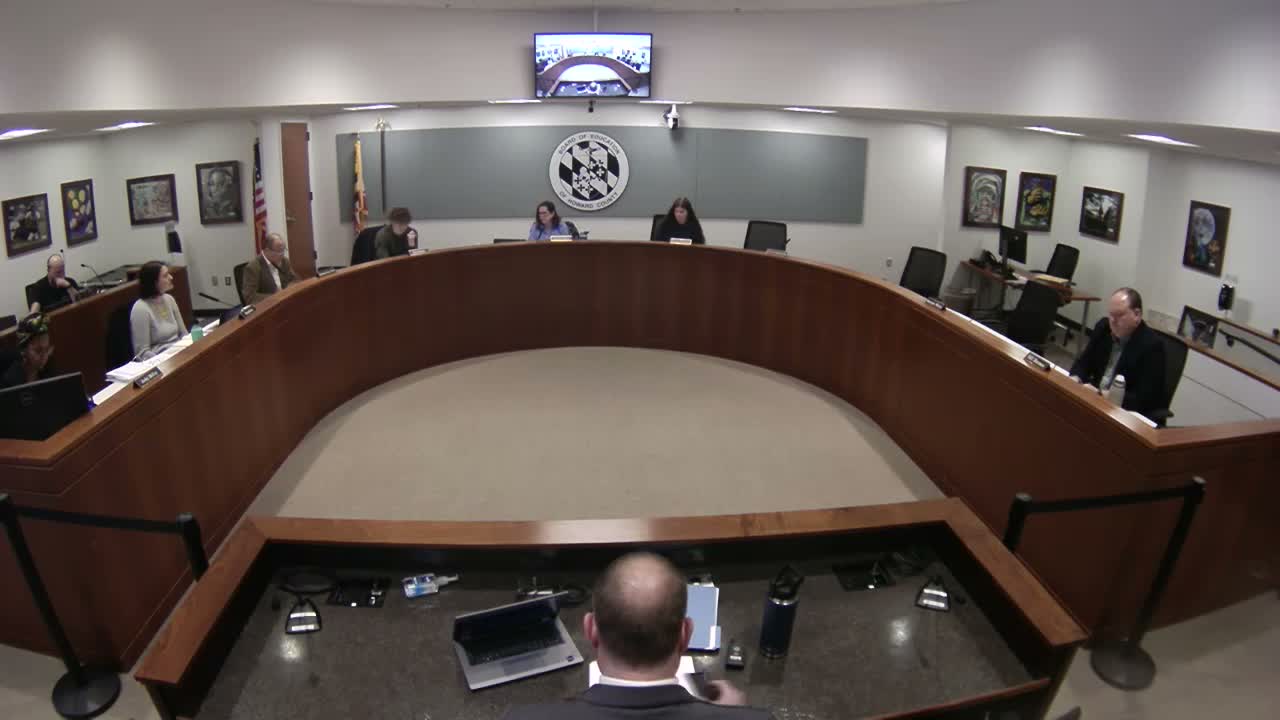
Board adopts FY27 budget basis, approves technical adjustments and restores dozens of positions
Loading...
Summary
Board adopted the superintendent's FY27 recommended budget as the basis for its requested budget, approved technical revenue/expenditure adjustments reflecting updated state and local projections, and approved a slate of restorations and additions (science paraeducators, media specialists, middle-school paraeducators, multilingual teachers, and training).
The Howard County Board of Education voted to adopt the superintendent's FY27 recommended budget as the basis for the board's requested budget, with the expectation that motions for restorations and additions would follow. The motion to adopt the budget basis was made by Ms. Watts and passed by roll call.
Staff described technical updates to revenue following preliminary MSDE and county figures: an updated state-aid estimate (presented in the work session), a removal of $993,310 in state share private pre-K tuition that will now flow directly to the county, and a small MOE (maintenance-of-effort) update tied to enrollment. The board amended the initial technical package to remove the summer-school tuition line for separate consideration, then approved the remaining technical revenue adjustments by vote.
During deliberations the board approved a series of restorations and program additions funded from the revised revenue picture and technical amendments. Notable actions included converting a previously proposed $4.0 million special-education placeholder to specific positions (19 paraeducators, 16 special-education teachers, 4 registered behavioral technicians, 2 social workers and 2 board-certified behavior analysts); the motion to convert the placeholder passed 7-0. The board also restored 14 high-school science paraeducators and later restored 14 high-school media specialists (removing 13 media paraeducators) and 20 middle-school media paraeducators; each restoration passed on roll-call votes.
Other additions approved during the deliberations included districtwide science-of-reading training ($968,850) and 20 additional multilingual English-language-development teachers ($2,224,401). The board also approved an increase to the dual-enrollment tuition budget line ($200,000) and a modest increase to operations supplies and materials ($300,000).
Interpreter pay was a separate line of discussion during the language-access presentation earlier in the session. Staff initially presented an increase from $30 to $35 per hour; later the board voted unanimously to increase contracted interpreter pay to $40 per hour, and staff said the budget office would provide precise score-sheet impacts for both central and Department of Communications budgets.
What happens next: staff will prepare score sheets and a budget resolution reflecting the board's motions for adoption of the operating budget at the board's February 26 meeting. The budget team will calculate exact revenue offsets and the final net effect of restorations and additions for final motions.