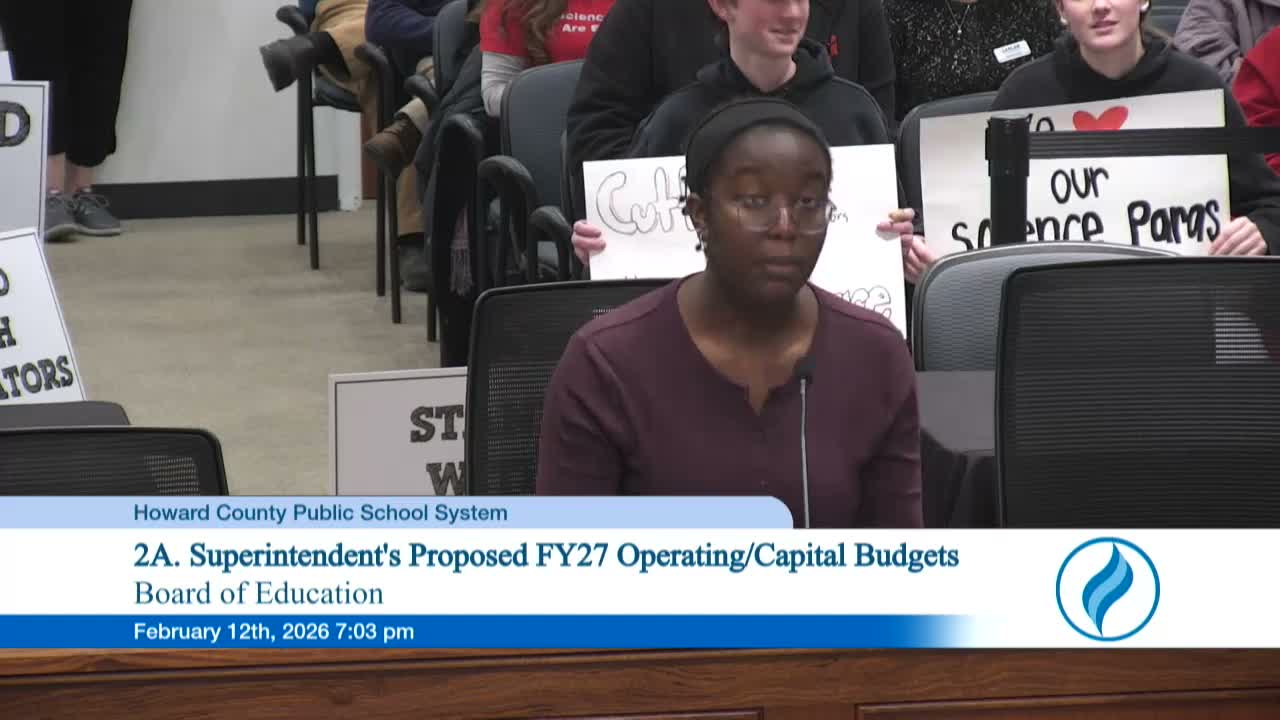
Students, educators and parents press Howard County board to restore cuts to media specialists and science paraeducators
Loading...
Summary
At a Feb. 12 public hearing on the FY27 budget, dozens of students, teachers and parents urged the Howard County Board of Education to reverse proposed cuts that would reduce high‑school media specialists and eliminate science paraeducator roles, citing library access, technology support, lab safety and equity concerns.
Dozens of students, educators and community members told the Howard County Board of Education on Feb. 12 that proposed FY27 budget cuts to media specialists and science paraeducators would damage classroom instruction, hands‑on science learning and equitable access to library and technology services.
Fatou Savage, a senior at Reservoir High School, said cutting one of two high‑school media specialists would undercut literacy and practical tech support: "Our media specialists play a crucial role in curating book talks, promoting diverse works of literature, teaching AI lessons, and educating students on how to properly and productively use these new technologies," Savage said. She told the board her school — about 1,500 students and more than 100 staff — relies daily on the two specialists for device and projector support.
Matthew Roush, a Howard High senior, described media staff as central to school culture and student wellbeing, recounting how a media specialist helped him after a personal loss. "They do more than manage resources or troubleshoot technology. They help build the culture of a school," Roush said, urging the board to reconsider cuts that "may save money in the short term, but it will cost our school far more in the long run academically, socially, and emotionally."
Students and staff also framed science paraeducators as essential to lab safety and compliance. Ryan Shaw, a Centennial High senior, said science paraeducators enable safe lab experiences that spark student interest in STEM. Multiple science teachers and paraeducators described detailed lab preparation — measuring solutions, disposing of chemical waste, and multi‑day setup for complex experiments — and warned that eliminating the positions would reduce hands‑on labs and could imperil AP accreditation for certain courses.
Jessica Stockham, a Centennial science paraeducator, and other school staff argued the paraeducator roles amount to professional lab management rather than incidental support. Stockham said the county’s 14 science paraeducator positions total "just under $1,000,000," and that eliminating the roles would redistribute responsibilities to teachers and operations staff without clear accountability.
Media and library staff provided operational data to illustrate impact. One speaker said an elementary media center managed more than 8,400 book checkouts and 345 Chromebook repair tickets last year; another reported a paraeducator's daily interactions ranged from 37 to 58 students on sampled days. Staff and parents said reduced staffing has already led to fewer book circulation opportunities and gaps in supervision for open media spaces that lack doors.
Speakers repeatedly asked the board to use improved revenue projections and fund balances cited at recent advisory meetings to restore cuts. Anthony DeBella, a community member, noted county operating revenue projections have improved and explicitly called on the board to reinstate instructional staff reductions that were proposed for fiscal reasons.
The hearing produced no vote; the board listened to testimony as it continues work on its FY27 operating and capital budget. Several speakers asked the board to prioritize student safety, restore staffing for labs and media centers, and pursue alternatives that preserve hands‑on learning and equitable access to resources.