
Library media specialists and immigration-enforcement policy draw public comment at BCPS meeting
Get AI-powered insights, summaries, and transcripts
Sign Up Free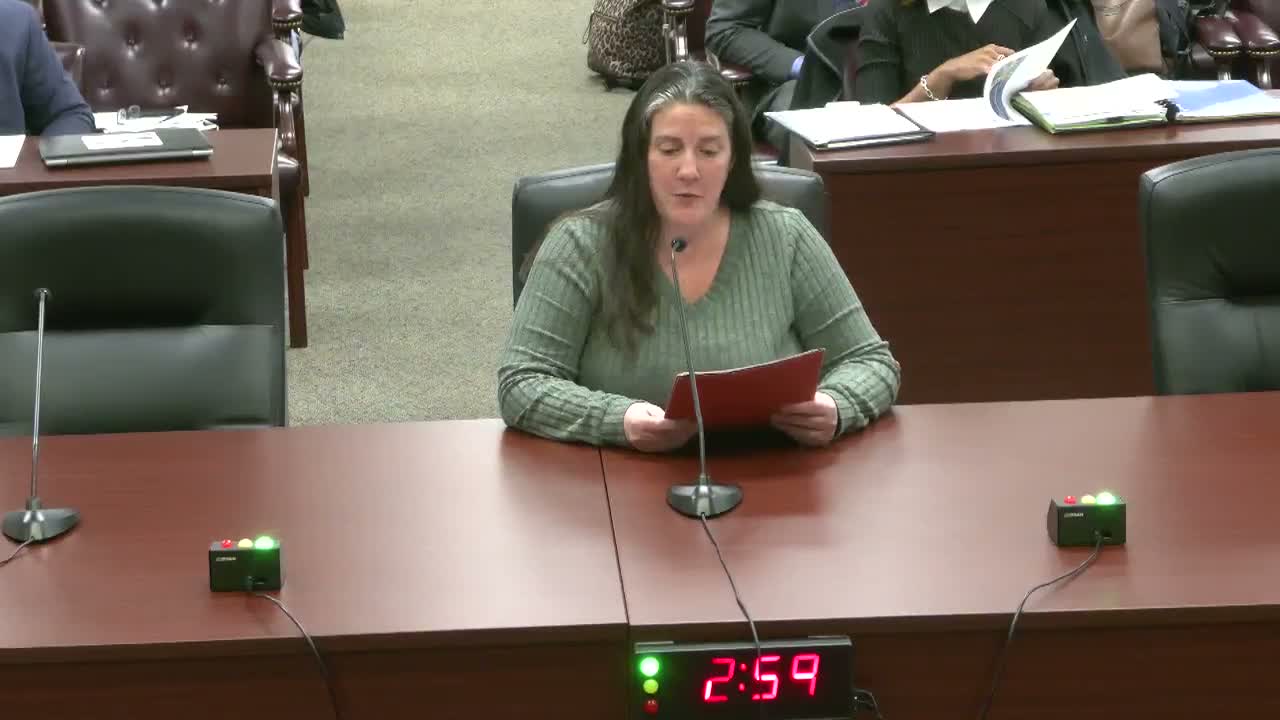
Summary
Union and parents urged the Baltimore County Board to adopt a policy limiting immigration-enforcement activity in schools and to adopt revised Policy 6-200 on school libraries that secures licensed full-time media specialists and aligns district practice with state standards.
During public comment on Feb. 2, representatives from educator groups and library media specialists urged the Baltimore County Board of Education to adopt two distinct policy priorities: clearer limits on immigration enforcement at schools and stronger protections and staffing for school libraries.
Kelly Holtz, speaking for TABCO, told the board that educators'safety and students' sense of security are threatened when immigration-enforcement actions occur near school communities. "It is not to enforce civil immigration law any more than it is to enforce criminal law," she said, urging a policy that explicitly removes schools from immigration enforcement and repeated staff training so adults know protocols when enforcement agents enter school property.
Several library media specialists and BCPS parents spoke in favor of revisions to Policy 6-200 on school libraries. Santina Genotti and Maureen Navan said the proposed policy aligns BCPS with COMAR, the Maryland School Library Media standards, the ALA Bill of Rights and the Maryland Freedom to Read Act. They argued that licensed, full-time media specialists are necessary to deliver inquiry-based instruction, uphold intellectual freedom, and ensure equitable access to resources. Genotti said similar policies adopted by other Maryland districts reduce legal and procedural risk and improve instructional consistency.
Board members did not take a final vote on the policies during the meeting; the Policy Review Committee's report recommending changes to policies 11-10, 54-70 and 6-200 was accepted for first reading and will return for subsequent consideration. Speakers and several board members requested clear implementation steps and staffing guidance if the policy is adopted, including full-time licensure and explicit procedures for handling challenges to library materials.
The board chair noted that public comment procedures remain available and that written comments may also be submitted via boe@bcps.org. The Policy Review Committee will present additional recommendations at a future meeting for the board's formal action.