Lifetime Citizen Portal Access — AI Briefings, Alerts & Unlimited Follows
Emergency manager explains earthquake risks, ShakeAlert and practical safety steps
Loading...
Summary
Brian Turbusch outlined Washington’s earthquake threats — Cascadia megathrust, deep earthquakes and crustal faults — highlighted ShakeAlert early‑warning uses and thresholds, and urged residents to practice drop, cover and hold on and to secure unreinforced masonry buildings.
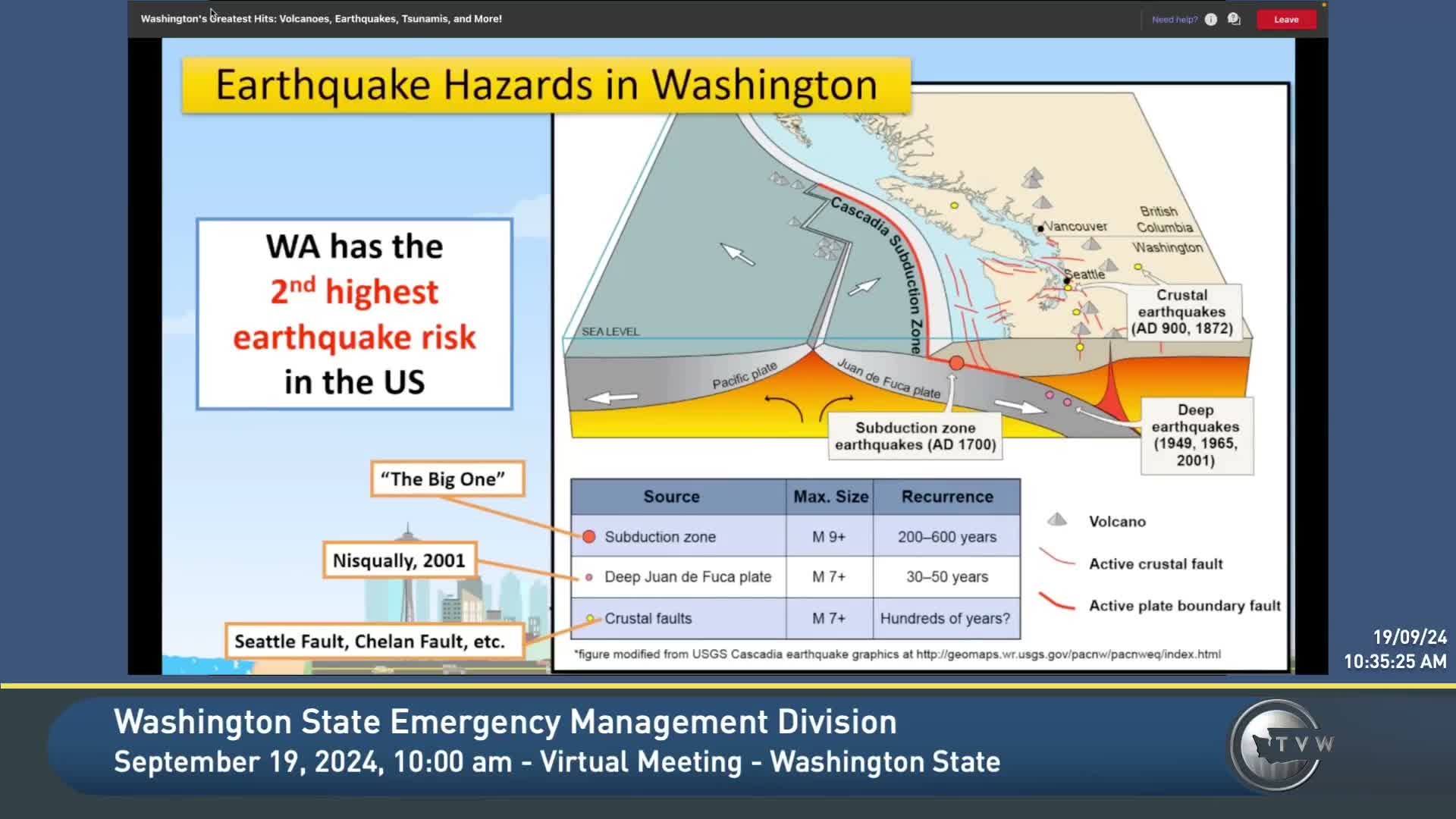
Brian Turbusch, earthquake and volcano program manager for the Washington Emergency Management Division, said Washington has the second‑highest earthquake risk in the United States and explained three primary sources of large quakes: the Cascadia Subduction Zone, deep subducting‑plate earthquakes and shallow crustal faults such as the Seattle and Tacoma faults.
Turbusch described Cascadia as roughly 700 miles long and said studies place a "15 to 25% chance" of a large Cascadia earthquake in the next 50 years. He explained that intensity (what people experience at a location) is more consequential for damage than magnitude and used the Nisqually 2001 quake as an example, noting it caused about $4 billion in damage and around 400 injuries.
On early warning, Turbusch explained ShakeAlert and how P‑wave detection can give seconds of notice before stronger shaking arrives. He said people in Washington, Oregon and California already receive ShakeAlert messages on phones if wireless emergency alerts are enabled. He recommended enabling local alerts on Apple phones, using Android’s built‑in alerts or downloading the MyShake app for test messages, and practicing responses so those seconds are used effectively.
For personal safety during shaking, Turbusch reiterated the three simple steps: "drop, cover, and hold on," and warned against running during shaking because many injuries occur when people fall. On mitigation, he noted a state effort to catalog and help retrofit unreinforced masonry buildings, citing an estimate of "anywhere between 6,030" such buildings statewide, and urged owners and jurisdictions to pursue retrofit resources where possible.
Turbusch said ShakeAlert can also be integrated into systems — slowing trains, opening elevator doors and triggering school PA systems — and that some uses require funding or installation grants. He closed by encouraging residents to learn their hazards, secure heavy items and participate in preparedness exercises such as the Great Washington ShakeOut.