Lifetime Citizen Portal Access — AI Briefings, Alerts & Unlimited Follows
State official urges preparedness for Washington’s five active volcanoes
Loading...
Summary
Washington Emergency Management Division volcanologist Brian Turbusch outlined how eruptions, ash, pyroclastic flows and lahars can affect communities, described monitoring and alert levels from USGS, and urged residents to sign up for alerts and practice evacuation routes.
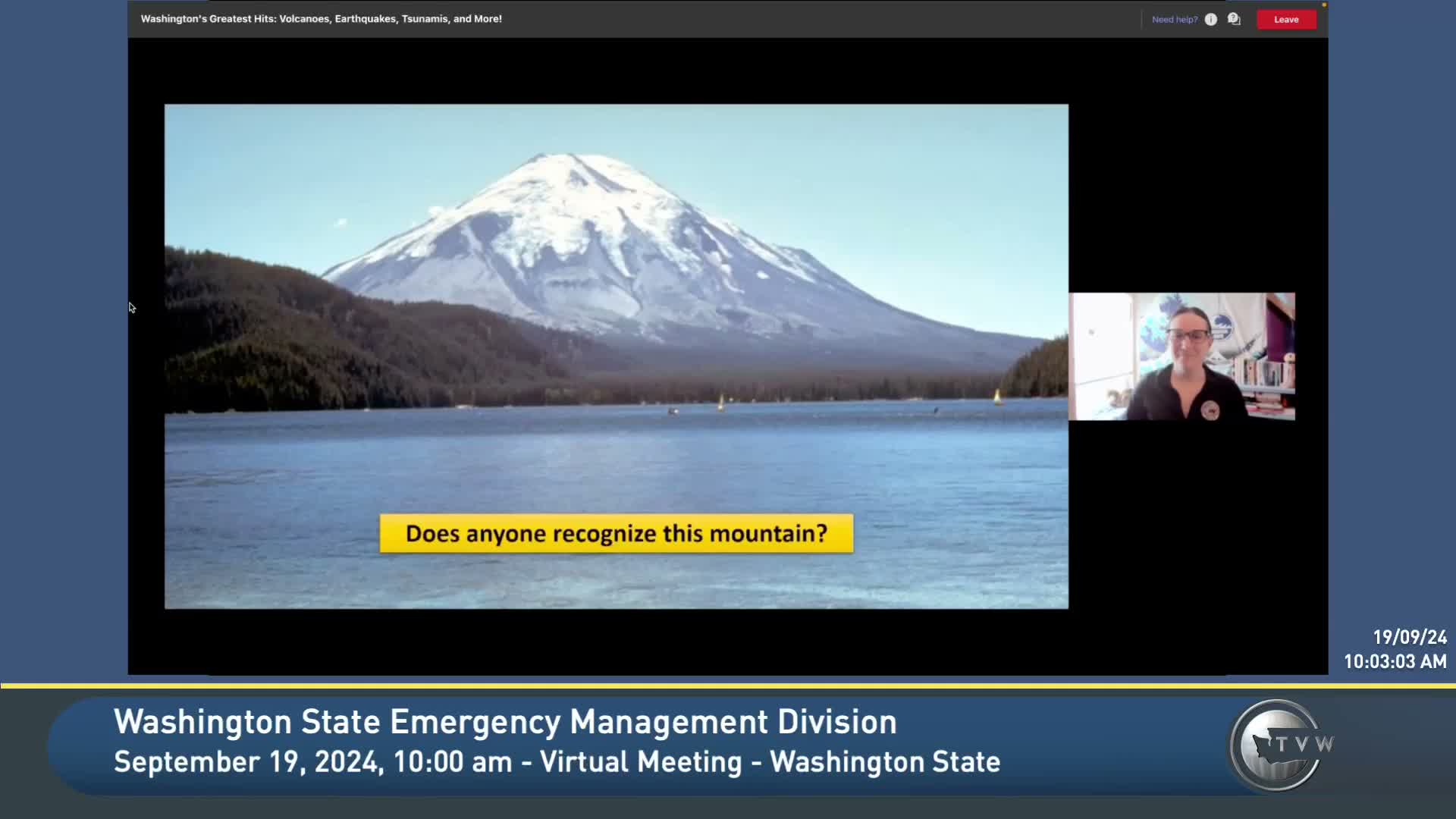
Brian Turbusch, earthquake and volcano program manager for the Washington Emergency Management Division, opened the webinar’s volcano segment by reminding listeners that "Washington has 5 active volcanoes" and by citing Mount St. Helens' 1980 eruption as an example of how dramatically a volcano can change the landscape.
Turbusch described how scientists use seismicity, GPS deformation, gas measurements and stream chemistry to detect unrest. He said monitoring typically produces days to years of warning in some cases, but emphasized uncertainty: "they [volcanoes] get really interesting because decision makers ... have to make decisions before we know exactly what's gonna happen." He recommended signing up for USGS alerts and local emergency notifications so residents and managers get timely updates.
The presentation separated near‑volcano hazards (tephra, ballistic rocks, slow but destructive lava flows, pyroclastic density currents) from downstream hazards such as lahars — fast, dense volcanic mudflows that can travel tens of miles. Turbusch warned that heavy wet ash "can collapse most roofs" if it accumulates in large amounts and that lahars can bury homes: "if you live in a lahar zone, you might not be coming back to your home." He advised evacuation to high ground when lahar warnings are issued.
Turbusch highlighted community preparedness examples, including a twice‑yearly lahar drill run by the East Pierce Interlocal Coalition that he said involved about 40,000 students and teachers. He encouraged communities to practice evacuation routes and recommended that residents follow volcano-monitoring agency guidance and sign up for free USGS volcano notifications.
The webinar linked USGS Cascades Volcano Observatory hazard maps and recommended consulting those maps to understand local near‑volcano zones and lahar-prone river valleys. The presenters also encouraged visiting national park visitor centers for local information and noted that closures of national lands during unrest serve public-safety purposes.
Turbusch closed the section by urging attendees to enjoy and learn about volcanic landscapes while also preparing for the remote possibility of renewed activity.