Get Full Government Meeting Transcripts, Videos, & Alerts Forever!
Get email alerts on the School Budget topic
No spam. Unsubscribe anytime.
District budget proposes 9-mill operating increase as ESSER funds expire
Summary
The district presented a 2024-25 budget that includes a planned 9-mill operating increase, teacher pay-scale changes and a projected $778,116 shortfall the presenter said would be covered by fund balance; the public hearing closed with a voice vote.
The district presented its proposed 2024-25 operating budget, including a plan to pursue a 9-mill increase in operating millage, as federal ESSER grants that funded positions expire in September 2024.
The presenter said the board's direction from prior work sessions is to recapture 7.6 mills left from last year and capture 1.4 mills of this year's allowable increase to reach a 9-mill increase for the operating budget. "Our ESSER funds expire in September 2024," the presenter said, noting the district must decide whether to continue positions previously funded by ESSER through the general fund or other sources.
Why it matters: the district projects $67,365,188 in revenues and $68,143,304 in proposed expenditures for 2024-25, leaving a shortfall of $778,116. The presenter said the district would use fund balance to balance the budget and pointed to a fund-balance policy that sets a floor at 17% of general fund expenditures.
Details and context: the presenter outlined how local property-tax increases are capped by the Consumer Price Index (4.12% this year) and population growth (0.49%). With a current operating millage of 222.6, the presenter said the formula would allow roughly 10.2 mills this year; combined with look-back authority the district could have up to 17.8 mills but, following board discussion, is pursuing a 9-mill increase.
The presenter explained Act 388'driven calculations for separate operating and debt-service mill values and said the district's assessed value used in those calculations is about $143,000,000. Using a roughly 94% collection rate, the presenter said one operating mill generates about $73,000 for the district while a typical teaching position is budgeted at roughly $100,000, illustrating a gap between per-mill revenue and staffing costs.
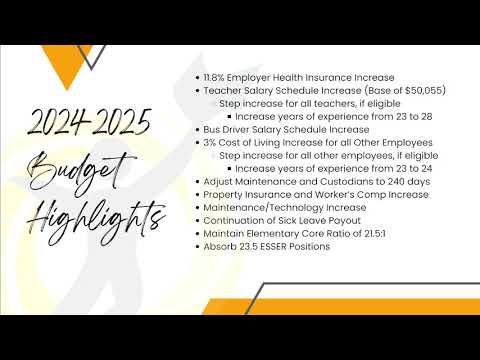
On personnel and benefits, the presenter said the board adjusted the teacher salary schedule so a beginning teacher (bachelor's, 0 years) would start at $50,055 under the proposed scale, up from $45,180 this year. The presenter added that the state increased the minimum teacher-salary schedule to 28 years and the district has adjusted its scale accordingly so long-tenured teachers move to the appropriate step. The presenter also said most other employees will receive a 3% cost-of-living increase and that bus driver and other scales will increase by one year (from 23 to 24) for step eligibility.
Benefits and costs: the presenter cited a PEBA estimate of an 11.8% increase in the employer portion of health insurance effective January 2025 and said the district had not been told of an employee portion increase. The budget also accounts for increased property and casualty and workers'compensation premiums, technology/device replacement costs, and adjustments to maintenance and custodial contract days (from 260 to 240 days).
Other allocations: the presenter listed nearly $5 million in maintenance and technology allocations within roughly $6 million in department allocations, about $558,000 in school allocations, approximately $210,000 for school resource officers (noting the district must continue funding three SROs that cannot be covered by state grants), and a little over $1,000,000 for substitute services.
Next steps and public process: the presenter said the district relied on Senate projections for state funding while the state budget remained in conference committee. The chair opened the floor for public questions, and when none were offered Miss Howell moved to close the public hearing; Mister Revels seconded the motion and the body voted "aye" on a voice vote. The chair declared the public hearing closed. The general session was slated to begin at 6:30 p.m.
Votes at a glance: a motion to close the public hearing on the 2024-25 budget was made by Miss Howell, seconded by Mister Revels, and carried by voice vote; no recorded roll-call tally appears in the transcript.