Get Full Government Meeting Transcripts, Videos, & Alerts Forever!
Get email alerts on the Lawyer Discipline topic
No spam. Unsubscribe anytime.
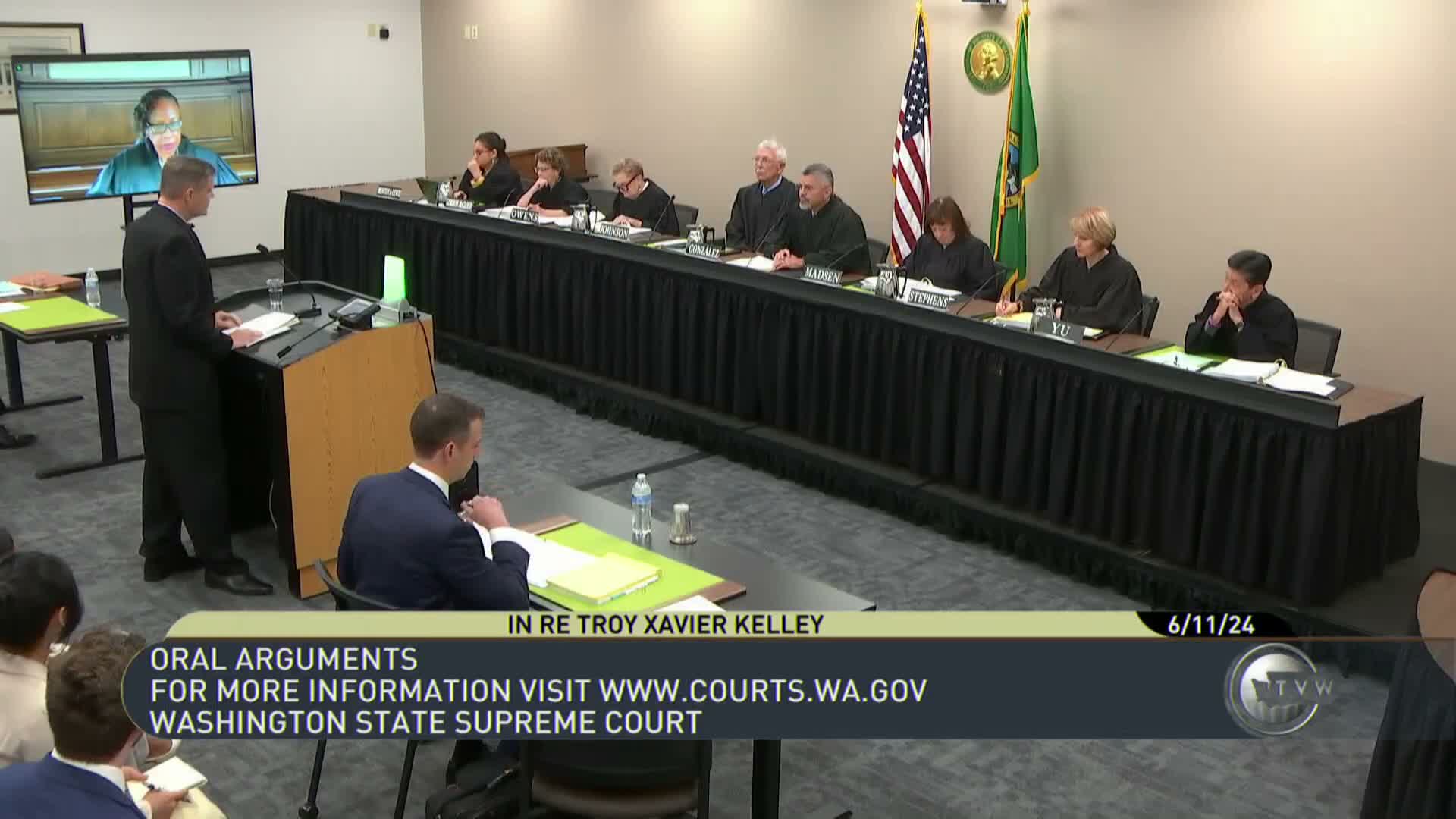
Washington Supreme Court hears arguments on Troy Kelly’s disbarment appeal
Summary
The Washington Supreme Court heard arguments June 11, 2024, over whether eight federal felony convictions require disbarment for Troy (Ray) Kelly or whether the Office of Disciplinary Counsel must present factual detail beyond a short jury verdict so a hearing officer can weigh mitigating and aggravating factors. The court took the matter under submission with no immediate decision.
Troy Kelly urged the Washington Supreme Court on June 11 to require the Office of Disciplinary Counsel (ODC) to present factual detail beyond a short jury verdict when seeking disbarment, saying reliance on a “one- or two-page jury verdict” deprives a hearing officer of meaningful discretion. "This court should hold on the narrow issue that when ODC is seeking disbarment, ODC must present more than a 1 or 2 page jury verdict," Kelly told the justices.
Ben Attanasio, appearing for ODC, responded that Kelly has been convicted of eight federal felonies, all upheld on appeal, and that the only question before the court is the appropriate disciplinary sanction. "These are crimes of dishonesty," Attanasio said, and ODC asked the court to adopt the disciplinary hearing officer’s recommendation of disbarment.
The parties focused on legal standards and the scope of the record. ODC pointed to ABA Standard 5.11(a), which creates a presumptive disbarment for convictions of certain serious crimes, and to the disciplinary hearing officer’s independent finding that Kelly acted intentionally on the counts at issue. Attanasio told the bench that, while hearing officers may consider aggravating and mitigating factors, the record here does not include evidence sufficient to reduce the presumptive sanction.
Kelly countered that particular facts behind the convictions matter for determining the proper sanction. He argued, for example, that one central dispute concerns a $125 reconveyance fee his business charged and whether the criminal case’s theory reflects theft in the conventional sense. "I did not pick up money from the deserted street," Kelly said in rebuttal, challenging prosecutorial analogies he said appeared in the federal record.
The justices pressed both sides on the record before the disciplinary board and on procedural questions about reinstatement. ODC said interim suspension time can be credited toward a disbarred lawyer’s earliest eligibility to seek reinstatement under the admissions rules (APR 25), but it cautioned that the reinstatement process before the character-and-fitness board is distinct from the disciplinary sanction determination now before the court.
Justices also questioned whether the possession-and-concealment count required proof of a higher mental state than other counts and whether the jury instructions in the criminal case (not always in the disciplinary record) show which theory the jury relied on. ODC maintained that the conviction itself operates as conclusive evidence of commission of the crime for disciplinary purposes and that the court will review the sanction de novo, applying ABA standards and weighing aggravators and mitigators.
Kelly told the court he has been under interim suspension roughly 6½ years and argued that the passage of time, restitution matters and his public-service record (including prior elective office and military service, as noted in his briefing) should be considered as mitigation. ODC replied that much of the material Kelly cites does not appear in the disciplinary record and therefore was not presented to the hearing officer for consideration.
After argument and a brief rebuttal from Kelly, the court took the matter under submission. No ruling was issued at the session; the justices will rule after reviewing the briefs and the record.
The parties and bench repeatedly framed the dispute as legal: whether the fact of conviction (particularly for counts described by ODC as crimes of dishonesty) presumptively compels disbarment under ABA guidance or whether factual context must be presented so a hearing officer can exercise discretion. The court’s forthcoming decision will determine how strictly Washington applies the ABA presumptive-disbarment standard and how much factual detail ODC must include in similar disciplinary proceedings.