Get Full Government Meeting Transcripts, Videos, & Alerts Forever!
Get email alerts on the Public Records Act Privacy topic
No spam. Unsubscribe anytime.
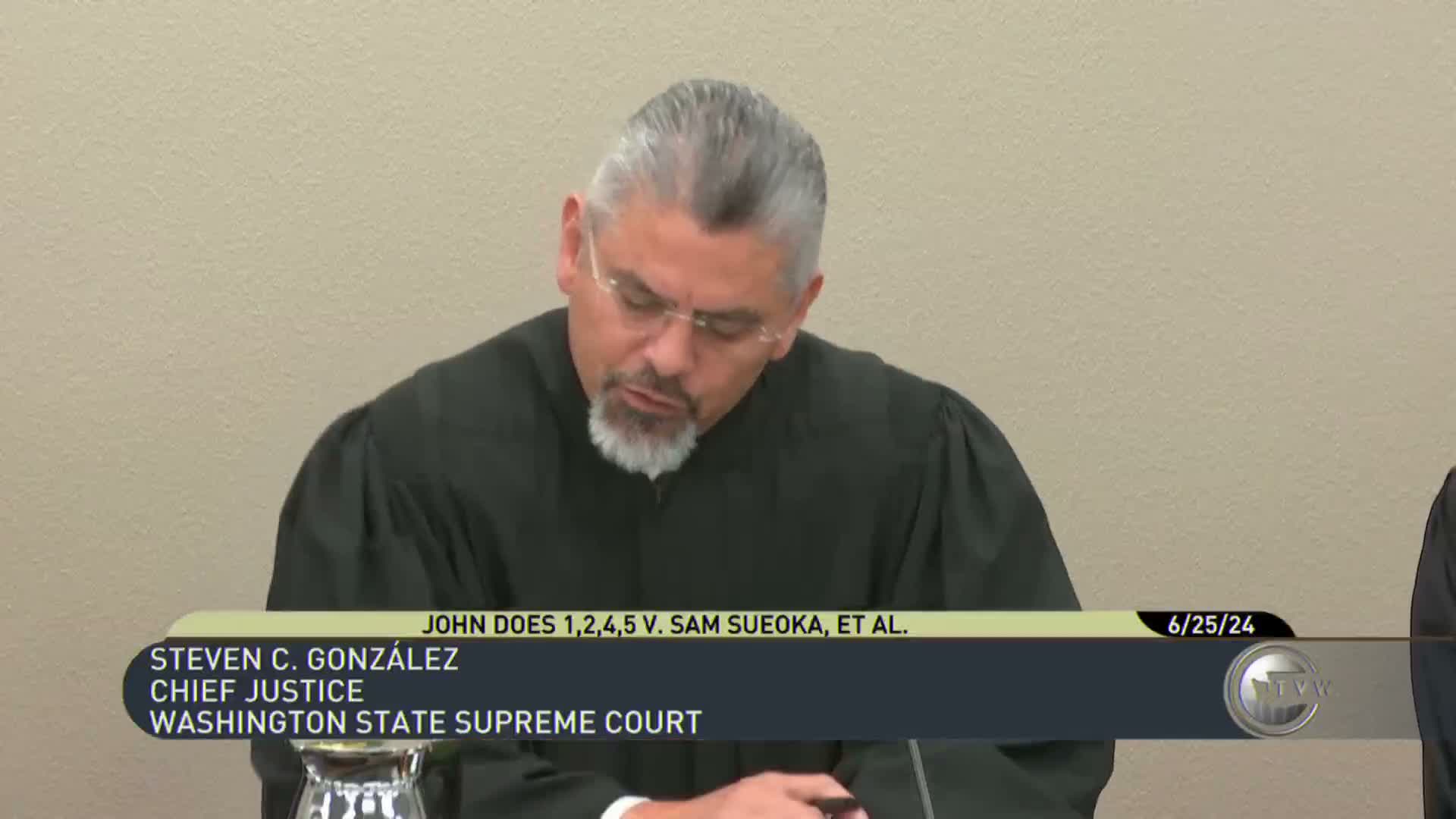
Washington Supreme Court hears arguments over whether officers’ names may be withheld under Public Records Act
Summary
The Washington Supreme Court on June 25 heard competing arguments over whether police officers who attended the January 6 rally can suppress their identities under the Public Records Act, and whether agencies must independently assert third-party constitutional rights or follow statutory third‑party notice procedures.
The Washington Supreme Court on June 25 heard argument in a dispute over whether officers who attended the January 6 rally can keep their names out of public records and how courts should apply constitutional exemptions to the state Public Records Act.
City counsel Jessica Leiser, representing the City of Seattle, told the court that the Court of Appeals erred by requiring agencies to independently assert third‑party constitutional rights and by applying strict scrutiny rather than an "exacting" standard. "First, this court should reiterate that the third party notice provision of the PRA injunction statute applies whether the potential exemption is statutory or constitutional," Leiser said, warning that the appellate approach would force agencies to choose between PRA liability and exposure under 42 U.S.C. § 1983.
The argument centers on two linked questions: when a constitutional exemption is implicated in a PRA request, who must trigger that protection (the agency or the court), and what standard of review should apply. Leiser argued agencies cannot practically make the highly fact‑intensive determinations courts make, such as distinguishing political hyperbole from a true threat, and asked the high court for clearer guidance so agencies can comply with their records obligations.
Petitioner counsel Neil Fox, representing a requester, argued that the evidentiary record does not support anonymity or a threat of targeted harassment that would justify withholding names under First Amendment precedents. Fox said the plaintiffs never sought an in‑camera review of the records and that some identifying information already appears in public sources: "The fact that they have already been named... vitiates any concerns that the release of this information will lead to targeted harassment or some sort of intimidation," he told the court.
Responding, Blair Russ, counsel for the four unnamed officers, said the officers were compelled to report attendance under threat of termination and that compulsion matters: the officers "were compelled because they were required to participate in investigation under threat of termination," Russ said, arguing that compelled disclosure changes the legal analysis and that Office of Police Accountability investigatory materials enjoy confidentiality interests that weigh against routine disclosure.
Justices pressed both sides on fine distinctions: whether attendance at a public demonstration strips a person of any privacy interest; whether the PRA record is the only appropriate factual universe for deciding exemptions; and whether the constitutional analysis should be folded into ordinary PRA review or handled separately. Several justices asked counsel to identify the specific information at issue and whether redaction or in‑camera review had been pursued.
Counsel acknowledged overlapping arguments. Respondents said they sought a preliminary injunction and remand so the trial court could preserve the status quo while privacy and First Amendment claims were evaluated; petitioners urged a stricter evidentiary showing of harassment or adverse consequences before anonymity relief would be appropriate.
The case raises potential implications for agencies beyond Seattle: if courts require agencies to make independent constitutional determinations in responding to PRA requests, counsel warned that agencies could face conflicting statutory and constitutional liabilities and repeated litigation. The court recessed for a 10‑minute break after the arguments; no decision was announced at the hearing.
Next step: the court will consider the briefs and oral arguments before issuing a written decision that could clarify whether and how constitutional anonymity claims are resolved in PRA litigation and whether redaction, in‑camera review, or statutory exemptions provide adequate protection for compelled disclosures.