Get Full Government Meeting Transcripts, Videos, & Alerts Forever!
Get email alerts on the Indigent Defense Caseloads topic
No spam. Unsubscribe anytime.
Washington Supreme Court hearing draws sharply divided testimony on proposed public-defense caseload standards
Summary
At a public hearing in Thurston County, defenders, prosecutors, county and city officials, and victims gave contrasting accounts of proposed revisions to the court's indigent defense standards — defenders urged adoption to reduce burnout and protect clients'rights, while local governments and prosecutors warned the changes would be unaffordable and worsen staffing shortages without state funding and further study.
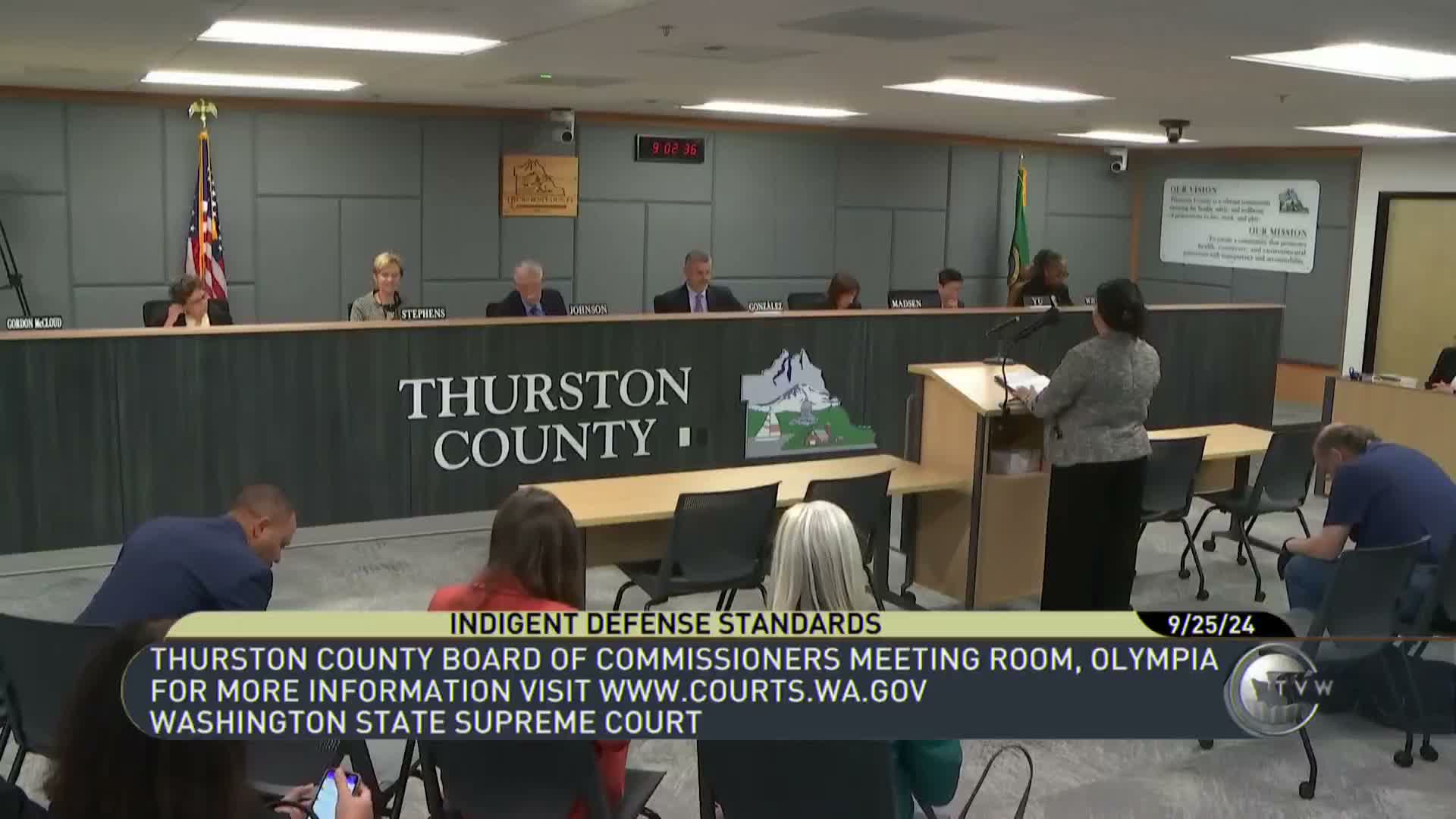
The Washington Supreme Court convened in Thurston County to gather public comment on proposed revisions to the court's indigent defense standards, including lower weighted caseload limits for public defenders, revised qualification and certification rules, and minimum staffing supports for both attorneys and non-attorney staff. The hearing included presentations by the Washington State Bar Association (WSBA), the Office of Public Defense (OPD), state and local associations, prosecutors, and hundreds of individual commenters.
The WSBA's president, Sunitha Angelvel, told the court the Bar adopted updated standards after more than two years of study and stakeholder engagement intended to ensure public defenders can meet constitutional and ethical obligations. "The WISBA board takes seriously the constitutional obligation to provide adequate legal counsel to anyone facing a criminal charge," Angelvel said. WSBA materials and presenters relied on the RAND National Workload Study and on a Washington-specific review by the Bar's Council on Public Defense to recommend a weighted-case model rather than a flat-hour assumption for all felonies.
Supporters of the changes — including public defenders and OPD Director Larry Jefferson — framed the proposals as necessary to stop a cycle of attrition and substandard representation. Jefferson said the standards are "a day for history" and that the state has long underfunded public defense staffing and support roles. "This crisis is an opportunity to give promise to Gideon's promise," Jefferson said, urging adoption with an implementation plan and jurisdiction-level action plans compiled by OPD. Several frontline defenders described crushing workloads: one public defender said a recent 10-week intake amounted to the equivalent of nearly a year's work, and multiple speakers described routine evenings and weekend work to keep cases moving.
Opponents — including county and city associations and prosecutors — argued the proposals would shift undue costs to local governments and risk public-safety consequences if jurisdictions could not hire enough attorneys. Derek Young of the Washington State Association of Counties said current state funding covers only about 3% of local public-defense costs and warned the proposals could "double or triple county costs" without a state funding commitment. Russell Brown, executive director of the Washington Association of Prosecuting Attorneys, asked the court to reject the proposed rules or require a Washington-specific caseload study, calling the RAND report a national survey that does not substitute for a targeted state analysis.
Municipal and rural officials stressed uneven workforce capacity across the state. Deanna Dawson of the Association of Washington Cities told the court the proposed changes could require hiring thousands of new attorneys statewide and estimated cities alone could face hundreds of millions of dollars in additional annual expense. Several small-county representatives said that in their jurisdictions there are too few criminal practitioners available to staff expanded defender rosters.
Commenters also raised consequential secondary questions: whether the court's standards should be phased in more slowly; whether implementation can be tied to reliable, statewide data collection; and how to ensure that non-attorney supports (investigators, social workers, paralegals) are funded and available. OPD proposed an approach that ties phased implementation to written "public defense action plans" filed by jurisdictions, with annual performance metrics and accountability reporting.
Speakers representing victims and law enforcement warned of unintended consequences, including fewer felony filings or more dismissals if jurisdictions cannot staff prosecutions to match lower defender caseloads. Prosecutors emphasized that charging decisions are not controlled by counties' budget choices and said any change in caseload standards must consider how court processing and diversion resources would shift.
Chief themes that emerged were funding, workforce, and timeline. Proponents argued that without enforceable standards and staffing ratios the state is continuing a long-term under-resourcing of constitutional defense that damages clients and defenders; opponents argued that adoption without a credible funding plan and Washington-specific data would create fiscal and operational instability and recommended further study and a longer phase-in.
The court accepted oral testimony across many speakers and reminded participants that written comments remain open through the formal comment period. Justice Yu, chair of the rules committee, said the comment period ends Oct. 31 and announced a follow-up hearing scheduled for Nov. 13 at the Temple of Justice. The court made no decision at the hearing.
What happens next: the court invited written comments responsive to points raised at the hearing and plans another public hearing; any final rule change would require the court's internal deliberation and, if adopted, a clearly articulated implementation plan tied to the funding and monitoring mechanisms discussed at the hearing.