Get Full Government Meeting Transcripts, Videos, & Alerts Forever!
Get email alerts on the Superintendent Evaluation topic
No spam. Unsubscribe anytime.
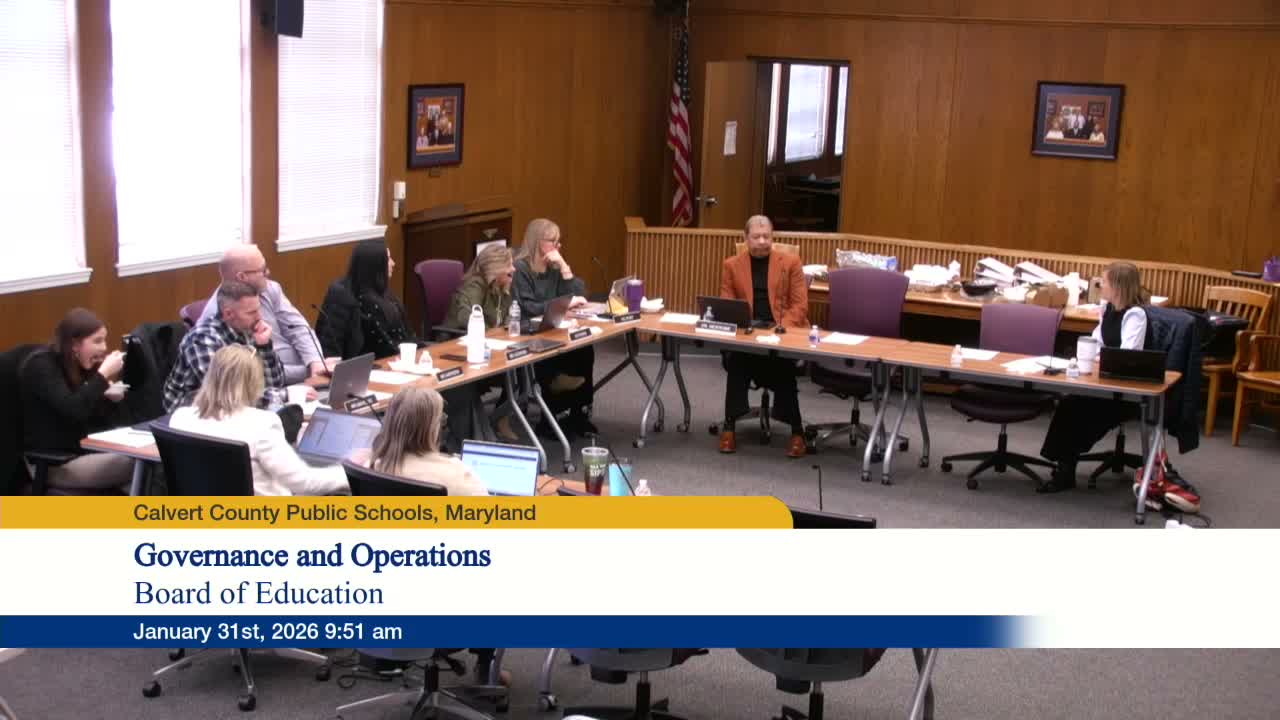
Calvert County board retreat outlines superintendent evaluation template and March check‑in
Summary
At a March 2 board retreat, Calvert County Public Schools trustees agreed to develop a measurable evaluation template for Interim Superintendent Marcus Newsome, set a March open discussion for evaluation metrics and favored periodic check‑ins rather than a single annual review.
At a board retreat on March 2, the Calvert County Public Schools board agreed to develop a durable, measurable evaluation template for Interim Superintendent Marcus Newsome and to take up a public discussion of evaluation metrics in March after budget season.
Facilitator Molly from the Maryland Association of Boards of Education urged the board to focus on the conversation and the process rather than only the form of the tool. "The conversation is the most important part," she said, describing the evaluation as more than a checklist and urging regular check‑ins during the year rather than a single annual rating.
Why it matters: Board members said the previous evaluation instrument was too broad and lacked specific, measurable criteria. Trustees signaled they want an instrument that can be used across administrations but whose annual metrics can change to reflect priorities in the strategic plan. During the retreat members discussed goal areas the superintendent proposed — student achievement, Blueprint for Maryland's Future implementation, succession planning, staff morale, family and community engagement, fiscal responsibility and operational efficiency — and debated how to translate those priorities into SMART metrics.
What the board said: Several trustees argued that a template should be durable but allow annually updated metrics recommended by the superintendent and discussed in public. One member said the old form was "very overarching, not very specific" and lacked measurable calibration. Another suggested that the superintendent propose a draft of metrics as a starting point: the board would then review and adjust them in open session.
Process and timing: Members favored a March conversation about the instrument and calendar, with periodic check‑ins (options discussed included quarterly or semiannual reviews). Molly recommended that the superintendent propose suggested metrics and that the board document the cadence and the evidence the superintendent should provide at each check‑in so expectations are clear.
Documentation and fairness: Trustees emphasized the need for documentation so a superintendent is not surprised by end‑of‑year judgments. The group discussed using qualitative and quantitative evidence — for example, surveys for staff morale and progress monitoring data for academics — and fitting documentation into the agreed cadence.
Next steps: The board agreed to discuss a draft instrument and metrics in March; staff and an executive team will prepare supporting evidence and suggested metrics ahead of that meeting. A subsequent formal evaluation timeline will be adopted after those March discussions.
The retreat moved to a closed session after the public portion concluded.