Get Full Government Meeting Transcripts, Videos, & Alerts Forever!
Get email alerts on the Therapy Dogs Policy topic
No spam. Unsubscribe anytime.
Waunakee policy committee discusses therapy-dog policy, plans pilot at Heritage Elementary
Summary
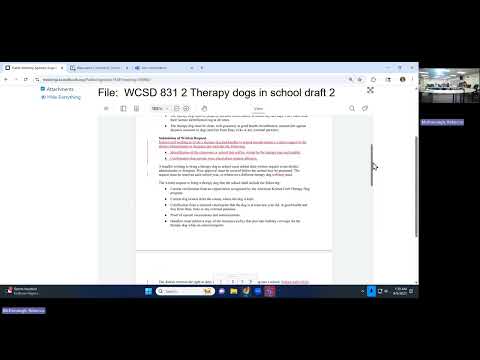
The Waunakee Community School District policy committee reviewed a draft therapy-dog policy on Aug. 8, discussing AKC certification, liability, handler requirements and family notifications; administrators proposed a pilot with Heritage Elementary co-principal Emily Morehouse’s certified dog and agreed to edit the draft for follow-up.
The Waunakee Community School District policy committee discussed a draft therapy-dog policy at its Aug. 8 meeting and signaled support for a limited pilot at Heritage Elementary, where co-principal Emily Morehouse has a certified therapy dog.
A presenter told the committee that the policy provides "a very specific definition of what a therapy dog is and what it is not" and establishes a district-level approval process so decisions are consistent across buildings. The presenter said the policy aims to "start" in one building as a pilot rather than allow dogs in every school every day.
Committee members identified three central issues for the draft: liability and insurance, health and allergy procedures, and handler responsibility. Steve summarized the district insurer's guidance, saying, "there is no exclusion for dogs on the school district's liability policy," but added that dog owners remain responsible for damage or injury and that the district should request a copy of the handler's insurance before visits.
Health and safety procedures were described as already in place. The presenter noted the district's nursing staff knows which students have allergies and that "we would proceed accordingly," saying some spaces would be excluded if a student had a significant allergy.
Members pressed for clarity on how many dogs would be allowed and how visits would be scheduled. A committee member asked whether the policy should cap the number of dogs in a building; the presenter said the approval process would control that and that "on our typical day" the district would likely have one dog in a given space, while larger, one-day events can involve multiple dogs on rotation.
Several members raised concerns about who must handle the dog if the named handler (Emily Morehouse) is called away during the school day. The presenter and other members agreed the draft should add flexibility allowing a trained alternate handler and that administrators should check the handler's insurance terms to see whether coverage requires the handler to be present.
On program costs, a staff member said volunteers who bring therapy dogs "have no fee" in the examples they have used, indicating the district is unlikely to incur direct fees when volunteers provide the service.
Administrators and committee members agreed to edit the draft policy language to clarify handler flexibility, notification procedures for families, and documentation requirements for handlers' insurance. The committee did not record a formal adoption of the policy during the meeting; members agreed to refine the draft and proceed with the proposed approval process and pilot planning. The meeting adjourned following a motion and second.