Get Full Government Meeting Transcripts, Videos, & Alerts Forever!
Get email alerts on the School Budget topic
No spam. Unsubscribe anytime.
Platteville School District outlines $22.2 million draft budget; Nov. 5 referendum to determine balance
Summary
Business administrator Dimitri Andrews presented a draft 2024–25 budget projecting $22.2 million in expenses, outlined two mill-rate scenarios tied to a Nov. 5 operational referendum, and described enrollment, revenue sources and planned maintenance/security upgrades.
Dimitri Andrews, the Platteville School District's business administrator, presented the district's draft 2024–25 budget, saying the district projects about $22.2 million in expenses and that an operational referendum on Nov. 5, 2024, will determine whether revenues will match those expenditures.
Andrews told attendees the referendum outcome will determine whether the general fund can be balanced: “If voters approve it, we can expect to achieve a balanced budget,” he said; “however, if the referendum does not pass, we'll face a potential deficit.” The presentation shows a scenario in which the district's proposed mill rate would be about 7.02 per $1,000 of equalized value if the referendum passes and about 7.05 if it does not, compared with last year's 7.59.
Why it matters: The district said rising costs, particularly staff wages and benefits, have put pressure on recurring revenues. Andrews said staff wages and benefits make up the largest portion of the budget and noted last year the board approved a 2 percent salary increase while health insurance costs rose about 6 percent.
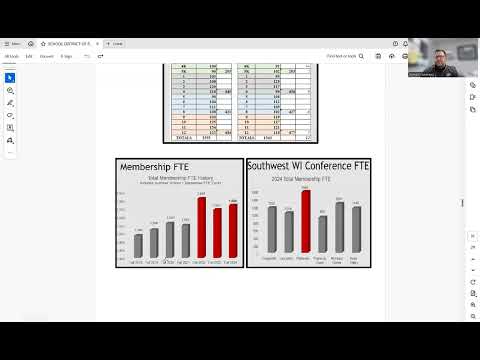
The presentation included revenue and enrollment details. Andrews said equalized state aid increased roughly 7.5 percent and that, depending on the referendum scenario, general fund revenue growth ranges in the booklet's tables. For funding purposes the district's membership is listed at 1,570 students this year (an increase of 17 compared with the prior-year membership average of 1,553). Andrews separately noted a plain headcount change of a dozen students compared with last year.
The district reports a projected revenue limit of $18.2 million for 2024–25 and a revenue mix of roughly 31 percent property taxes and 69 percent state aid. Andrews said the district has increased its fund balance to prepare for potential shortfalls and that fund balance should be used for one-time expenses rather than recurring costs; this, he said, is a central reason for seeking recurring operational authority from voters.
Operational and capital notes: The booklet shows planned maintenance and operations upgrades including additional security cameras, secured glass and technology for new spaces, and calls out increased property and business insurance costs. Andrews said part of the district's ability to hold the tax amount steady stems from recent debt management: the district paid off part of its debt in April 2024 and made early payments on other obligations, producing interest savings.
Other budget details: The presentation lists the district's major funds (fund 10 general, fund 21 special projects, fund 27 special education, funds 38/39 debt service, fund 49 capital projects, fund 50 food service and fund 80 community service). Andrews said fund 80 supports items such as a weekend custodian, the community resource officer and a crossing guard, and is budgeted this year at $80,000.
Next steps: No formal vote was taken at the hearing. The district emphasized Nov. 5, 2024, as the decisive event for the operational referendum; Andrews encouraged community engagement ahead of that ballot measure and closed the presentation with an invitation for questions.