
Westerville staff give board a status update on 2019 bond projects and facility master plan
Get AI-powered insights, summaries, and transcripts
Sign Up Free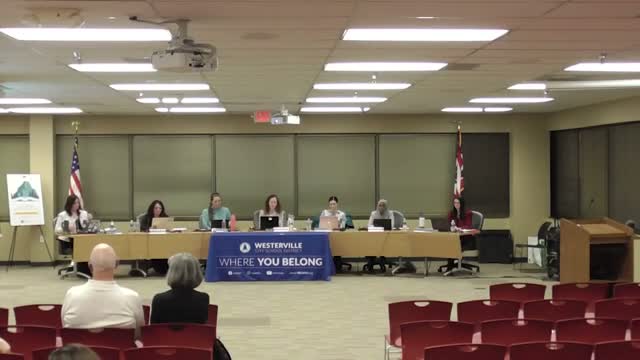
Summary
District facilities staff told the board they have completed multiple bond-funded school renovations and security upgrades, flagged roughly 8,000 square feet at South High School still unrenovated, and said the district may be eligible for state CFAB funds that would cover about $0.35 on the dollar of eligible work.
Carrie Dennis, a member of the district facilities team, told the Westerville City Board of Education the presentation updated the board on the status of projects funded by the 2019 capital improvement bond and on the district’s facility master plan.
Dennis said the district’s 2017 facilities master planning committee—19 community members, staff, parents and business partners—helped shape a plan informed by a public “thought exchange” that involved just under 1,700 participants and yielded more than 51,000 ratings. “This thought exchange had, just over just under 1,700 participants, but they did provide over 51,000 ratings,” Dennis said, describing how community feedback guided early priorities.
Doug, another facilities team member who led the project walkthrough, said the master plan prioritized whole‑building projects—particularly buildings roughly 50 years or older—rather than incremental repairs. “We tried to move beyond patchwork building projects,” he said, noting work intended to improve teaching environments, staff spaces and district‑wide safety and security standards.
Completed projects Doug reviewed include Amherst Elementary (renovation and a seven‑classroom addition), Minerva France Elementary (opened August 2022 on a 14.7‑acre site acquired via land swap), the new middle school on Farview, and multiple elementary renovations such as Whittier and Hawthorne. He said many renovated schools now have secured main entries, upgraded access control and integrated security cameras, interactive teaching monitors in classrooms, and new mechanical, electrical and plumbing work.
The district and food service department together elevated kitchen facilities at three schools toward a ‘semi‑autonomous’ cooking model; Dennis said upgrades included a new walk‑in cooler at one site and hot/cold serving wells at others to expand on‑site meal production.
Doug flagged Emerson, Hamby and Longfellow as older buildings that were bond‑funded but not eligible for the Ohio Facilities Construction Commission (OFCC) credit because OFCC generally does not co‑fund wood structures. He described recent Emerson work—an enlarged clinic and added single‑use ADA restroom—and similar phased renovations at Hamby and Longfellow.
On South High School, Doug said the district completed several phases (including secured entry and new PBLA flexible learning spaces) but still has roughly 8,000 square feet of unrenovated area around the OX gym—locker rooms, former concessions and a ticket booth. An architect, Triad, has been engaged to propose programming and reconfiguration options. “There’s some mystery space that’s just south of the OX gym … we need to do something with that,” Doug said.
Doug reviewed project close‑out status and finances: the district has outstanding punch‑list and warranty items at Whittier, Hawthorne and South that are keeping contracts open while HVAC systems are tuned. The district’s original bond totaled about $103,000,000, he said, and the bond has generated roughly $2,200,000 in interest with no assigned purpose; approximately $4,000,000 in original bond funds remained unallocated in the projection he presented.
Doug also explained partnership options with the Ohio Facilities Construction Commission and the Classroom Facilities Assistance Program (CFAB). He said the state program can provide roughly $0.35 for every eligible district dollar spent under CFAB once a district is placed and accepts funds; Westerville’s ranking is improving and the district expects more clarity on eligibility in the coming months. “If and when we become eligible for CFAB … we would receive that check, and that would defer our cost for whatever part of the CFAB or whatever other buildings we want to partner with them,” he said.
A board member asked about rising HVAC costs; the member observed that HVAC price escalation since the COVID years has made those projects a large portion of annual capital spending and asked whether bond interest could be used to offset some HVAC expenses. Doug said PI funds historically cover about $3,000,000 a year for construction and that an elementary roof can easily cost $1,000,000, so annual PI allocations do not stretch far.
Next steps presented for the board included a proposed March work session with the superintendent to review remaining bond funds, interest and options for unassigned projects, plus the work of a revived facilities committee to reassess the master plan and potential phase‑2 priorities if the district pursues CFAB eligibility.
The presentation closed with staff urging the board to consider programming options for the remaining South High square footage and to direct any questions about prioritization to the upcoming work session.