Get Full Government Meeting Transcripts, Videos, & Alerts Forever!
Get email alerts on the Statutory Interpretation topic
No spam. Unsubscribe anytime.
Washington Supreme Court weighs whether juvenile statute requires explicit client direction to appeal
Summary
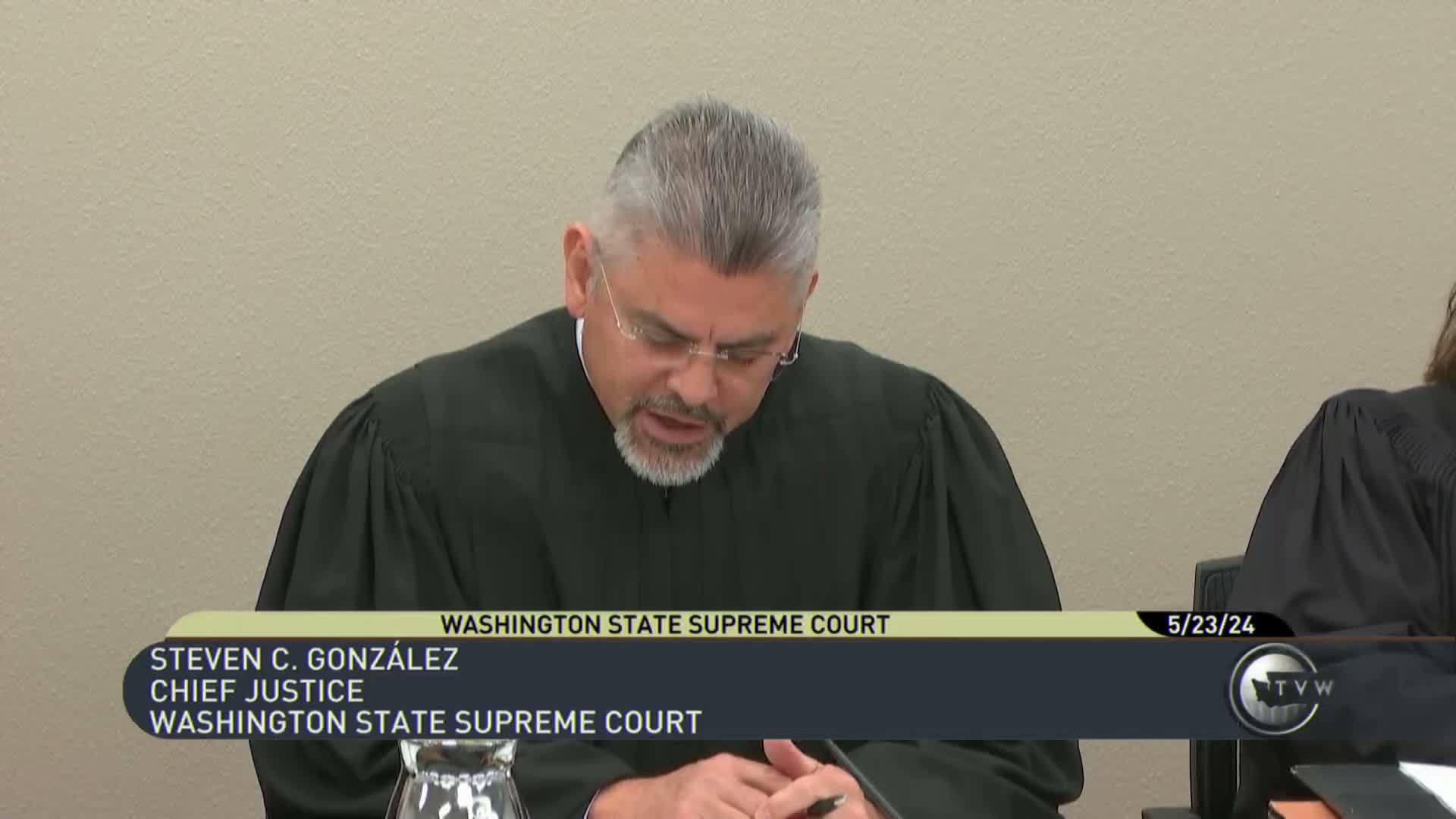
On May 23, 2024 the Washington Supreme Court in Tumwater heard argument over whether RCW 13.04.033(3) allows appellate courts to dismiss discretionary review when a party did not specifically direct counsel to file a notice; appellant counsel said filing ordinarily suffices, the state urged that in some juvenile cases something more may be required.
The Washington Supreme Court heard argument May 23 in Tumwater on whether RCW 13.04.033(3) permits appellate courts to dismiss discretionary review when a party did not specifically direct counsel to file a notice for review.
Appellant counsel Christopher Petrone of the Washington Appellate Project told the court that "the filing of the notice itself is sufficient evidence the client directed the attorney to file that notice" in the ordinary case, and urged the justices to resolve the question by the statute's plain text rather than imposing a separate signature requirement.
Patricia Allen, an assistant attorney general representing the Department of Children, Youth, and Families, told the court that the Court of Appeals correctly found no specific direction in the record here and that the statute allows dismissal where a party did not give specific direction. "The way we know that something is absent is by looking for its presence," she said, arguing that the legislature intended an additional gatekeeping step in juvenile cases to prevent empty-chair appeals.
Justices pressed both sides on whether a client's signature, an attorney's sworn declaration, or the notice's plain text should satisfy the statute. Petrone said that, at minimum, an attorney's declaration is an acceptable alternative and that the act of filing typically shows client authorization; Allen countered that the particular declaration in the record was untimely and did not reliably show specific direction given surrounding circumstances, including a lapse in client contact and counsel's withdrawal.
Several justices raised practical concerns about vulnerable parents in dependency proceedings: housing instability, intermittent contact, and pandemic-era limits on in-person signatures. Counsel for the appellant warned that requiring a physical signature in every case could hinder access to review for clients who are transient or lack reliable communication.
Both sides agreed the statute applies across proceedings in juvenile court, not only dependency and termination cases, which the justices noted would amplify any change in procedural requirements statewide. After questioning and brief rebuttal, the court submitted the case for decision and adjourned.
The court did not issue a ruling at the hearing; the matter is submitted for decision.