
Rep. Brian Mast defends presidential military authority, cites Iran as an ‘imminent threat’ and warns about munitions levels
Get AI-powered insights, summaries, and transcripts
Subscribe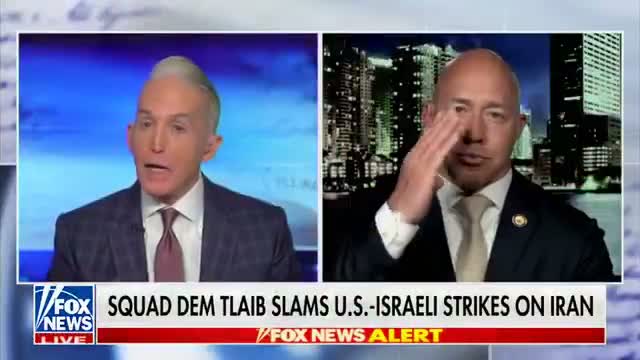
Summary
Rep. Brian Mast, chair of the House Committee on Foreign Affairs, told colleagues the president can act as commander in chief against what he described as an ʻimminent threatʼ from Iran and said a pending war-powers resolution would force U.S. forces to withdraw; a member pressed Mast about worries that U.S. munitions are running low.
Rep. Brian Mast, chair of the House Committee on Foreign Affairs, defended the president’s authority to direct the operation in the Middle East and warned that Iran poses an “imminent threat” to U.S. personnel and allies in the region. “We’re not requesting a declaration of war, that would be congress,” Mast said, adding, “The president is saying he’s the commander in chief.”
Mast told the committee the administration was not seeking a formal declaration of war or a new authorization for use of military force, but argued the current circumstances — which he described as an imminent threat stemming from Iran’s ballistic missile and terrorist programs — justified presidential action to protect Americans. He characterized the operation’s goal as eliminating “every single piece of military hardware that has a capability of reaching out and touching an American anywhere in the region,” naming locations including the Straits of Hormuz, Bahrain, Qatar and the United Arab Emirates.
The exchange included a brief, heated moment over rhetoric toward the United States. A committee member cited Representative Rashida Talib’s comment referring to the U.S. as “they,” asking how that sat with service members. Mast responded that he would not refer to Americans as “they,” said he had lost three “brothers, my sisters in arms,” and urged that politics should not extend to troops engaged in hostilities.
The committee member also asked Mast about media reports suggesting the United States is running low on munitions. Mast said the Pentagon maintains a baseline surplus of munitions for contingency operations and that concerns arise as stocks approach that baseline. “We like to keep a baseline of surplus,” he said, and urged U.S. defense producers to increase production. He warned that a war-powers resolution Democrats were preparing would, in his view, compel U.S. forces to “withdraw from hostilities” and stop defensive actions — including shooting down incoming missiles — which he said would leave allies and Americans in the region exposed.
Mast framed the choice as operational: he argued American ordinance and forces currently “knock[] … Iranian ballistic missiles out of the sky,” and said a legislative curtailment of presidential authority could interrupt those defensive measures. He repeated that the administration was not seeking a congressional declaration of war and said the disputed war-powers resolution was expected to be considered in the coming days.
The hearing closed with brief thanks and collegial remarks between the members.