Get Full Government Meeting Transcripts, Videos, & Alerts Forever!
Get email alerts on the Land Use topic
No spam. Unsubscribe anytime.
Consultant outlines redevelopment options for town-owned downtown parcels, cites site shape and cost challenges
Summary
DFI consultant Eric Thomas presented a feasibility and market analysis for the town’s 5.4-acre former Energy United parcels in downtown Mocksville, noting stakeholder interest in housing, retail and open space but warning that the site's irregular shape, existing office buildings and lower downtown rents could limit financial feasibility without creative interventions.
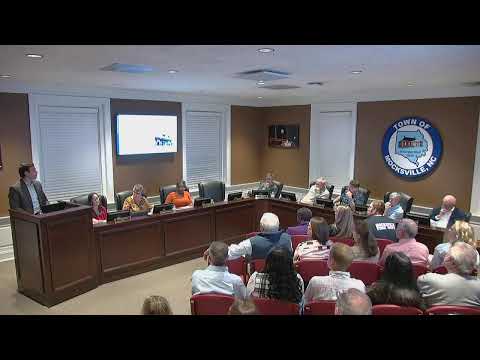
Eric Thomas of DFI briefed the Mocksville board on a feasibility and market analysis for the town‑owned former Energy United parcels in downtown Mocksville.
"I'm here to provide an update on the downtown project, the former Energy United Parcels in downtown," Thomas said as he outlined DFI’s scope: market and site analysis, financial pro formas and recommendations for whether the site can attract private development or require public support. He said the town acquired the roughly 5.4‑acre site in 2024 for about $2,000,000 using state funds and currently uses part of it for the farmers market and leased storage.
Thomas summarized stakeholder priorities: more downtown residential stock (townhomes or market‑rate rentals), ground‑floor retail to support downtown businesses and increased public open space and streetscape improvements. He presented market figures—up to about 70,000 square feet of retail demand in the trade area over five years and downtown retail rents averaging roughly $9.50 per square foot—but warned that downtown rents that are lower than construction costs could hinder feasibility for new mixed‑use development.
He also detailed constraints that could affect yield: the parcel’s irregular "hourglass" shape, two existing single‑story office buildings on the site and neighboring privately‑owned tracts. Commissioners discussed the potential to extend Depot Street to increase developable area; Thomas noted the cost of such infrastructure would be part of the cost‑benefit analysis.
Thomas said the next steps include site studies and building financial pro formas to test scenarios (multifamily, townhomes, retail, open space and preservation of existing office buildings) and to model tools a local government could use to attract private partners or form public‑private partnerships if private feasibility is insufficient.
The board did not take formal action on the study but asked staff and the consultant to return with costed scenarios and options for how to assemble the site to meet the town’s priorities.