Get Full Government Meeting Transcripts, Videos, & Alerts Forever!
Get email alerts on the Historic Markers topic
No spam. Unsubscribe anytime.
Clarkdale commission weighs funding, materials and ADA access for historic markers
Summary
At the Sept. 2 Clarkdale Historic Preservation Commission meeting, members debated materials, durability and funding for a townwide refresh of historic markers and agreed staff will return existing panel printouts to a workshop and pursue either a supplemental budget request or outside grants.
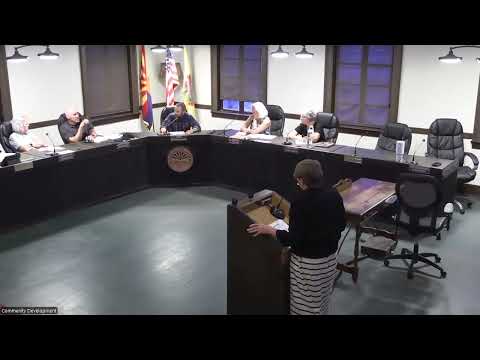
Chair Gabbard opened the Sept. 2 meeting of the Clarkdale Historic Preservation Commission by asking the group to consider assembling a budget request for the town council so the commission's signage work can be completed rather than relying only on uncertain outside grants. "I would like to discuss the possibility of putting together a budget for signage, and presenting it to the town council in January," Chair Gabbard said.
Town staff told commissioners the set of markers replaced in 2022 cost $4,634. "The total cost for that was $4,634," Ruth, a town staff member, said, and recommended moving a supplemental project through the town's budget process rather than pursuing small grants for this scope of work.
Commissioners and a contractor who handled the 2022 printing described material choices and longevity. A vendor identified in the meeting, Drake Meineke, said the 2022 panels were produced on a dye-bond/dye-sublimation material with a UV-treated coating and estimated that earlier signage runs had cost about $350 per side ("They were $350 per side. They were $700 a sign," Meineke said). Another commissioner reported a current quote of just under $600 per double-sided panel, not including shipping.
Discussion centered on balancing cost, durability and design: several commissioners urged using more visuals, larger fonts and layouts that meet ADA recommendations so visitors can read panels easily, while also preserving the historical content that commissioners described as generally accurate. One commissioner recommended budgeting for two or three material tiers to give the council options for a phased approach.
Staff said a supplemental request is the likely path and pledged to continue outreach about grant opportunities (state Historic Preservation Office and some state parks grant programs were discussed as possibilities). "At that amount, you're starting to think about maybe some grants," Ruth said, noting that external programs can change year to year and that a federally funded grant would follow a different set of rules than town dollars.
The commission agreed on several next steps: staff will bring printouts of the existing panels to a workshop at the next meeting, commissioners plan a site-by-site review (a field trip) with public notice and timed stops to comply with open-meeting requirements, and the group will try focusing first on location to inform content and format decisions. "So what staff will bring back is the printouts that we have of the existing signs," Ruth said; commissioners also discussed limiting field-trip stops to about 15 minutes per marker for public access.
The meeting concluded without formal action on a funding request; commissioners will reconvene at the next work session to review materials and discuss whether to prepare a supplemental budget request to present to the town council in January.