Get Full Government Meeting Transcripts, Videos, & Alerts Forever!
Get email alerts on the Signs topic
No spam. Unsubscribe anytime.
Clarkdale advisory committee reviews major changes to sign code, from measurement rules to political‑sign zones
Summary
The Citizen Advisory Committee reviewed a rewritten Chapter 7 (signage) on Oct. 16, 2025, endorsing new objective measurement rules, changes to political‑sign zones, limits on illumination near residences, and revisions to temporary/portable sign procedures; staff will return revised text for final review.
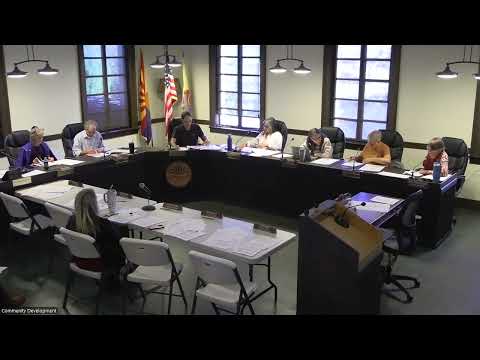
The Town of Clarkdale’s Zoning Code Update Citizen Advisory Committee on Oct. 16 reviewed a sweeping rewrite of Chapter 7, the municipality’s sign regulations, focusing on how signs will be measured, where political signs are allowed, rules for temporary and portable signs, and administrative review procedures.
Ruth, the staff presenter, said the rewrite is meant to bring the code into compliance with recent case law and state legislation and to simplify administrative review. “We can only use objective standards for signage,” she said, citing the need to avoid content‑based regulation after Reed v. Gilbert and to reflect changes from House Bill 24‑47. She walked the committee through new diagrams and a measurement approach that “draws a line around the perimeter of the sign copy” to calculate sign area.
Why it matters: the measurement and content rules determine what kinds of signs businesses and property owners may erect, how much of a façade they can use, and how the town will enforce violations. Committee members repeatedly pressed staff on practical effects for corner buildings, murals and business identification, and how permanent decorative elements will be treated.
Key changes and debate - Political sign zones: staff noted the political sign “free zone” map was adjusted so Cement Plant Road is no longer part of the free zone (political signs allowed there), and the town park, town complex and Selma Mangini Park were explicitly included in the map. Staff said the new page in the packet replaces prior subsections and will be codified in the next draft. (Ruth)
- Measurement and signage area: the chapter adds detailed measurement rules and examples for wall, projecting, window and freestanding signs so staff can apply standards consistently. Ruth said the perimeter method reduces time‑consuming calculations. Committee members asked for clarity on V‑shaped signs and how bases or monument structures contribute to overall height and area. (Ruth; Committee members)
- Content neutrality and legal constraints: Ruth told the committee the draft removes subjective “character” language and focuses on objective, measurable design and placement standards, because the town cannot regulate sign content. “We can no longer judge content; we can only regulate manner and placement, size,” she said. The committee discussed the effect of Reed v. Gilbert and state law on political and ideological signage. (Ruth)
- Administrative approvals, appeals and the Board of Adjustment: staff recommended administratively approving any application that meets the chapter standards; deviations, variances or unique design interpretations would be subject to higher‑level review. Several members argued appeals should go to the Board of Adjustment rather than the town council and noted uncertainty about which body is legally appropriate when public‑hearing requirements differ under new state law. (Committee Member 6; Ruth)
- Temporary, portable and special‑event signs: the draft moves portable signs into the temporary‑signs section and allows them in central business, commercial and industrial districts with restrictions. The committee debated permitting off‑premise portable signs and asked staff to verify prior decisions and state constraints. For special events, staff proposed directional signs be allowed up to 12 hours before and for a limited period after events; members suggested longer removal windows and clearer permitting mechanics. (Ruth; Committee members)
- Illumination and hours: the draft prohibits sign illumination within 75 feet of a residential district except where a PUD or PAD allows it. Lighting must be shielded; internally illuminated signs should use opaque backgrounds with translucent lettering. Staff proposed that certain signs be extinguished by business close or by 10:01 p.m., subject to final wording. (Ruth)
- Murals and embedded advertising: committee members asked staff to clarify when murals containing business names, logos or promotional text would be treated as signage subject to sign‑area limits rather than as public art. Members flagged a potential loophole where murals could be used to advertise without counting against a property’s sign allowance. (Committee members)
Next steps and procedural notes Staff said the committee will revisit Chapter 7 at the Nov. 6 meeting for a final review and then take the chapter to the Planning Commission before a public hearing. Chapter 8 work will begin Nov. 6 and continue on Nov. 20, with Chapters 11 and 12 pushed to December to accommodate changes required by House Bill 24‑47. The committee approved the Sept. 18 minutes by voice vote and adjourned at the end of the meeting.
The draft code contains numerous technical specifics—measurement diagrams, a 50% replacement threshold for legally nonconforming signs, a 50‑square‑foot guidance for freestanding signs and an area formula tied to linear frontage—that staff will clean up for the next packet. The committee asked staff to check exact statutory language for required contact information on political signs and to tighten definitions for "public information" signs in the right‑of‑way.