
Oak Harbor details pedestrian-safety effort, crosswalk upgrades and funding needs
Get AI-powered insights, summaries, and transcripts
Subscribe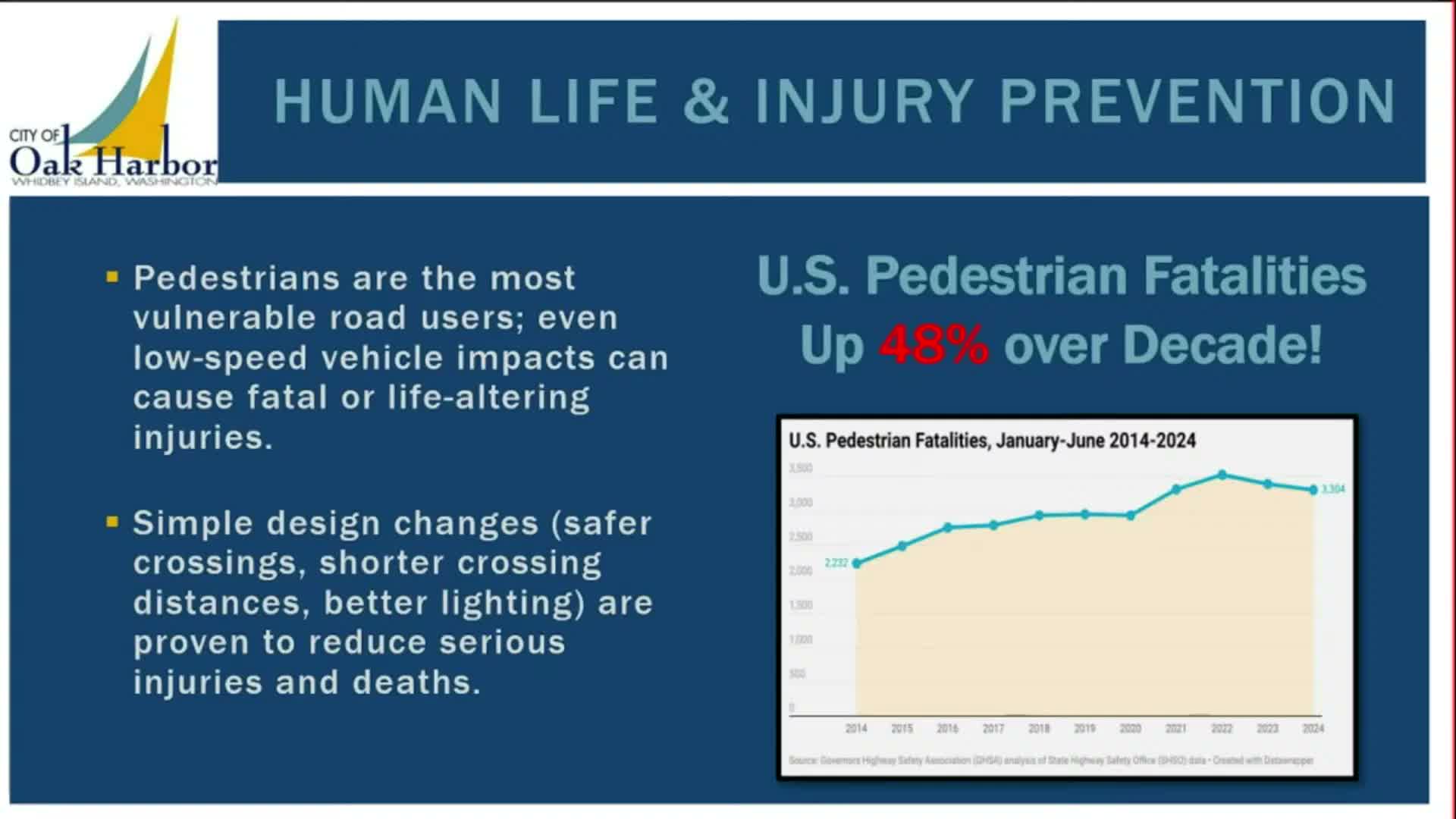
Summary
Public works and engineering staff reported rising pedestrian fatalities and outlined recent treatments (RRFBs, shared-use paths), a failed $5 million federal grant application, planned thermoplastic crosswalk upgrades, and next steps including a consultant-led transportation plan and continued grant pursuit.
Oak Harbor’s public works and engineering teams told the council Feb. 24 they are accelerating pedestrian-safety work after a decade in which the city’s population rose modestly but pedestrian fatalities and severe injuries increased sharply.
"Over the last 10 years or so, we've grown by about 7 percent. But, our pedestrian fatalities and severe accidents have grown by 48 percent or more," Public Works Director Steve Schuler said, framing the safety briefing by reference to the council-adopted comprehensive safety action plan that sets an objective of zero deaths and serious injuries by 2045.
City Engineer Alex Warner described treatments the city has installed since 2019: roughly 15 rectangular rapid-flashing beacons (RRFBs) — six in school areas — and more than 2,500 feet of shared-use path. Warner also said the city applied for a $5,000,000 federal Safe Streets for All grant but was not awarded funding; he noted the city typically has about $100,000 per year in local funds for pedestrian improvements.
"We've installed 15 sets of these rectangular rapid flashing beacons... and 6 of those have been in our school areas," Warner said. He told council the city will continue to look for grant opportunities while using local capital projects to leverage pedestrian and active-transportation improvements.
Council members raised design and operational questions. Several councilors said they have heard pushback about new bike and multimodal lanes (Swan Town and 7th Avenue) and warned painted bike lanes can provide a false sense of security. "Painted bike lanes... really do give a sense of false security to those who use them," Councilmember Romero said, urging consideration of physical separations where warranted. Warner and Schuler said narrower lane widths and other design choices are intentional to slow traffic and that more robust treatments are used where appropriate.
On maintenance, staff said painted markings wear quickly and the city plans to acquire thermoplastic equipment for longer-lasting crosswalks and stop bars; the operations team has added a position (from four to five crew members) to help catch up with maintenance backlogs. Staff also discussed continuity of sidewalks between private developments and options to prioritize missing links using local funds or developer-frontage agreements paired with fee reimbursements.
Warner highlighted collision clustering on Highway 20 (from Whidbey Avenue south toward Erie) and said the city must coordinate with the Washington State Department of Transportation for any changes on that state facility; staff said some state design work could align with a 2027 design year for Highway 20 improvements.
What happens next: staff will continue seeking grant funding, pursue thermoplastic crosswalk upgrades and bring a transportation-comprehensive-plan consultant to the council in the coming month to guide longer-term, coordinated active-transportation and street-design decisions.