Get Full Government Meeting Transcripts, Videos, & Alerts Forever!
Get email alerts on the School Budget topic
No spam. Unsubscribe anytime.
Tallmadge City Schools outline staff, bus and program cuts as forecast shows looming deficit
Summary
District officials presented a four‑year forecast showing a likely deficit without new revenue and outlined potential reductions — including eliminating some high‑school busing, cutting several teaching and classified positions and raising activity fees — while urging a May levy to avoid deeper program cuts.
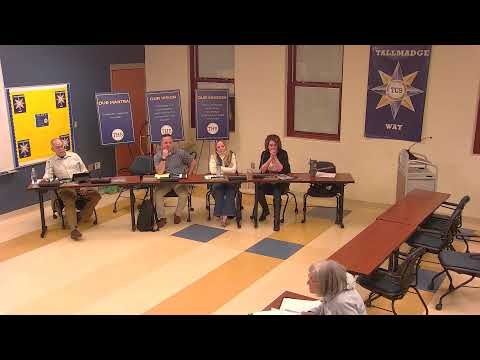
Tallmadge City Schools officials told a board work session on Feb. 11 that the district faces a mounting budget shortfall and is preparing a set of reductions that could include staff layoffs, eliminating some bus routes and raising pay‑to‑play fees if voters do not approve new revenue.
"We are running out of money," Superintendent Wood said as he introduced Treasurer Mr. Hostetter to present the district's required multi‑year forecast to the state. Hostetter said he had removed previously built‑in savings to show a baseline picture and warned that, under state forecasting rules, the district must show a positive balance by the third year of the forecast (fiscal 2028).
Hostetter gave several figures to illustrate the pressure: a projected ending balance of about $1.4 million for fiscal 2026, a forecast that turns negative in fiscal 2027 without corrective action, and a claim that changes in the state's funding formula and local valuation shifts have reduced Tallmadge's state funding "to the tune of about $2,000,000 a year." He said the forecast will be returned to the board for formal adoption after the finance committee refines routing and staffing assumptions.
Board discussion focused on three main cost drivers: personnel, transportation and purchase services. Hostetter used illustrative scenarios to show the effect of staff reductions (for example, seven certified positions at a modeled salary of $48,000 each) and emphasized that actual savings depend on who retires or leaves. The district noted roughly 181 certified staff and about 105 classified staff currently on payroll.
Transportation drew repeated attention. Hostetter said a typical route costs about $86,000 and that the district's net cost per route is approximately $56,000 after estimated state reimbursement; Tallmadge now runs about 32 routes. Under a "state minimum" busing scenario described by staff, the district would end high‑school busing and stop busing students who live within a two‑mile driving distance of K‑8 campuses; officials estimated that change could save in the $700,000–$900,000 range annually.
Superintendent Wood and staff framed reductions as a last resort and said they intend to prioritize protecting classroom instruction where possible — relying first on attrition and not filling vacancies. Wood noted the district has reduced staff and consolidated buildings in recent years and stressed the difficulty of further cuts without harming program quality.
On program costs, staff said new curriculum adoptions and other nonessential purchases would be paused; ongoing digital subscriptions and grant‑funded items largely sit in restricted funds and do not directly offset general‑fund liabilities. The district also said it will review facility‑use fees and weekend custodial overtime to identify smaller savings.
Several board members urged the community to back a May levy, saying that voter approval of new local revenue is the clearest route to avoid deep service reductions. A board member formally moved to adjourn the work session after the presentation, the motion was seconded and the board voted to adjourn.
The district expects to return a refined forecast to the board at its regular meeting next week, with updated routing counts and staffing assumptions before formal adoption of the required state forecast.