
HCA expands caregiver training and CRAFT facilitator sessions to support families of youth with SUD
Get AI-powered insights, summaries, and transcripts
Subscribe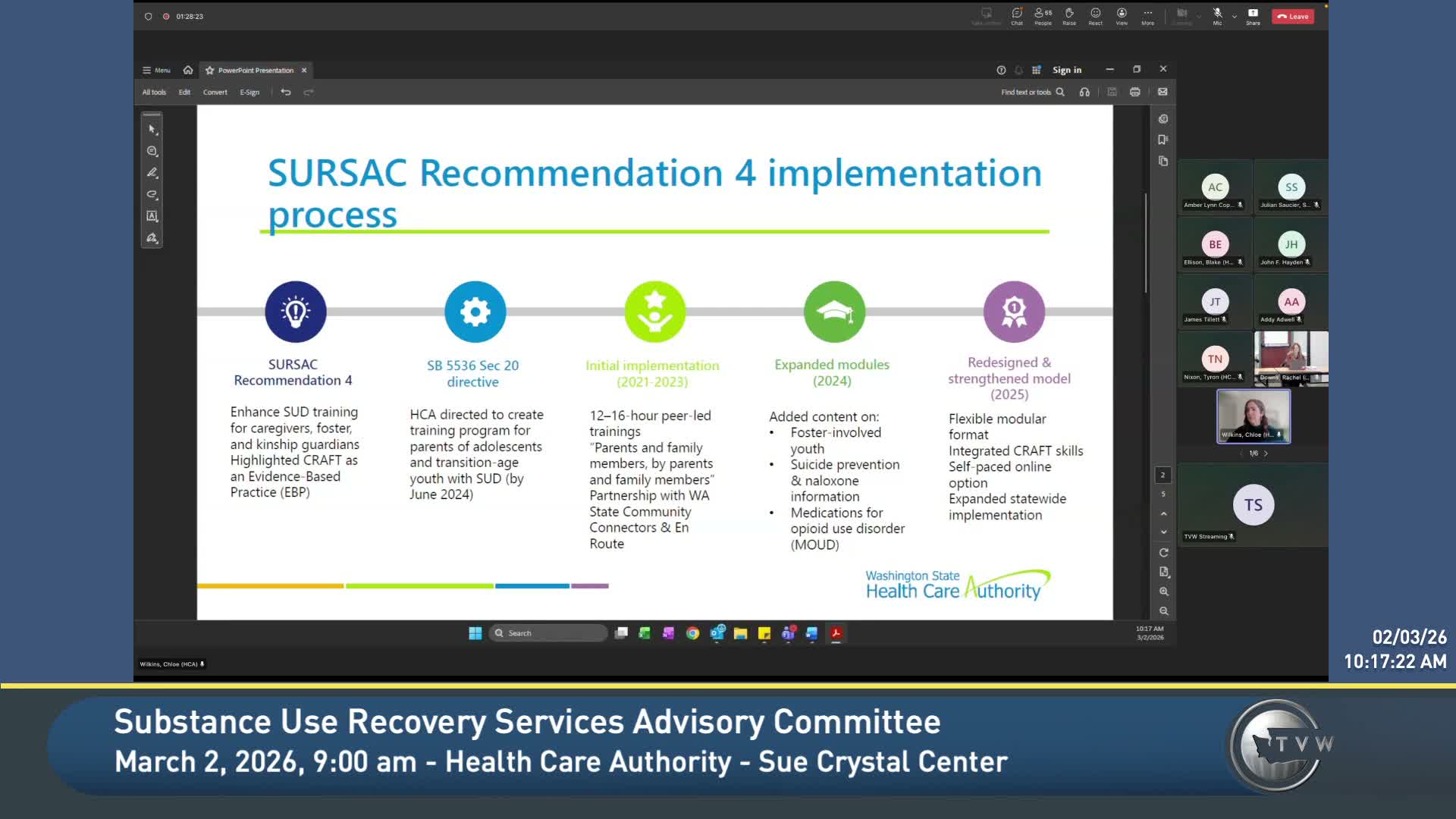
Summary
HCA reported it shifted caregiver training to shorter modular sessions, added CRAFT facilitator trainings and an online self-paced option, and requires trained organizations to provide weekly CRAFT groups for at least 12 months to evaluate impact on families.
Chloe Wilkins, who works in HCA’s Division of Behavioral Health and Recovery on prenatal-through-25 work, updated the advisory committee on implementation of CIRSAC recommendation 4: expanding training and supports for caregivers of adolescents and transition-age youth with substance use disorder.
Wilkins said the original 16-hour single-session format proved difficult for many caregivers to attend. HCA redesigned the training into eight 2-hour modules scheduled over multiple days and offered morning and evening options, and it also made a self-paced online version available. "A version of this training can also be accessed outside the scheduled training times, through an online self-paced version at sudwashington.com," Wilkins said.
To build provider capacity, HCA offered CRAFT (community reinforcement and family training) facilitator trainings: two in-person 16-hour facilitator trainings (May 2025 and November 2025) and two additional trainings planned, one targeting youth residential providers and another focusing on rural outreach. Organizations that complete facilitator training commit to provide at least one CRAFT group per week for at least 12 months and to participate in surveys to measure effectiveness.
Wilkins described outreach channels (Washington State Community Connectors, provider networks, gov-delivery messaging, Athena forum and collaboration with DCYF) and the learning supports HCA has provided (webinar series, implementation coaching calls and a published policy-and-operations guide). She said early feedback shows provider interest in offering CRAFT and that HCA is tracking implementation and equity of access.
A committee member offered public praise for the training’s impact on providers and families. Wilkins said more facilitator training dates and rural-outreach planning are forthcoming.