
CalCPA director details peer-review trends, PRSU Number 3 and enforcement pathways
Get AI-powered insights, summaries, and transcripts
Subscribe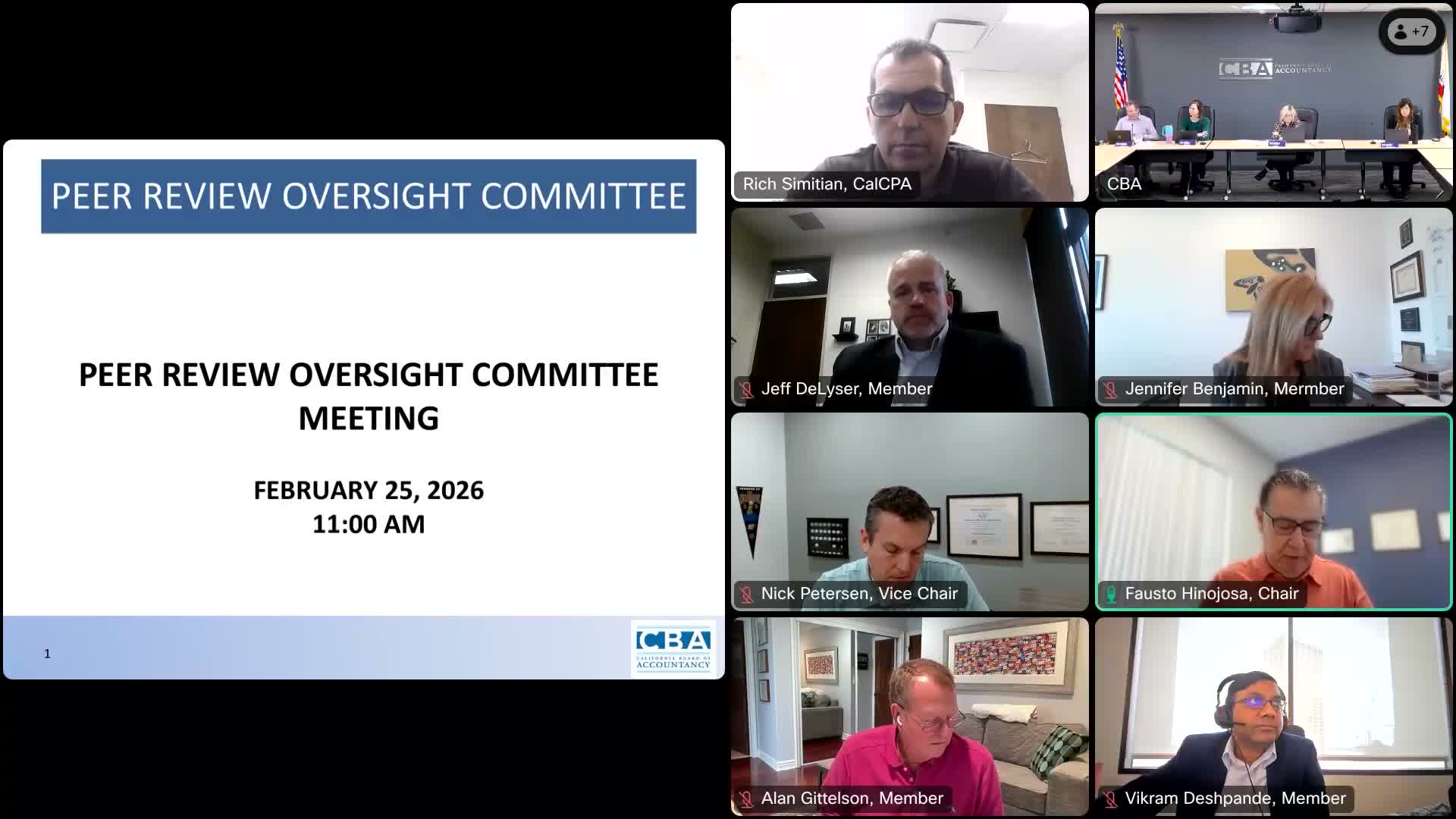
Summary
CalCPA’s peer review director told the California Board of Accountancy’s PROC on Feb. 25 that PRSU Number 3 takes effect Feb. 28, 2026, and that CalCPA is seeing fewer enrolled firms, more consolidation including private-equity activity, higher non-pass rates among small firms and a stepped process of remedial action and referrals for repeat failures.
Rich Samidian, director of CalCPA’s peer review program, gave the Peer Review Oversight Committee a detailed briefing on Feb. 25 about how the association administers peer reviews for California, Arizona and Alaska and how recent changes will affect which entity administers reviews. Samidian said the AICPA’s Peer Review Standards Update (PRSU) Number 3 was approved in February and “is effective for peer reviews scheduled on or after 02/28/2026.”
Why it matters: PRSU Number 3 includes temporary assignment of certain elevated-risk or alternative-practice-structure (APS) firms to the AICPA’s National Peer Review Committee (NPRC) rather than to state administering entities; Samidian and member Laura Ross said NPRC technical resources are being used while the new approach is evaluated. Samidian warned that larger structural changes in practice ownership — including consolidation driven in part by private equity — are shrinking the pool of enrolled firms and changing the peer-review population.
Samidian described the program’s operations: CalCPA contracts technical reviewers, administers enrollment and scheduling through its Prima portal, performs technical reviews of returned reports, and brings reviews to a Review Acceptance Body (RAB) for acceptance or further action. He explained the difference between system reviews (for firms that perform audits) and engagement reviews (for firms whose highest service is review-level work), and said engagement reviews can be less forgiving of an isolated nonconforming engagement because of their narrower scope.
On ratings and remediation, Samidian summarized the rating outcomes available to a reviewer: pass, pass with deficiency, fail or deferred acceptance. For remedial responses CalCPA commonly assigns continuing professional education, post-issuance or pre-issuance reviews, and other corrective steps. He said the program tracks nonconforming engagements and conducts about 20–25 oversights a year, focusing on system reviews where risk is higher.
Samidian said CalCPA’s data show a higher proportion of non-pass ratings compared with the combined administering entities nationally, a pattern he attributed in part to the population mix (a larger share of small firms and engagement reviews) rather than a single systemic deficiency. “I think what you’re gonna find is we have a higher non pass rating than the rest of the country,” he said.
On repeat non-passes, Samidian described a stepped process: firms with two or more consecutive non-pass peer reviews undergo a consecutive-non-pass assessment; persistent problems can lead to referral to the AICPA and potential removal from the peer review program. Michelle Center of CBA staff clarified that all failures are forwarded to the board’s enforcement division and that firms are responsible for notifying the board when they have failed a review.
Samidian also noted enrollment trends and numbers: CalCPA had about 2,300 enrolled firms in an earlier period, later about 2,100, and he said he expects the published 2025 data to show the number below 2,000 as some firms exit attest work or consolidate. He said some firms enroll in the peer-review program even when they are not currently performing attest services to keep the option open, historically because enrollment was free.
Committee members asked about referrals to enforcement. Samidian said initial steps normally go through the AICPA appeal and review process; if the outcome warrants, staff will recommend referral to the board and enforcement. Michelle Center added that staff provides enforcement with a list of failed reports to close the loop.
The committee did not take other formal actions on the presentation; members thanked the presenter and asked follow-up questions about RAB composition, technical-review capacity and oversight.