Get Full Government Meeting Transcripts, Videos, & Alerts Forever!
Get email alerts on the Nfp Overview topic
No spam. Unsubscribe anytime.
Planning staff reviews Natural Feature Protection (NFP) overlay, variance process and administrative reviews
Summary
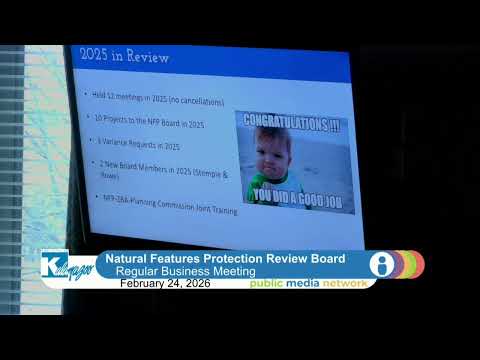
Nolan, planning staff liaison, gave a high-level overview of the NFP overlay — which protects wetlands, water resources, trees, woodlands and steep slopes — explained how the board interacts with site plan review and the Zoning Board of Appeals, and reported roughly 10 NFP projects reviewed and three variance requests in 2025.
Nolan, the planning staff liaison, presented a high-level annual review of the Natural Feature Protection (NFP) overlay at the Feb. 24 meeting, describing what the ordinance covers and how the review board fits into the city’s site plan and variance process.
Nolan said NFP functions as an overlay zoning district that adds standards focused on wetlands, water resources, protected trees and woodlands, and slopes steeper than 20 percent. He framed the ordinance as "zoning" designed to balance development with protection of on-site natural features and said the NFP rules were developed with technical expertise and community input to reduce the risk of legal challenge.
Staff described typical workflows: during pre-development staff coaching, applicants may seek alternatives to avoid variance requests; if a variance is needed, the NFP board makes a recommendation and the Zoning Board of Appeals (ZBA) has final decision-making authority on variances. Nolan emphasized that an unfavorable NFP recommendation does not legally bar an applicant from taking a variance request to the ZBA, but it can reduce the likelihood of ZBA approval.
Nolan outlined administrative-review cases that typically do not require full board review, including interior work within fenced cell tower compounds, replacing a garage within its existing footprint, and interior renovations such as those proposed at Growler Stadium adjacent to Mares Riverfront Park. He said staff monitors submitted plans and works with building and trades staff to ensure changes do not trigger new board review.
Board members asked whether applicants must be Kalamazoo City residents; Nolan replied that this NFP board does not require residency even though some city boards do. He also agreed to consult with the city attorney about how or whether a property’s intended use should factor into NFP deliberations and offered to provide more detail at a future meeting.
For 2025 staff reported roughly 10 projects came before NFP, about three variance requests, and two new board members; Nolan said he will return in March with deeper data and the NFP guide for further review and training with the board.
The board also created a three-member nominating subcommittee to interview a recent applicant with an architecture background (affiliated with Eckert and Wardell) and bring a recommendation back to the board for potential forwarding to the city commission.