Get Full Government Meeting Transcripts, Videos, & Alerts Forever!
Get email alerts on the Artificial Intelligence Policy topic
No spam. Unsubscribe anytime.
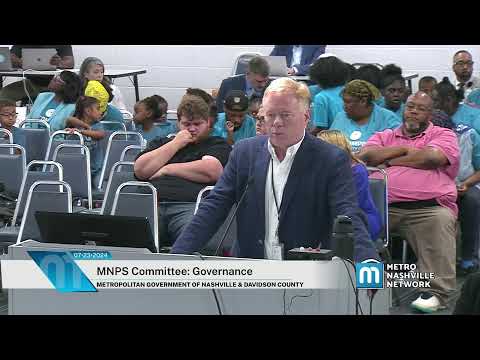
Committee adopts AI guidance for classrooms, establishes training and reporting
Summary
The Metro Nashville governance committee unanimously approved a new AI guiding-principles policy focused on student-facing instructional use, paired with internet-use language, a teacher training rollout July 31 and reporting requirements for tools and enforcement actions.
The governance committee for Metro Nashville Public Schools unanimously approved a guiding-principles policy on artificial intelligence intended to govern student-facing uses and to inform related district practices.
Dr. Sabir, who presented the draft policy, said it was created in response to Public Chapter 550 and aims to "help students understand what is an appropriate use of AI in completing assignments." He told the committee the policy is intentionally framed as guiding principles that will let administrative procedures handle implementation details across instruction, finance and human resources.
Board members focused questions on definitions, enforcement and training. "Define AI programs — because there's software that on its face isn't presented as an AI program, but it uses AI in some components," Dr. Gentry asked, seeking clarity about what will appear on the district's website list of approved tools. Dr. Sabir replied the statute looks through a student-facing lens and that the district will list tools that students clearly know they are using as AI, such as widely recognized chat-based brands.
Doug Renfro of the Office of Digital Strategy told the committee a teacher training module will be available July 31. "It will cover the policy, it will cover the law, it will cover the use in the classroom, what you can and cannot do with it, and it will also cover basic prompt use of AI and how to prompt to get the information out that you want," Renfro said.
The committee also discussed enforcement and detection. Staff noted the district already uses site-blocking tools and will continue to rely on academic-integrity procedures: staff said Turnitin (plagiarism-detection software) will flag suspicious submissions and that educators will investigate flagged work under the student-handbook academic-integrity provisions. Staff further said Copilot has been approved for staff use because of protective controls, and Canva is currently the only tool approved for student use.
After questions and brief discussion, the committee voted to adopt the AI guiding principles and a companion internet-use amendment that requires AI internet uses to align with the new principles. The vote was unanimous.
The district plans to publish an approved-tools list on ops.org/ai, post use-case procedures, provide teacher training tied to the July rollout and report annually on enforcement actions and changes to the approved list.