
Tallmadge treasurer warns state funding cuts leave district asking voters again in May
Get AI-powered insights, summaries, and transcripts
Subscribe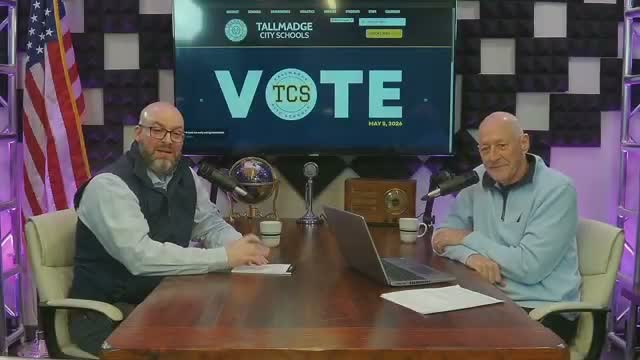
Summary
Treasurer Jeff Hostetler told a district video audience the combination of rising staffing costs, a recent property reappraisal and state funding rules (House Bill 920 and a multi‑year funding phase‑in) have reduced Tallmadge City Schools' state aid by about $1.7 million this year and could reach $2 million next year, prompting a May general-fund levy request.
Chad Davis, a member of the Tallmadge City Schools Board of Education, and district Treasurer Jeff Hostetler recorded a video presentation explaining why the district will ask voters again in May for a general‑fund levy.
Hostetler said district expenses are largely fixed—“most of our costs…are in staff and benefits”—so steady salary increases and benefit costs push spending higher year after year. He warned that the district is not generating offsetting local tax revenue because of state limits and recent property reappraisals.
Why it matters: the district says a recent reappraisal raised property valuations that, under the state funding formula and House Bill 920, reduced Tallmadge’s state aid. Hostetler summarized state figures showing the district’s state share of base funding fell from about $7.8 million in fiscal year 2024 to roughly $6.1 million in fiscal year 2026, a current shortfall he described as about $1.7 million and projected to rise to roughly $2 million next year.
Hostetler walked viewers through state payment reports to show how the formula is calculated. He described the state’s “base cost” calculation as built from average salaries, employer‑paid insurance and retirement costs and then adjusted by the district’s average daily membership (ADM). In the presentation he cited the district ADM as 2,465 and said the state‑share percentage for fiscal year 2026 is 30.22%.
On House Bill 920: Hostetler explained that House Bill 920 (1976) reduces effective millage when property values rise so taxpayers do not pay more simply because their property appreciates. That mechanism, he said, prevents the district from capturing higher tax receipts after reappraisals even as the state formula treats higher valuations as greater local capacity. “House Bill 920 basically kept the tax… the same,” he said during the presentation.
Hostetler also described a state funding overhaul referenced in the presentation as the “Cut Patterson” plan, which he said was adopted and is being phased in over six years but not fully funded and that cost factors in the formula have been held at older (FY2022) levels. “They’re using four‑ or five‑year‑old cost data,” he said, arguing that freezes and partial implementation mean the state is not keeping pace with current expenses.
Local levy context: the district reviewed levy types—bond issues for capital projects, permanent improvement (PI) levies for equipment, and general‑fund levies for day‑to‑day operations—and explained differences between general operating levies and fixed‑sum (emergency) levies. Hostetler noted the district’s longstanding PI history and said general‑fund levies support everything from salaries to transportation contracts (he cited the district’s contract with Peterman Busing).
Next steps and outreach: Davis and Hostetler said the general‑fund levy failed in November and the board plans to place a revised general‑fund measure on the May ballot. Hostetler provided an email (host.jeff@calmyschools.org) and invited residents to contact him with questions; Davis said district links and board contact information would be posted online.
What remains unresolved: Hostetler attributed the district’s funding shortfall primarily to state policy choices (HB 920’s interaction with the funding formula and phased implementation of the Cut Patterson plan) and recent county reappraisals. The district did not present a new revenue estimate tied to the May ballot language in this video, and no formal board vote on a specific ballot measure was recorded in the presentation.
The board closed by thanking viewers and directing them to posted materials for further detail and contact information for questions.