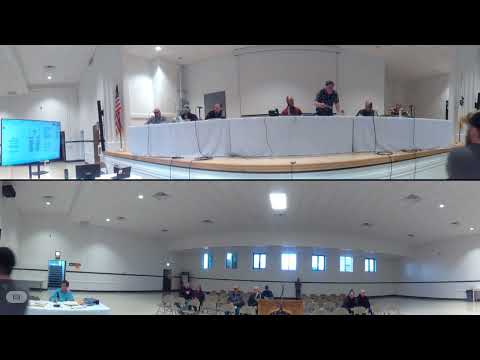
Project manager presents plan for 20‑million‑pound potato storage near Linton; board and neighbors press on traffic, lighting and airport safety
Loading...
Summary
Troy Hansen, the project manager for a proposed Cavendish Farm potato storage site, outlined a 22‑acre, 20‑million‑pound environmentally controlled facility with a one‑mile access road and Sept. 1, 2026 target. Board members and neighbors raised questions about haul routes, lighting near an airport protective area, water/waste handling and a proposed $10,000 per‑year road maintenance contribution; no final county‑commission action is recorded in the transcript excerpt.
Troy Hansen, the project manager for the proposed Cavendish Farm storage site, told the Emmons County board the project would include environmentally controlled storage with total capacity of about 20,000,000 pounds on a 22‑acre site three miles south and three miles west of Linton. Hansen said the plan includes two large bins per building, a permanent truck scale, a containerized scale house and construction of one mile of gravel access roadway; the team set a target to have the site operational by Sept. 1, 2026.
Hansen framed the project as a response to a local storage shortfall: “We have a shortfall on storage capacity,” he said, arguing that an on‑site facility would preserve product quality, reduce spoilage and spread harvest traffic over nine to 10 months instead of concentrating it during peak harvest. During the presentation he described potatoes colorfully: “the potatoes are living, breathing organisms,” a comment intended to explain why immediate environmentally controlled storage improves product quality.
Board members and neighbors probed operational details. Questions focused on fan noise (the team said fans run inside a closed fan house, limiting exterior decibels), haul routes (82nd and 84th Streets were cited), and road capacity; the applicant said on‑site storage would reduce the number of loaded trucks leaving the immediate area. The applicant offered to budget $10,000 per year toward road maintenance and dust suppression on 84th Street and discussed mag chloride as a mitigation approach.
Neighbors also raised airport safety and nighttime‑lighting concerns because the site sits near an airport protective area. A commenter noted a 45‑degree protective zone off the runway and asked that yard lights not shine upward toward approaching aircraft; the applicant agreed to include permanent yard lighting in plans and to seek aeronautics review to confirm compliance.
Other items covered in public comment and board questioning included seasonal employment (the applicant said the operation typically uses about 85 seasonal workers during harvest, with the new site adding roughly 15 seasonal positions and 3–4 potential full‑time positions), wastewater/waste handling for spoiled potatoes (applicant said waste would be managed and not left exposed), and future expansion possibilities (no formal expansion plan exists at this time).
The transcript excerpt ends after an extended Q&A; the record provided does not include a clearly stated final vote by the county commissioners on the Cavendish permit. The board recorded roll‑call responses later in the excerpt, but the transcript is noisy and does not unambiguously attach that roll call to a formally stated motion in the provided passage.