Get Full Government Meeting Transcripts, Videos, & Alerts Forever!
Get email alerts on the Design Review topic
No spam. Unsubscribe anytime.
Clarkdale commission weighs objective design guidelines after state law shifts review to staff
Summary
Planning staff told the commission that a recently referenced House Bill ("24 47" in the transcript) moved design review to an administrative process, limiting subjective standards; staff and commissioners discussed measurable options such as LRV ranges, facade articulation, materials lists, and public outreach. No action was taken; staff will return with illustrated examples.
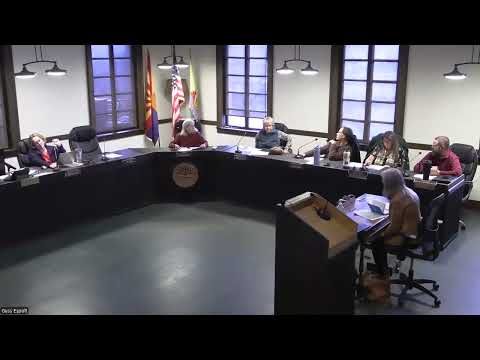
The Town of Clarkdale Planning Commission spent the bulk of its regular meeting discussing how to draft objective design-review standards after staff said state legislation removed the commission’s authority to perform design review.
Staff member (speaking as planning staff) told commissioners that the legislature passed “house bill 24 47” which “takes design review away from the commission, makes it an administrative process.” The staff presentation emphasized that the commission may still help set objective, measurable standards but cannot use subjective language about a building’s “character” or whether it “looks good.”
Clover, a planning staff member, laid out examples the town could consider: ‘‘You could say tinted or mirror glass is prohibited at ground floor,’’ she said, and suggested facade-articulation triggers (for example, a required change every X feet), blank-wall maximums, minimum facade-material requirements, ground-floor transparency for commercial storefronts, parapet and roofline treatments, and lighting standards such as fully shielded fixtures at roughly 3,000 kelvins. Clover also proposed using light-reflectance-value (LRV) ranges to limit extreme color contrasts between adjacent buildings rather than prescribing specific styles.
Commissioners pressed for practical illustrations. One commissioner said writing objective standards ‘‘is a huge job’’ and asked staff to show examples of how neighboring towns (Cottonwood, Sedona, Camp Verde were mentioned in the discussion) have approached scorecards or checklists. Staff said few jurisdictions have completed full programs and that the town’s draft work will be iterative and include legal review.
Advisory member Carol Johnson urged broader public outreach so residents understand proposed changes and can attend meetings. Staff agreed to expand outreach options, including posting materials on the town website, adding items to the town newsletter, and holding work sessions or illustrated presentations at future commission or joint meetings.
Staff warned that another bill under consideration in the legislature could further limit local options, so the commission has asked staff to continue drafting objective measures now rather than wait. The commission did not take formal action on guidelines at the meeting; staff said they will return with a more formalized presentation and illustrative examples at a future meeting.
Procedure and next steps: staff will prepare visual examples (good/bad illustrations), possible scorecards or yes/no frameworks, LRV-range proposals and sample facade-trigger metrics, and coordinate legal review before returning the materials to the commission. A joint meeting with the council on the zoning-code update and a separate joint meeting to review a housing study were also scheduled in the coming weeks.