Get email alerts on the Nonconformance Code topic
No spam. Unsubscribe anytime.
Director Fitzgibbons proposes nonconformance code changes, including 50% rebuild threshold for disaster‑damaged structures
Summary
Planning staff urged clearer definitions and a 50% damage threshold for requiring full compliance when structures are rebuilt after disasters; commissioners debated whether whole‑site upgrades should be required for disaster‑related rebuilding and asked for more detail at the March public hearing.
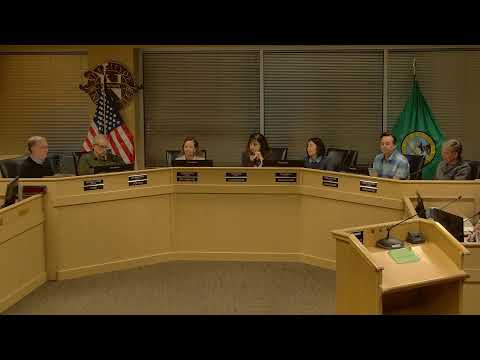
Director Fitzgibbons presented a compact nonconformance code update on Feb. 25 that focused on definitional clarity and thresholds for when nonconforming structures or site improvements must be brought into compliance.
Fitzgibbons said staff recommend a clear definition for “site improvement” and proposed that structures damaged, destroyed or demolished beyond 50% of the property’s assessed or appraised value should trigger full compliance with current code. “If the structure… has been damaged, destroyed, or demolished beyond 50% of the subject property's assessed or appraised value, whichever is higher,” Fitzgibbons explained, the city would treat the structure as no longer eligible to continue its nonconforming status.
Why it matters: the proposed threshold would change when owners can reconstruct to previous footprints and when they must meet current setback, impervious‑surface and environmental requirements. Commissioners noted that in critical‑area or tight‑setback properties, forcing full compliance could prevent rebuilding in the original footprint and raise insurance and affordability issues.
Discussion highlights
- Scope of compliance after disaster: Commissioners debated whether the exemption for disaster‑forced rebuilding should allow an entire site to remain nonconforming (to avoid undue hardship after a widespread natural disaster) or whether only the structure should be allowed to remain nonconforming while site improvements (paving, landscaping) are brought into compliance. Several commissioners said they favored allowing broader relief in the case of an uncontrollable natural disaster and preserving stricter compliance for voluntary demolitions.
- Examples and edge cases: commissioners used hypothetical and local examples (properties along Lake Boren and narrow lots) to explore how the 50% threshold would operate and how the rule interacts with the recently passed critical‑areas ordinance. Fitzgibbons said reasonable‑use and other existing processes will still apply in constrained sites.
- Insurance and equity concerns: commissioners raised the potential insurance consequences for homeowners who must rebuild to a higher standard and the possibility that disaster victims could face unaffordable upgrades; some suggested emergency or council‑level relief measures in a major disaster.
Next steps
Commissioners indicated they were comfortable returning the revised nonconformance code for a public hearing at the March meeting; staff will refine examples, clarify the threshold language and produce materials showing how the rule would apply in different scenarios.
Representative quotes
“If the structure… has been damaged, destroyed, or demolished beyond 50% of the subject property's assessed or appraised value,” Director Fitzgibbons said, “then we would be looking to trigger compliance.”
“I think I saw more heads nod to the first option that you agree that the whole site should be allowed to be nonconforming,” Chair Charlie Cassey said while gauging commission preference for disaster scenarios.
Ending
Staff will return to the March meeting with a public‑hearing draft that includes clarified thresholds, example cases and suggested language about emergency relief and applicability to critical‑areas properties; no final ordinance was adopted at this session.
AI generated
The text on this page is AI generated. Summaries, highlights, analysis, and video transcripts are all produced from the original source material.
AI can make mistakes, so if you spot one, and we will fix it for everyone.
Note: the source content is unaltered by us. Any content source we link to, be it a video, an audio recording, or a document, is presented exactly as its publisher released it. That publisher is usually a government body, sometimes an individual official or another organisation.